
A.V. Dovgal – författare
Visar alla böcker från författaren A.V. Dovgal. Handla med fri frakt och snabb leverans.
3 produkter
3 produkter
Inbunden, Engelska, 2002
1 633 kr
Skickas inom 10-15 vardagar
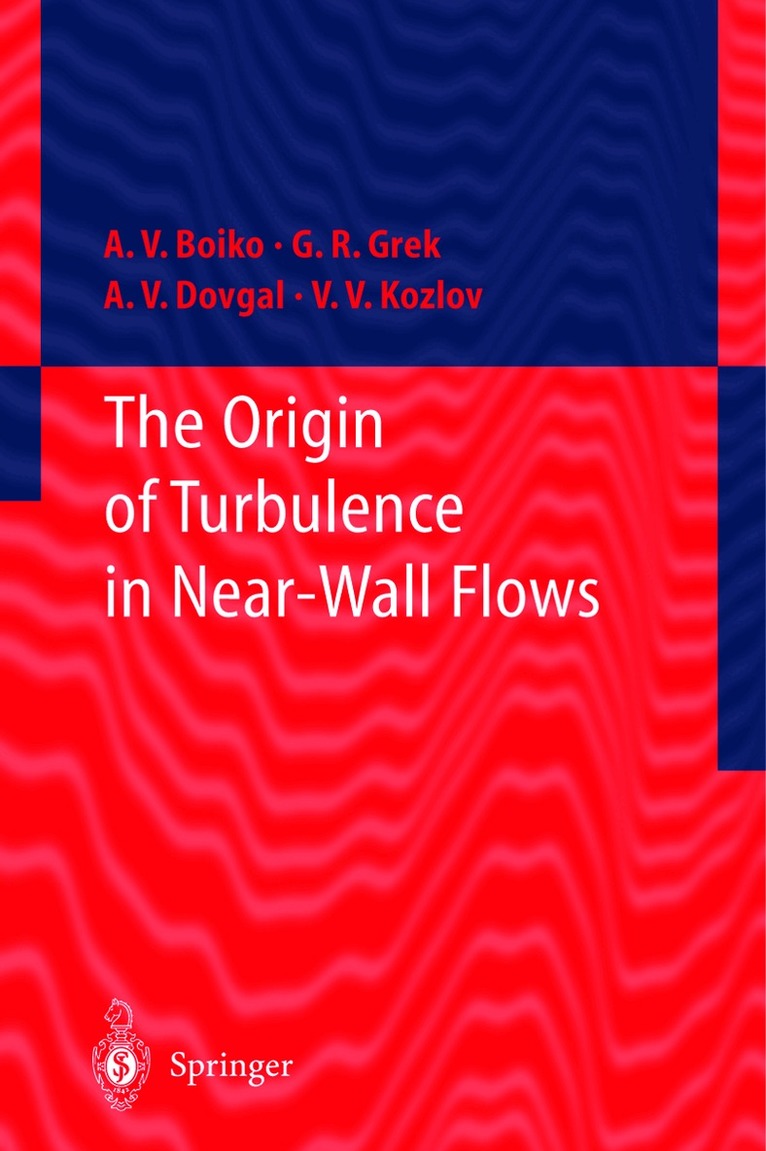
The Origin of Species Charles Darwin The origin of turbulence in fluids is a long-standing problem and has been the focus of research for decades due to its great importance in a variety of engineering applications. Furthermore, the study of the origin of turbulence is part of the fundamental physical problem of turbulence description and the philosophical problem of determinism and chaos. At the end of the nineteenth century, Reynolds and Rayleigh conjectured that the reason of the transition of laminar flow to the 'sinuous' state is in stability which results in amplification of wavy disturbances and breakdown of the laminar regime. Heisenberg (1924) was the founder of linear hydrody namic stability theory. The first calculations of boundary layer stability were fulfilled in pioneer works of Tollmien (1929) and Schlichting (1932, 1933). Later Taylor (1936) hypothesized that the transition to turbulence is initi ated by free-stream oscillations inducing local separations near wall. Up to the 1940s, skepticism of the stability theory predominated, in particular due to the experimental results of Dryden (1934, 1936). Only the experiments of Schubauer and Skramstad (1948) revealed the determining role of insta bility waves in the transition. Now it is well established that the transition to turbulence in shear flows at small and moderate levels of environmental disturbances occurs through development of instability waves in the initial laminar flow. In Chapter 1 we start with the fundamentals of stability theory, employing results of the early studies and recent advances.
Häftad, Engelska, 2010
1 635 kr
Skickas inom 10-15 vardagar
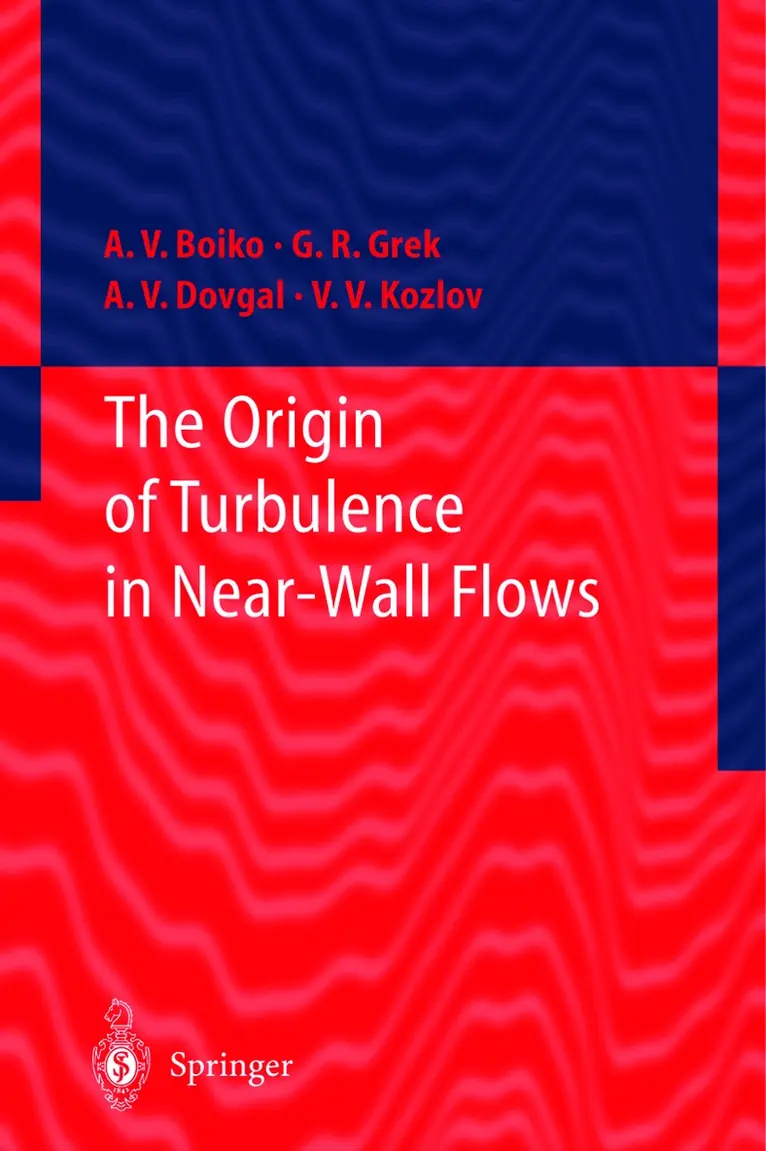
The Origin of Species Charles Darwin The origin of turbulence in fluids is a long-standing problem and has been the focus of research for decades due to its great importance in a variety of engineering applications. Furthermore, the study of the origin of turbulence is part of the fundamental physical problem of turbulence description and the philosophical problem of determinism and chaos. At the end of the nineteenth century, Reynolds and Rayleigh conjectured that the reason of the transition of laminar flow to the 'sinuous' state is in stability which results in amplification of wavy disturbances and breakdown of the laminar regime. Heisenberg (1924) was the founder of linear hydrody namic stability theory. The first calculations of boundary layer stability were fulfilled in pioneer works of Tollmien (1929) and Schlichting (1932, 1933). Later Taylor (1936) hypothesized that the transition to turbulence is initi ated by free-stream oscillations inducing local separations near wall. Up to the 1940s, skepticism of the stability theory predominated, in particular due to the experimental results of Dryden (1934, 1936). Only the experiments of Schubauer and Skramstad (1948) revealed the determining role of insta bility waves in the transition. Now it is well established that the transition to turbulence in shear flows at small and moderate levels of environmental disturbances occurs through development of instability waves in the initial laminar flow. In Chapter 1 we start with the fundamentals of stability theory, employing results of the early studies and recent advances.

E-bok
PDF, Engelska, 20131 977 kr
Läs direkt efter köp
The Origin of Species Charles Darwin The origin of turbulence in fluids is a long-standing problem and has been the focus of research for decades due to its great importance in a variety of engineering applications. Furthermore, the study of the origin of turbulence is part of the fundamental physical problem of turbulence description and the philosophical problem of determinism and chaos. At the end of the nineteenth century, Reynolds and Rayleigh conjectured that the reason of the transition of laminar flow to the ''sinuous'' state is in stability which results in amplification of wavy disturbances and breakdown of the laminar regime. Heisenberg (1924) was the founder of linear hydrody namic stability theory. The first calculations of boundary layer stability were fulfilled in pioneer works of Tollmien (1929) and Schlichting (1932, 1933). Later Taylor (1936) hypothesized that the transition to turbulence is initi ated by free-stream oscillations inducing local separations near wall. Up to the 1940s, skepticism of the stability theory predominated, in particular due to the experimental results of Dryden (1934, 1936). Only the experiments of Schubauer and Skramstad (1948) revealed the determining role of insta bility waves in the transition. Now it is well established that the transition to turbulence in shear flows at small and moderate levels of environmental disturbances occurs through development of instability waves in the initial laminar flow. In Chapter 1 we start with the fundamentals of stability theory, employing results of the early studies and recent advances.