Aviad Rubin - Böcker
Visar alla böcker från författaren Aviad Rubin. Handla med fri frakt och snabb leverans.
3 produkter
3 produkter
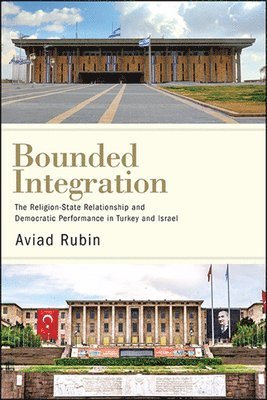
Bounded Integration
The Religion-State Relationship and Democratic Performance in Turkey and Israel
Häftad, Engelska, 2021
611 kr
Skickas inom 3-6 vardagar
Investigates Turkey and Israel's contrasting treatment of religion and demonstrates how this treatment has had a significant impact on these countries' democratic performance.In this comparative study of the religion-state relationship in Turkey and Israel in the modern era, Bounded Integration reveals the influence this dynamic interaction has had on democratic performance in both countries. In societies where a dominant religion serves as an important component of individual and collective identity, the imposition of secular policies from above may not facilitate democratization but may rather impede the embedding of democracy in society. Moreover, the inclusion or exclusion of religion following statehood may facilitate a certain type of path-dependent political culture, one with long-term political consequences. Aviad Rubin's refreshing analytical approach comparing and contrasting the region's only two longstanding democratic entities and the dynamics of religion and the state in two different religions, Islam and Judaism, facilitates generalizable lessons for emergent political regimes in the post–Arab Spring Middle East.
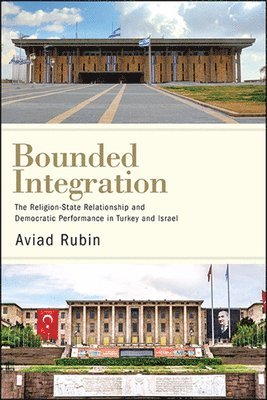
Bounded Integration
The Religion-State Relationship and Democratic Performance in Turkey and Israel
Inbunden, Engelska, 2020
1 499 kr
Skickas inom 3-6 vardagar
Investigates Turkey and Israel's contrasting treatment of religion and demonstrates how this treatment has had a significant impact on these countries' democratic performance.In this comparative study of the religion-state relationship in Turkey and Israel in the modern era, Bounded Integration reveals the influence this dynamic interaction has had on democratic performance in both countries. In societies where a dominant religion serves as an important component of individual and collective identity, the imposition of secular policies from above may not facilitate democratization but may rather impede the embedding of democracy in society. Moreover, the inclusion or exclusion of religion following statehood may facilitate a certain type of path-dependent political culture, one with long-term political consequences. Aviad Rubin's refreshing analytical approach comparing and contrasting the region's only two longstanding democratic entities and the dynamics of religion and the state in two different religions, Islam and Judaism, facilitates generalizable lessons for emergent political regimes in the post–Arab Spring Middle East.
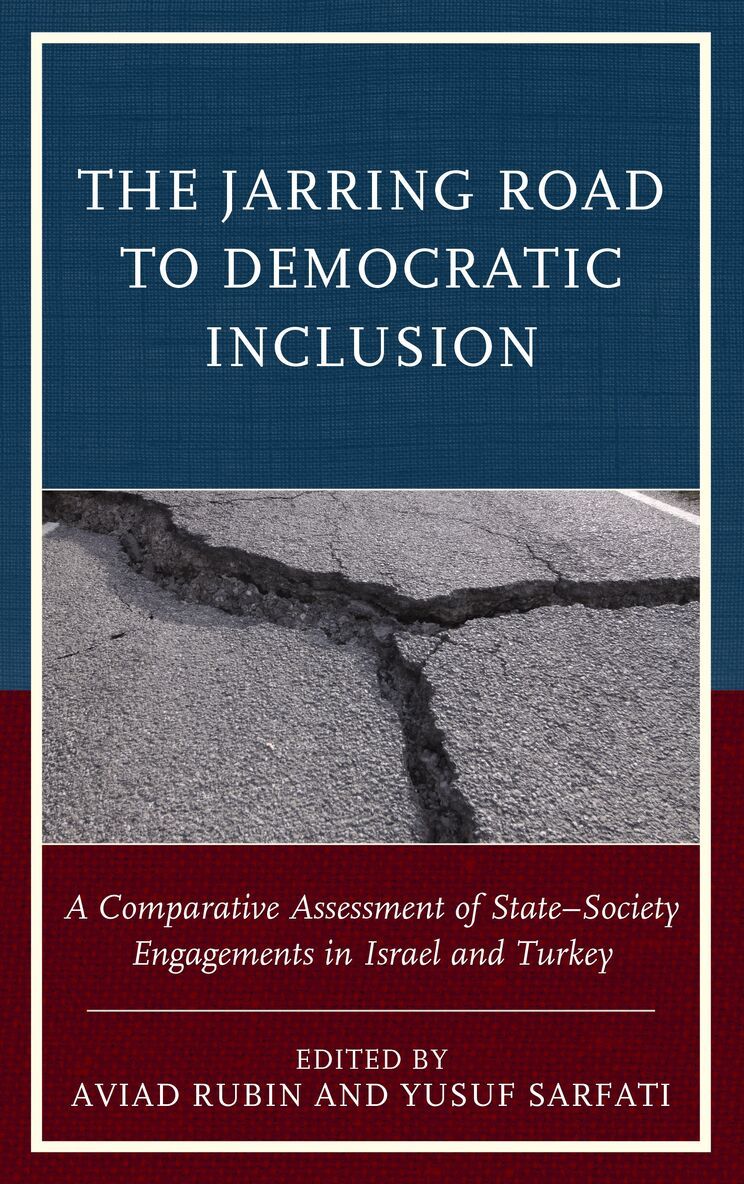
Jarring Road to Democratic Inclusion
A Comparative Assessment of State–Society Engagements in Israel and Turkey
Inbunden, Engelska, 2016
1 209 kr
Skickas inom 10-15 vardagar
This edited volume brings together chapters that offer theoretically pertinent comparisons between various dimensions of Israeli and Turkish politics. Each chapter covers a different aspect of state–society interactions in both countries from a comparative perspective, including the public role of religion, political culture, women rights movements, religious education, religious movements, marriage regulation, labor market inclusion, and ethnic minorities. Israel and Turkey share significant similarities, such as state formation under nationalist ideologies, familiarity with democratic governance since the 1940s, strong affiliation with the West, recent resurgence of religious parties, ongoing conflict with ethno-national minority groups that challenge the dominant national project, contemporary popular protests against the incumbent regime, and recent serious erosion of democratic rights. At the same time they differ on major variables, such as size, majority religion, geopolitical location, level of economic development, policy towards ethnic minorities, and institutional arrangements to managing the state–religion relations. The presence of these differences in face of common backgrounds facilitates analytically grounded comparisons in a host of dimensions. Therefore, employing a case-oriented comparative method, this book provides historically interpretative and causally analytic accounts on the politics of both societies. The contributions reveal the dynamic and complex—rather than one-dimensional and linear—nature of political processes in both settings. This empirically rich and theoretically sophisticated volume should contribute to a better understanding of these two important states, and, no less important, stimulate new directions for comparative research, especially on Middle East regimes, social movements, and democratization.