Avishek Ray – författare
Visar alla böcker från författaren Avishek Ray. Handla med fri frakt och snabb leverans.
19 produkter
Vagabond in the South Asian Imagination
Resilience, Agency and Representation
Av Avishek Ray
Inbunden, 2021
2585 kr
Lägg i varukorg
This book discusses the epistemic foundation of the heuristic construct ‘vagabond’ and the convergence between the politics of itinerancy and that of dissent in the context of South Asia. It describes the fraught relationship between ‘native’ itinerant practices and techniques of governmentality …
Vagabond in the South Asian Imagination
Resilience, Agency and Representation
Av Avishek Ray
E-bok, 2021
746 kr
Lägg i varukorg
This book discusses the epistemic foundation of the heuristic construct ‘vagabond’ and the convergence between the politics of itinerancy and that of dissent in the context of South Asia. It describes the fraught relationship between ‘native’ itinerant practices and techniques of …
Vagabond in the South Asian Imagination
Resilience, Agency and Representation
Av Avishek Ray
E-bok, 2021
876 kr
Lägg i varukorg
This book discusses the epistemic foundation of the heuristic construct ‘vagabond’ and the convergence between the politics of itinerancy and that of dissent in the context of South Asia. It describes the fraught relationship between ‘native’ itinerant practices and techniques of …
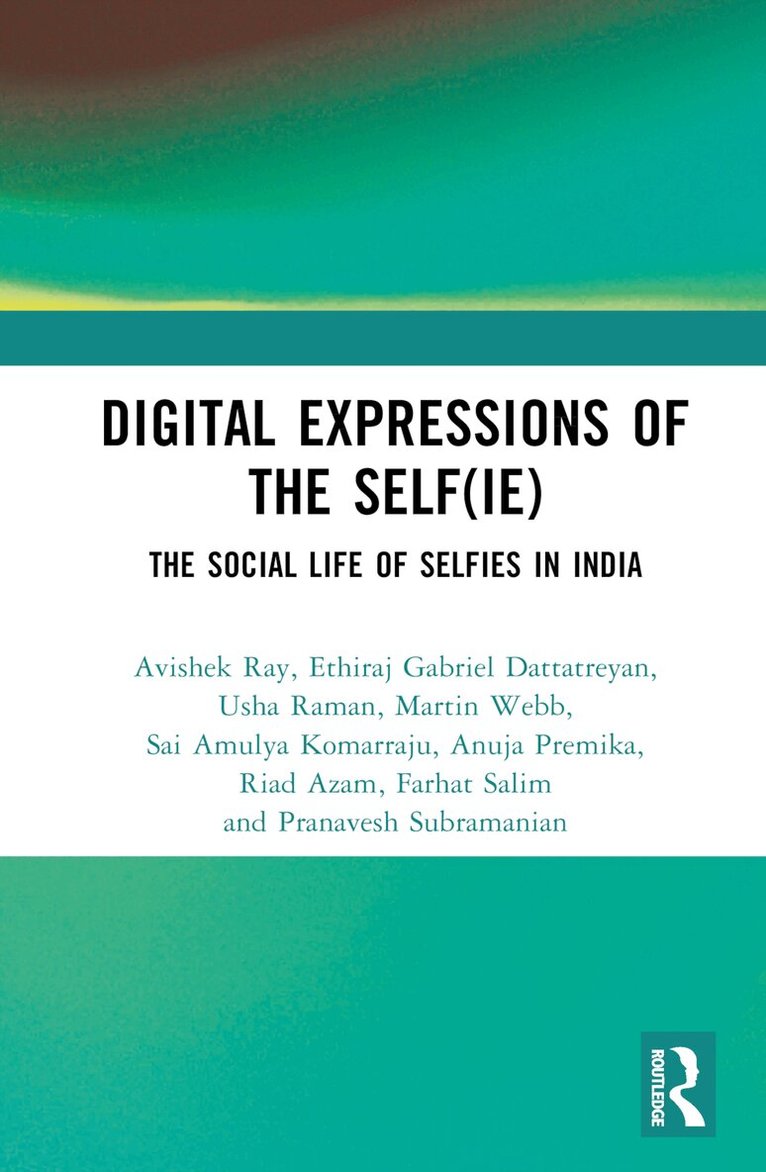
Digital Expressions of the Self(ie)
The Social Life of Selfies in India
Av Pranavesh Subramanian, Farhat Salim m. fl.
E-bok, 2024
831 kr
Lägg i varukorg
The book examines the social and cultural role of selfies in India. It looks at how the selfie, unlike the photograph, which was a gesture towards an external reality, remains intimately self-referential, yet reconfigures social ordering, identity formation, agency, and spaces in curious ways. This …
Digital Expressions of the Self(ie)
The Social Life of Selfies in India
Av Pranavesh Subramanian, Farhat Salim m. fl.
E-bok, 2024
831 kr
Lägg i varukorg
The book examines the social and cultural role of selfies in India. It looks at how the selfie, unlike the photograph, which was a gesture towards an external reality, remains intimately self-referential, yet reconfigures social ordering, identity formation, agency, and spaces in curious ways. This …
Vagabond in the South Asian Imagination
Resilience, Agency and Representation
Av Avishek Ray
Häftad, 2023
647 kr
Lägg i varukorg
This book discusses the epistemic foundation of the heuristic construct ‘vagabond’ and the convergence between the politics of itinerancy and that of dissent in the context of South Asia. It describes the fraught relationship between ‘native’ itinerant practices and techniques of governmentality …
Temporal Spaces in Calcutta
Digital Networks in the Wake of the Pandemic
Inbunden, 2025
3063 kr
Lägg i varukorg
This book explores how the COVID-19 pandemic has reshaped urban spatialities through the rise of digitally mediated "temporal spaces" in Calcutta. Focusing on Uber-enabled mobility, cycling pathways, and cafés, it examines how digital infrastructures and human practices intersect to create fluid, …
Digital Expressions of the Self(ie)
The Social Life of Selfies in India
Av Avishek Ray, Ethiraj Gabriel Dattatreyan m. fl.
Häftad, 2025
705 kr
Lägg i varukorg
The book examines the social and cultural role of selfies in India. It looks at how the selfie, unlike the photograph, which was a gesture towards an external reality, remains intimately self-referential, yet reconfigures social ordering, identity formation, agency, and spaces in curious ways.This …
Digital Expressions of the Self(ie)
The Social Life of Selfies in India
Av Avishek Ray, Ethiraj Gabriel Dattatreyan m. fl.
Inbunden, 2024
2585 kr
Lägg i varukorg
The book examines the social and cultural role of selfies in India. It looks at how the selfie, unlike the photograph, which was a gesture towards an external reality, remains intimately self-referential, yet reconfigures social ordering, identity formation, agency, and spaces in curious ways.This …
Decolonial Travel
Vernacular Mobilities in India
Av Avishek Ray
Inbunden, 2024
2585 kr
Lägg i varukorg
This volume brings together scholarship on indigenous forms of travel to decolonize travel theory. It looks at certain minoritarian-vernacular traveling cults – very rarely examined – that compel us to rethink, on the one hand, the conventional tropes of and rationales for travel; and, on the other …
Decolonial Travel
Vernacular Mobilities in India
Av Avishek Ray
Häftad, 2026
726 kr
Lägg i varukorg
This volume brings together scholarship on indigenous forms of travel to decolonize travel theory. It looks at certain minoritarian-vernacular traveling cults – very rarely examined – that compel us to rethink, on the one hand, the conventional tropes of and rationales for travel; and, on the other …
Decolonial Travel
Vernacular Mobilities in India
Av Avishek Ray
E-bok, 2024
785 kr
Lägg i varukorg
This volume brings together scholarship on indigenous forms of travel to decolonize travel theory. It looks at certain minoritarian-vernacular traveling cults – very rarely examined – that compel us to rethink, on the one hand, the conventional tropes of and rationales for travel; and, on the other …
Decolonial Travel
Vernacular Mobilities in India
Av Avishek Ray
E-bok, 2024
768 kr
Lägg i varukorg
This volume brings together scholarship on indigenous forms of travel to decolonize travel theory. It looks at certain minoritarian-vernacular traveling cults – very rarely examined – that compel us to rethink, on the one hand, the conventional tropes of and rationales for travel; and, on the other …
Temporal Spaces in Calcutta
Digital Networks in the Wake of the Pandemic
E-bok, 2025
831 kr
Lägg i varukorg
This book explores how the COVID-19 pandemic has reshaped urban spatialities through the rise of digitally mediated "e;temporal spaces"e; in Calcutta. Focusing on Uber-enabled mobility, cycling pathways, and cafes, it examines how digital infrastructures and human practices intersect to …
Temporal Spaces in Calcutta
Digital Networks in the Wake of the Pandemic
E-bok, 2025
813 kr
Lägg i varukorg
This book explores how the COVID-19 pandemic has reshaped urban spatialities through the rise of digitally mediated "e;temporal spaces"e; in Calcutta. Focusing on Uber-enabled mobility, cycling pathways, and cafes, it examines how digital infrastructures and human practices intersect to …
Conversations on Digital Humanities
Contentions and Contingencies in the Indian Context
Inbunden, 2026
2510 kr
Lägg i varukorg
This book brings together the essential debates concerning the emergent area of Digital Humanities (DH) in India. Through the interviews, the book attempts to identify the differences and convergences between DH practice in India and that of Global North. The book can be seen as a compendium for …
Conversations on Digital Humanities
Contentions and Contingencies in the Indian Context
Häftad, 2026
647 kr
Lägg i varukorg
This book brings together the essential debates concerning the emergent area of Digital Humanities (DH) in India. Through the interviews, the book attempts to identify the differences and convergences between DH practice in India and that of Global North. The book can be seen as a compendium for …
Nation, Nationalism and the Public Sphere
Religious Politics in India
Av Avishek Ray, Ishita Banerjee- Dube
Inbunden, 2020
836 kr
Lägg i varukorg
From the shaping of identities and belongings through to current reconfigurations of nation, governance and state under a Hindu-Right dispensation, this book tracks the sentiments and structures that sustain the nation and nationalism in India. Nation, Nationalism and the Public Sphere: Religious …
State, Nation, Religion
Politics and the Public Sphere in Modern India
Av Avishek Ray, shita Banerjee-Dub
Häftad, 2024
694 kr
Lägg i varukorg
The fourteen essays in this volume throw light on the intersections of religion and power in law, governance, politics and social life, inviting critical reflection on nationalism and democracy in a plural society.