Avner Cohen - Böcker
Visar alla böcker från författaren Avner Cohen. Handla med fri frakt och snabb leverans.
5 produkter
5 produkter
2 712 kr
Skickas inom 3-6 vardagar
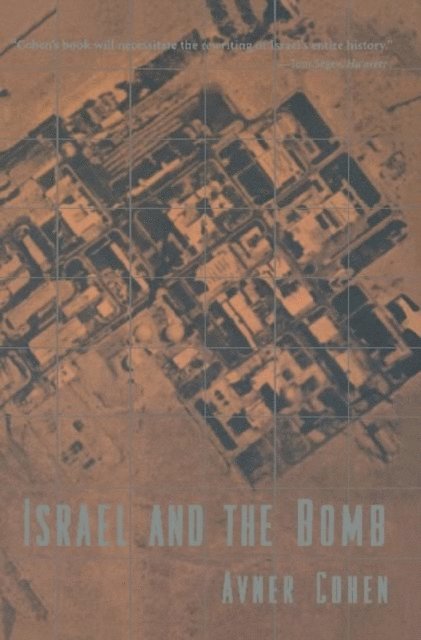
Until now, there has been no detailed account of Israel's nuclear history. Previous treatments of the subject relied heavily on rumors, leaks, and journalistic speculations. But with Israel and the Bomb, Avner Cohen has forged an interpretive political history that draws on thousands of American and Israeli government documents-most of them recently declassified and never before cited-and more than one hundred interviews with key individuals who played important roles in this story. Cohen reveals that Israel crossed the nuclear weapons threshold on the eve of the 1967 Six-Day War, yet it remains ambiguous about its nuclear capability to this day. What made this posture of "opacity" possible, and how did it evolve? Cohen focuses on a two-decade period from about 1950 until 1970, during which David Ben-Gurion's vision of making Israel a nuclear-weapon state was realized.He weaves together the story of the formative years of Israel's nuclear program, from the founding of the Israeli Atomic Energy Commission in 1952, to the alliance with France that gave Israel the sophisticated technology it needed, to the failure of American intelligence to identify the Dimona Project for what it was, to the negotiations between President Nixon and Prime Minister Meir that led to the current policy of secrecy. Cohen also analyzes the complex reasons Israel concealed its nuclear program-from concerns over Arab reaction and the negative effect of the debate at home to consideration of America's commitment to nonproliferation. Israel and the Bomb highlights the key questions and the many potent issues surrounding Israel's nuclear history. This book will be a critical resource for students of nuclear proliferation, Middle East politics, Israeli history, and American-Israeli relations, as well as a revelation for general readers.
738 kr
Skickas inom 3-6 vardagar
Until now, there has been no detailed account of Israel's nuclear history. Previous treatments of the subject relied heavily on rumors, leaks, and journalistic speculations. But with Israel and the Bomb, Avner Cohen has forged an interpretive political history that draws on thousands of American and Israeli government documents-most of them recently declassified and never before cited-and more than one hundred interviews with key individuals who played important roles in this story. Cohen reveals that Israel crossed the nuclear weapons threshold on the eve of the 1967 Six-Day War, yet it remains ambiguous about its nuclear capability to this day. What made this posture of "opacity" possible, and how did it evolve? Cohen focuses on a two-decade period from about 1950 until 1970, during which David Ben-Gurion's vision of making Israel a nuclear-weapon state was realized.He weaves together the story of the formative years of Israel's nuclear program, from the founding of the Israeli Atomic Energy Commission in 1952, to the alliance with France that gave Israel the sophisticated technology it needed, to the failure of American intelligence to identify the Dimona Project for what it was, to the negotiations between President Nixon and Prime Minister Meir that led to the current policy of secrecy. Cohen also analyzes the complex reasons Israel concealed its nuclear program-from concerns over Arab reaction and the negative effect of the debate at home to consideration of America's commitment to nonproliferation. Israel and the Bomb highlights the key questions and the many potent issues surrounding Israel's nuclear history. This book will be a critical resource for students of nuclear proliferation, Middle East politics, Israeli history, and American-Israeli relations, as well as a revelation for general readers.
1 266 kr
Skickas inom 7-10 vardagar
Israel has made a unique contribution to the nuclear age. It has created a special "bargain" with the bomb. Israel is the only nuclear-armed state that does not acknowledge its possession of the bomb, even though its existence is a common knowledge throughout the world. It only says that it will not be the first to introduce nuclear weapons to the Middle East. The bomb is Israel's collective ineffable--the nation's last great taboo. This bargain has a name: in Hebrew, it is called amimut, or opacity. By adhering to the bargain, which was born in a secret deal between Richard Nixon and Golda Meir, Israel has created a code of nuclear conduct that encompasses both governmental policy and societal behavior. The bargain has deemphasized the salience of nuclear weapons, yet it is incompatible with the norms and values of a liberal democracy. It relies on secrecy, violates the public right to know, and undermines the norm of public accountability and oversight, among other offenses. It is also incompatible with emerging international nuclear norms. Author of the critically acclaimed Israel and the Bomb, Avner Cohen offers a bold and original study of this politically explosive subject.Along with a fair appraisal of the bargain's strategic merits, Cohen critiques its undemocratic flaws. Arguing that the bargain has become increasingly anachronistic, he calls for a reform in line with domestic democratic values as well as current international nuclear norms. Most ironic, he believes Iran is imitating Israeli amimut. Cohen concludes with fresh perspectives on Iran, Israel, and the effort toward global disarmament.
322 kr
Skickas inom 7-10 vardagar
Israel has made a unique contribution to the nuclear age. It has created a special "bargain" with the bomb. Israel is the only nuclear-armed state that does not acknowledge its possession of the bomb, even though its existence is a common knowledge throughout the world. It only says that it will not be the first to introduce nuclear weapons to the Middle East. The bomb is Israel's collective ineffable--the nation's last great taboo. This bargain has a name: in Hebrew, it is called amimut, or opacity. By adhering to the bargain, which was born in a secret deal between Richard Nixon and Golda Meir, Israel has created a code of nuclear conduct that encompasses both governmental policy and societal behavior. The bargain has deemphasized the salience of nuclear weapons, yet it is incompatible with the norms and values of a liberal democracy. It relies on secrecy, violates the public right to know, and undermines the norm of public accountability and oversight, among other offenses. It is also incompatible with emerging international nuclear norms. Author of the critically acclaimed Israel and the Bomb, Avner Cohen offers a bold and original study of this politically explosive subject.Along with a fair appraisal of the bargain's strategic merits, Cohen critiques its undemocratic flaws. Arguing that the bargain has become increasingly anachronistic, he calls for a reform in line with domestic democratic values as well as current international nuclear norms. Most ironic, he believes Iran is imitating Israeli amimut. Cohen concludes with fresh perspectives on Iran, Israel, and the effort toward global disarmament.
275 kr
Skickas inom 3-6 vardagar
Book jacket: From postmodernist and post-philosophical quarters we now hear that philosophy is at the end of its rope, that modern philosophy is just another modernist product which has outlived its usefulness. Whatever the precise merits of the various postmodernist critiques, they have certainly compelled many philosophers to take notice, and to concede that their enterprise has reached an impasse.The essays in this volume mark a new stage in the debate. Though divergent in their philosophical -- or post-philosophical -- standpoints, the authors all share the view that philosophy is at a fateful juncture.Postmodernism, pragmatism, feminism, and historicism are some of the tendencies scrutinized in this wide-ranging symposium on the past, present, and many possible futures of the 'institution of philosophy.'