Aziz Elmuradov – författare
Visar alla böcker från författaren Aziz Elmuradov. Handla med fri frakt och snabb leverans.
4 produkter
4 produkter
E-bok
PDF, Engelska, 2022682 kr
Läs direkt efter köp
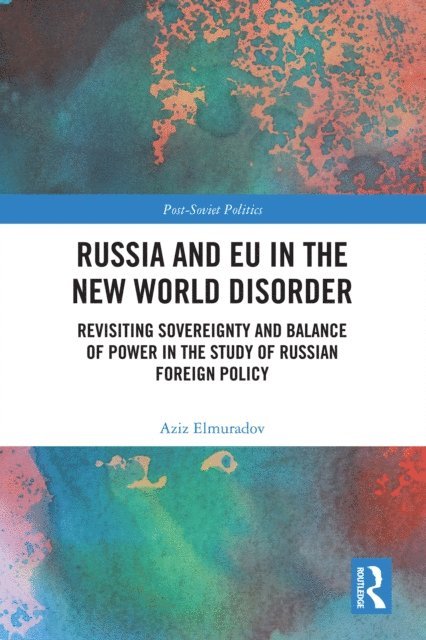
This book makes an original contribution to Russia-EU literature by analyzing constructions and trans-formations of the Russian ‘Self’ in relation to the European "Other". It provides an orientation towards understanding Russian foreign policy discourse under Putin and offers a thorough analysis of the actions of key policy actors to ground the Russian discourse ideationally, historically, psychologically, and politico-sociologically. Providing a rich analysis of how Russian foreign policy toward the EU evolved from cooperation to competition and ultimately conflict, the author argues that to understand these changes and continuities we must explore concepts of sovereignty and balance of power central to the drafting of Russian foreign policy. Primarily situated in the fields of International Relations and Russian foreign policy, this book will also be of interest to scholars in the fields of Foreign Policy Analysis, Post-Soviet Studies, Eurasian Studies, Historical International Relations, Critical Security Studies, Political Sociology, and Political Psychology.
E-bok
Engelska, 2022682 kr
Läs direkt efter köp
This book makes an original contribution to Russia-EU literature by analyzing constructions and trans-formations of the Russian ‘Self’ in relation to the European "Other". It provides an orientation towards understanding Russian foreign policy discourse under Putin and offers a thorough analysis of the actions of key policy actors to ground the Russian discourse ideationally, historically, psychologically, and politico-sociologically. Providing a rich analysis of how Russian foreign policy toward the EU evolved from cooperation to competition and ultimately conflict, the author argues that to understand these changes and continuities we must explore concepts of sovereignty and balance of power central to the drafting of Russian foreign policy. Primarily situated in the fields of International Relations and Russian foreign policy, this book will also be of interest to scholars in the fields of Foreign Policy Analysis, Post-Soviet Studies, Eurasian Studies, Historical International Relations, Critical Security Studies, Political Sociology, and Political Psychology.
Inbunden, Engelska, 2022
1 969 kr
Skickas inom 10-15 vardagar
This book makes an original contribution to Russia-EU literature by analyzing constructions and trans-formations of the Russian ‘Self’ in relation to the European "Other". It provides an orientation towards understanding Russian foreign policy discourse under Putin and offers a thorough analysis of the actions of key policy actors to ground the Russian discourse ideationally, historically, psychologically, and politico-sociologically. Providing a rich analysis of how Russian foreign policy toward the EU evolved from cooperation to competition and ultimately conflict, the author argues that to understand these changes and continuities we must explore concepts of sovereignty and balance of power central to the drafting of Russian foreign policy. Primarily situated in the fields of International Relations and Russian foreign policy, this book will also be of interest to scholars in the fields of Foreign Policy Analysis, Post-Soviet Studies, Eurasian Studies, Historical International Relations, Critical Security Studies, Political Sociology, and Political Psychology.
Häftad, Engelska, 2024
595 kr
Skickas inom 10-15 vardagar
This book makes an original contribution to Russia-EU literature by analyzing constructions and trans-formations of the Russian ‘Self’ in relation to the European "Other". It provides an orientation towards understanding Russian foreign policy discourse under Putin and offers a thorough analysis of the actions of key policy actors to ground the Russian discourse ideationally, historically, psychologically, and politico-sociologically. Providing a rich analysis of how Russian foreign policy toward the EU evolved from cooperation to competition and ultimately conflict, the author argues that to understand these changes and continuities we must explore concepts of sovereignty and balance of power central to the drafting of Russian foreign policy. Primarily situated in the fields of International Relations and Russian foreign policy, this book will also be of interest to scholars in the fields of Foreign Policy Analysis, Post-Soviet Studies, Eurasian Studies, Historical International Relations, Critical Security Studies, Political Sociology, and Political Psychology.