B. Delmon – författare
Visar alla böcker från författaren B. Delmon. Handla med fri frakt och snabb leverans.
19 produkter
19 produkter
E-bok
PDF, Engelska, 19993 827 kr
Läs direkt efter köp
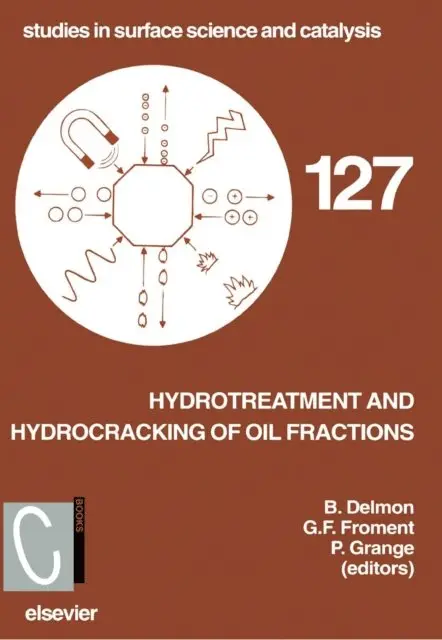
The 2nd International Symposium on Hydrotreatment and Hydrocracking of Oil Fractions, which is also the 7th in the series of European Workshops on Hydrotreatment, took place in Antwerpen, Belgium from November 14 to 17.The Symposium emphasized how oil refining faces increasingly severe environmental regulations. These and the increasing application of heavier crudes containing more S-, N- and metal components call for more efficient hydrotreatment and hydrocracking processes. It is clear from the keynote lectures, the oral contributions and the posters of this meeting that adapting the operating conditions will not suffice. Adequate catalysts need to be developed, with different composition and structure. Surface science techniques and molecular modeling are now well established tools for such a development. They should be of help in widely different aspects, like the role of precursors in the preparation or the modifications undergone by the catalyst under reaction conditions. The improvement of hydrotreatment and hydrocracking also needs accurate modeling of the chemical reactor. This requires more representative hydrodynamics and kinetic models whose validity extends to the very low S- and N-contents. These areas should be vigorously developed.
E-bok
PDF, Engelska, 19973 718 kr
Läs direkt efter köp
The symposium on Hydrotreatment and Hydrocracking of Oil Fractions aims to provide a global perspective and an inspection of the state-of-the-art of these processes. New American, European and Japanese environmental regulations call for advanced hydrotreatment processes for HDS and HDN for the removal of S- and Ni-components from oil fractions. These will alter the product slate of the oil refineries and the hydrocarbon composition of these products. Hydrocracking will play an important part in this shift.Adapting the operating conditions will not suffice to reach the desired product specifications and yields. Adequate catalysts will have to be developed. Powerful tools are now available for this, e.g. surface science techniques, molecular modeling and new types of reactors operated in a nonsteady mode.Another instrument in the improvement of hydrotreatment and hydrocracking units is the availability of more realistic kinetic models. These are based on a judicious insight into the reaction mechanism, also provided by the above-mentioned tools. Progress in the analytical techniques has allowed the reduction of the lumping of components in these kinetic models and first order kinetic equations are gradually replaced by equations accounting for the adsorption of the various components.More detailed and more realistic reactor models are now based on rigorous hydrodynamic models and their application has become possible through the rapidly increasing possibilities of computers.
E-bok
PDF, Engelska, 19982 759 kr
Läs direkt efter köp
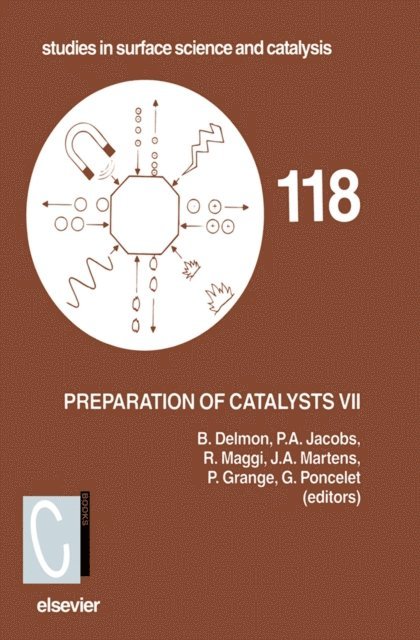
The proceedings of the VIIth International Symposium on the Scientific Bases for the Preparation of Heterogeneous Catalysts, are in line with the general scope of this series of events. Emphasis in all Symposia has been on the scientific aspects of the preparation of new and industrial catalysts, or on new methods of preparation, rather than on the catalytic reactions in which such solids are ultimately used. In the present context, the catalytic event itself has only been considered as another, though often decisive, method of catalyst characterization.
E-bok
PDF, Engelska, 19953 969 kr
Läs direkt efter köp
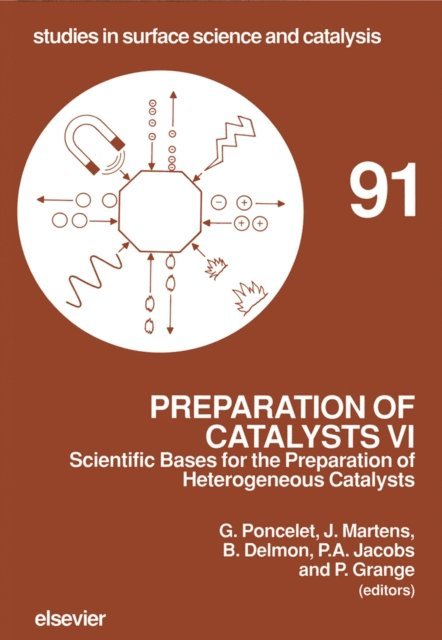
The organizers of this Sixth Symposium maintained their initial objectives, namely to gather experts from both industries and universities to discuss the scientific problems involved in the preparation of heterogeneous catalysts, and to encourage as much as possible the presentation of research work on catalysts of real industrial significance. Another highlight of these symposia is to reserve a substantial part of the program to new developments in catalyst preparation, new preparation methods and new catalytic systems. The fact that chemical reactions which were hardly conceivable some years ago have become possible today through the development of appropriate catalytic systems proves that catalysis is in constant progress.The papers in this volume deal with preparation of new catalysts and supports, catalyst preparation via sol-gel methods, supported catalysts and synthesis of nanometer size catalysts.
E-bok
PDF, Engelska, 1991783 kr
Läs direkt efter köp
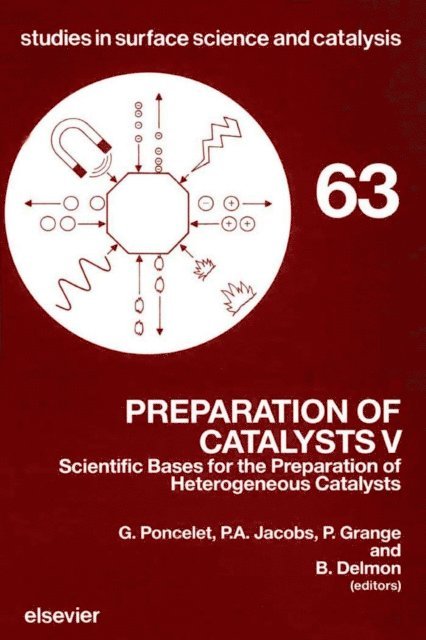
The organizers of this Fifth Symposium maintained their initial objectives, namely to gather experts from both industries and universities to discuss the scientific problems involved in the preparation of heterogeneous catalysts, and to encourage as much as possible the presentation of research work on catalysts of real industrial significance. Another highlight of these symposia was to reserve a substantial part of the program to new developments in catalyst preparation, new preparation methods and new catalytic systems. The fact that chemical reactions which were hardly conceivable some years ago have become possible today through the development of appropriate catalytic systems proves that catalysis is in constant progress.The papers in this volume deal with studies of unit operations in catalyst preparation, catalyst preparation via the sol-gel route, preparation of catalysts from layered structures and pillaring of clays, preparation and modification of zeolite-based catalysts, carbon supported catalysts, preparation of oxidation catalysts and novel and unusual preparation methods.
E-bok
PDF, Engelska, 1992696 kr
Läs direkt efter köp
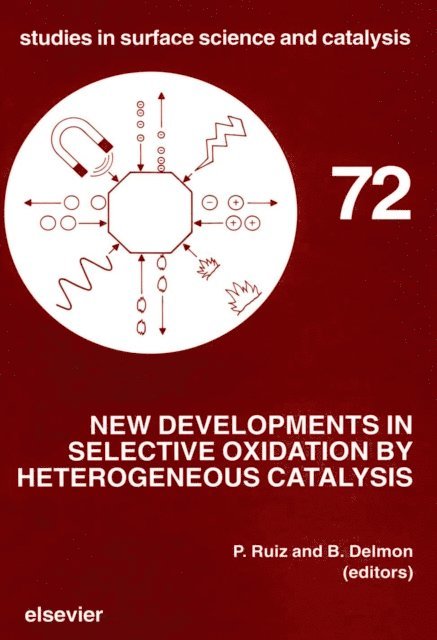
This volume contains invited papers and communications presented at the Third European Workshop Meeting on Selective Oxidation by Heterogeneous Catalysis. The purpose of the meeting was to present recent results and to discuss new aspects of partial oxidation by heterogeneous catalysis. The following topics were discussed: Novel processes for obtaining new fine chemicals by catalytic partial oxidation; selective oxidation and oxidative dehydrogenation of alkanes; new catalysts and advances in preparation methods of oxidation catalysts; new phenomena in partial oxidation and new aspects of surface chemistry in oxide catalysts; new applications of physicochemical methods for characterization of oxide catalysts; oxidation with other agents than oxygen and catalytic oxidation of carbohydrates. This book will provide a valuable set of data on reactions of selective oxidation which will be extremely useful to catalyst and related practitioners, whether fundamentalists or highly applied, and to process engineers who wish to evaluate current findings in this field. The wide-range approach to reactions of selective oxidation will disseminate knowledge in specialized areas of selective oxidation and encourage innovation and creativity.
E-bok
PDF, Engelska, 1994696 kr
Läs direkt efter köp
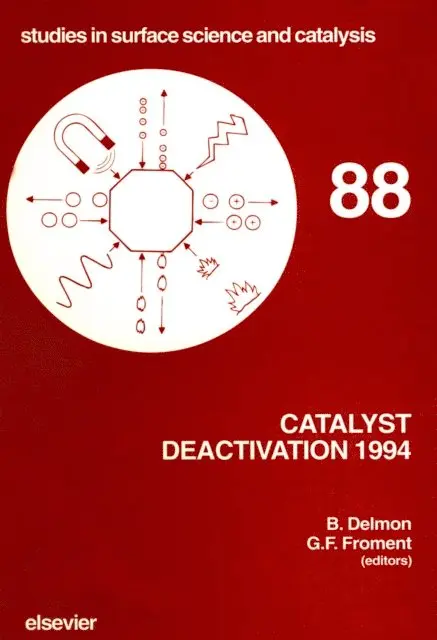
Catalyst Deactivation 1994 was an expansion of earlier, highly successful symposia. The objective of the symposium was to promote a scientific approach of the phenomenon of catalyst deactivation which will contribute to the development of catalysts which are less subject to structural transformations and more resistant to poisons and coke formation. These aspects are dealt with in 12 plenary lectures, 48 oral presentations and 35 poster papers, which were critically selected from an impressive response from some 30 countries.Both fundamental and applied aspects were covered. The deactivation of catalysts in important industrial processes like fluid bed catalytic cracking hydrotreatment, hydrodesulfurization, catalytic reforming, hydrodenitrogenation, steam reforming, hydrodemetallization, hydrocracking, Fischer-Tropsch synthesis, propane dehydrogenation, phthalic anhydride synthesis received considerable attention. Mechanisms of poisoning, sintering and coking were further investigated and modelled and new experimental techniques for the characterization and the quantification of deactivation were also introduced.
E-bok
PDF, Engelska, 20113 006 kr
Läs direkt efter köp
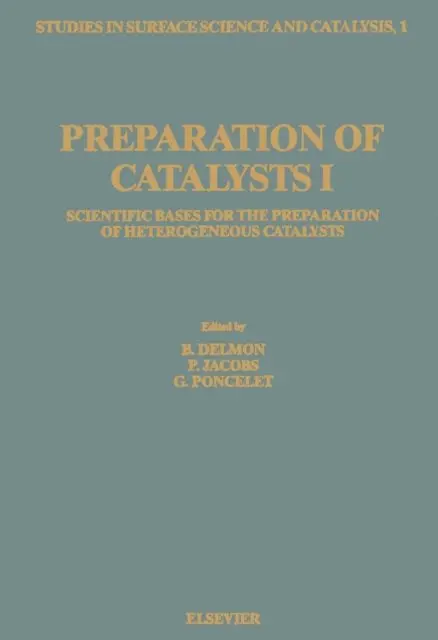
Preparation of Catalysts I
E-bok
PDF, Engelska, 20003 278 kr
Läs direkt efter köp
Catalyst Deactivation 1980: International Symposium Proceedings
E-bok
PDF, Engelska, 1977783 kr
Läs direkt efter köp
Preparation of Catalysts II
E-bok
PDF, Engelska, 1987783 kr
Läs direkt efter köp
The proceedings of the IVth International Symposium on the ``Scientific Bases for the Preparation of Heterogeneous Catalysts'''', are presented in this volume. Since its start in 1975, this series of Symposia has continued to attract increasing scientific attention. An appreciable proportion of the papers presented at this Fourth Symposium stemmed from industrial research laboratories. The symposium dealt with catalysts for selective oxidation, hydrodesulphurization, Fischer-Tropsch catalysis, methanol synthesis, metal supported catalysts and new trends in catalyst preparation.
E-bok
PDF, Engelska, 1987783 kr
Läs direkt efter köp
This Symposium on Catalyst Deactivation ensues those held at Berkeley (1985), Antwerp (1980) and Berkeley (1978).The three main topics emphasised at this most recent symposium were: the techniques used in deactivation studies, the mechanisms of catalyst deactivation, and modelling. With respect to the first, it became apparent that the study of deactivation faces even more difficulties than the characterization of fresh catalysts and the measurement of activity or selectivity, due to the multiplicity of interacting processes occurring during deactivation. Quite substantial progress has been made recently in the understanding of the mechanisms of various deactivation processes, particularly coking, and extra time was accorded to these topics at the symposium. The third topic corresponds to a problem which is very central to development studies and to the chemical engineering aspect of catalysis: it deals with the representativity of accelerated tests and the modelling of the deactivation phenomena.
Del 118 - Studies in Surface Science and Catalysis
Preparation of Catalysts VII
Inbunden, Engelska, 1998
1 876 kr
Skickas inom 10-15 vardagar
The proceedings of the VIIth International Symposium on the Scientific Bases for the Preparation of Heterogeneous Catalysts, are in line with the general scope of this series of events. Emphasis in all Symposia has been on the scientific aspects of the preparation of new and industrial catalysts, or on new methods of preparation, rather than on the catalytic reactions in which such solids are ultimately used. In the present context, the catalytic event itself has only been considered as another, though often decisive, method of catalyst characterization.
Del 126 - Studies in Surface Science and Catalysis
Catalyst Deactivation 1999
Inbunden, Engelska, 1999
2 542 kr
Skickas inom 5-8 vardagar
Studies in catalyst deactivation play a major role in the identification of the real catalytic system, in particular, the structure and texture of the solid, which is often in a metastable state, as it is operated in the industrial reactor. These studies also allow the identification of the experimental conditions which preserve this active and selective state. This is crucial for a real understanding of catalysts and catalysis. Another area of catalytic science concerns reactions kinetics, which, if properly determined, are of paramount importance in the elucidation of mechanisms. The behavior of the kinetics during aging and deactivation and an accurate modeling of the evolution of activity and selectivity are essential information for the process performance. These are just two typical examples, but quite generally, the science of catalyst deactivation is going to be more oriented to fundamental issues.
Inbunden, Engelska, 1991
546 kr
Skickas inom 10-15 vardagar
Proceedings of the workshop, Interfaces in New Materials, held in Louvain-la-Neuve, Belgium, 19-20 November 1990
Inbunden, Engelska, 1983
2 161 kr
Skickas inom 10-15 vardagar
In the field of heterogeneous catalysis. it is convenient to distinguish. in a perfectly unjustified and over··simplified way. bet:leen metal catalysts. 2nd the other catalysts. The fj.J"st are easy to define : they are those in which a reduced metal is the active phase. It is thus easy to circumscribe. by exclusion, the other class namely the "non-metals". We have adopted this definition for the sake of our colleagues working on catalysis by metals, and to avoid a lengthy title like "sm' face pl"operties and catalysts by transi tion metal oxides. sulftdes, carbides, nitriles, etc. Defined in this manner, non-metal catalysts represented, in 1980, 84 wt. % of the industrial heterogeneous catalysts. To be more specific, this proportion corresponds to catalysts which, under the working conditions in the industrial ?lant. contain their catalytically active metallic elements in a non-reduced state. It should however be recalled that most metal catalysts are supported on oxides, which, often, repl'esent over 90% (sometimes 99.4% in the case of the platinum reforming catalysts) of the total weight.
E-bok
PDF, Engelska, 20122 840 kr
Läs direkt efter köp
In the field of heterogeneous catalysis. it is convenient to distinguish. in a perfectly unjustified and over··simplified way. bet:leen metal catalysts. 2nd the other catalysts. The fj.J"st are easy to define : they are those in which a reduced metal is the active phase. It is thus easy to circumscribe. by exclusion, the other class namely the "non-metals". We have adopted this definition for the sake of our colleagues working on catalysis by metals, and to avoid a lengthy title like "sm'' face pl"operties and catalysts by transi tion metal oxides. sulftdes, carbides, nitriles, etc. Defined in this manner, non-metal catalysts represented, in 1980, 84 wt. % of the industrial heterogeneous catalysts. To be more specific, this proportion corresponds to catalysts which, under the working conditions in the industrial ?lant. contain their catalytically active metallic elements in a non-reduced state. It should however be recalled that most metal catalysts are supported on oxides, which, often, repl''esent over 90% (sometimes 99.4% in the case of the platinum reforming catalysts) of the total weight.
Häftad, Engelska, 2011
2 161 kr
Skickas inom 10-15 vardagar
In the field of heterogeneous catalysis. it is convenient to distinguish. in a perfectly unjustified and over··simplified way. bet:leen metal catalysts. 2nd the other catalysts. The fj.J"st are easy to define : they are those in which a reduced metal is the active phase. It is thus easy to circumscribe. by exclusion, the other class namely the "non-metals". We have adopted this definition for the sake of our colleagues working on catalysis by metals, and to avoid a lengthy title like "sm' face pl"operties and catalysts by transi tion metal oxides. sulftdes, carbides, nitriles, etc. Defined in this manner, non-metal catalysts represented, in 1980, 84 wt. % of the industrial heterogeneous catalysts. To be more specific, this proportion corresponds to catalysts which, under the working conditions in the industrial ?lant. contain their catalytically active metallic elements in a non-reduced state. It should however be recalled that most metal catalysts are supported on oxides, which, often, repl'esent over 90% (sometimes 99.4% in the case of the platinum reforming catalysts) of the total weight.
E-bok
PDF, Engelska, 2012712 kr
Läs direkt efter köp