B. Roy - Böcker
Visar alla böcker från författaren B. Roy. Handla med fri frakt och snabb leverans.
3 produkter
3 produkter
Del 12 - Nonconvex Optimization and Its Applications
Multicriteria Methodology for Decision Aiding
Inbunden, Engelska, 1996
2 164 kr
Skickas inom 10-15 vardagar
axiomatic results should be at the heart of such a science. Through them, we should be able to enlighten and scientifically assist decision-making processes especially by: - making that wh ich is objective stand out more c1early from that which is less objective; - separating robust from fragile conc1usions; - dissipating certain forms of misunderstanding in communication; - avoiding the pitfall of illusory reasoning; - emphasizing, once they are understood, incontrovertible results. The difficulties I encountered at the begining of my career as an operations researcher, and later as a consultant, made me realize that there were some limitations on objectivity in decision-aiding. In my opinion, five major aspects must be taken into consideration: 1) The borderline (or frontier) between what is and what is not feasible is often fuzzy. Moreover, this borderline is frequently modified in light of what is found from the study itself. 2) In many real-world problems, the "decision maker D" does not really exist as a person truly able to make adecision. Usually, several people (actors or stakeholders) take part in the decision process, and it is important not to confuse the one who ratifies adecision with the so-called decision maker in the decision ai ding process. This decision maker is in fact the person or the set of persons for whom or in the name of whom decision aiding effort is provided.
Del 12 - Nonconvex Optimization and Its Applications
Multicriteria Methodology for Decision Aiding
Häftad, Engelska, 2010
2 101 kr
Skickas inom 10-15 vardagar
This is the first comprehensive book to present, in English, the multicriteria methodology for decision aiding. In the foreword the distinctive features and main ideas of the European School of MCDA are outlined. The twelve chapters are essentially expository in nature, but scholarly in treatment. Some questions, which are too often neglected in the literature on decision theory, such as how is a decision made, who are the actors, what is a decision aiding model, how to define the set of alternatives, are discussed. Examples are used throughout the book to illustrate the various concepts. Ways to model the consequences of each alternative and building criteria taking into account the inevitable imprecisions, uncertainties and indeterminations are described and illustrated. The three classical operational approaches of MCDA: synthesis in one criterion (including MAUT), synthesis by outranking relations, interactive local judgements, are studied. This methodology tries to be a theoretical or intellectual framework directed towards formulating recommendations for action.Audience:The book is addressed to graduate students, postgraduates and researchers in management sciences, operations research or decision analysis, as well as all scientists who use models and methods for guiding decisions. In addition all those who, in business and administration, wish to take part in decision-making through scientific reasoning will be interested. The contents of the book are organized in such a way as to help individuals with different backgrounds and interests chart an appropriate course through the chapters (see Reader's Guide in the front-matter).
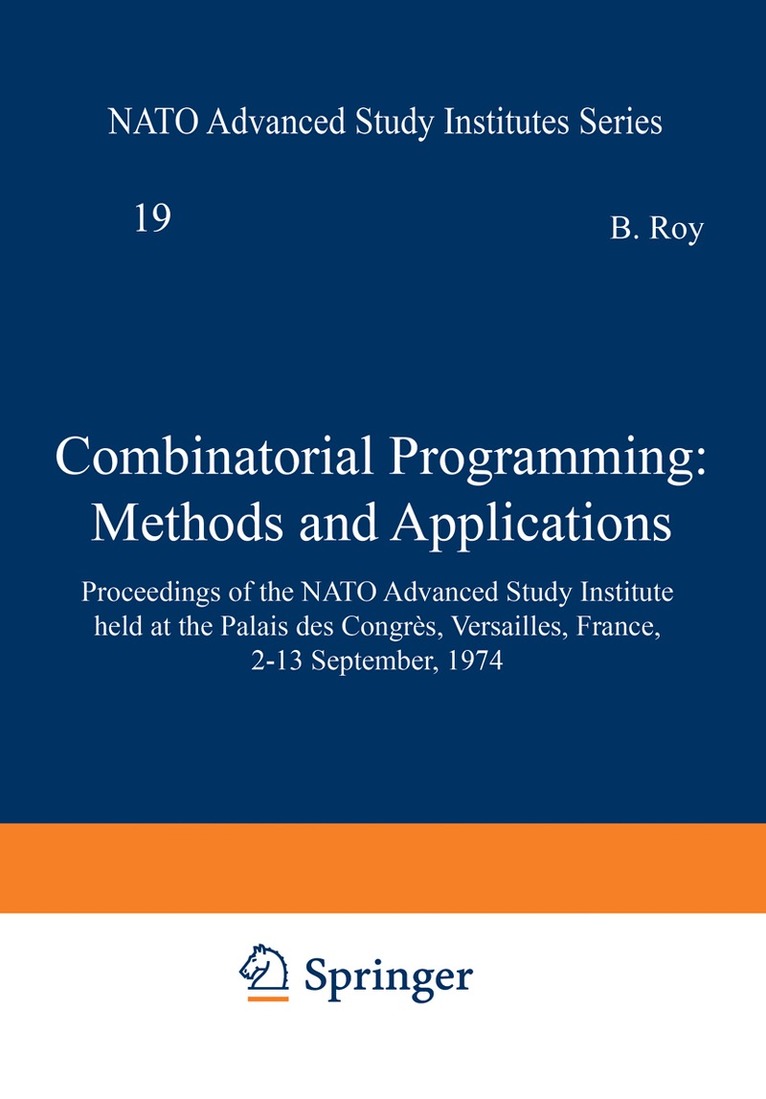
Combinatorial Programming: Methods and Applications
Proceedings of the NATO Advanced Study Institute held at the Palais des Congrès, Versailles, France, 2–13 September, 1974
Häftad, Engelska, 2013
552 kr
Skickas inom 10-15 vardagar
"Combinatorial Programming" are two words whose juxtaposition still strike us as unusual, nevertheless their association in recent years adequately reflects the preoccupations underlying differing work fields, and their importance will increase both from methodology and application view points. To those who like definitions and consider the function of this book to furnish one for combinatorial programming, I will simply say that it is precise ly this which is exclusively treated here and which in the eyes of the autors is the heart of this branch of applied mathematics. Such was the initial intention of those who in the spring of 1973 gathered tog~ther in Paris to state the work of the Advanced Study Institute from which this book arises. As young as combinatorial programming is, it was easy to see that a two week school was insufficient to cover the subject in an exhaustive manner. Finally the decision had to be taken to reduce to book form, and to organise within this particular means of expression, the essential syntheses and communications. Unfortunately the discussions, the round tables, and the majority of the case studies could not be included in this book which is more of a hand-book on the subject. XIV PREFACE The choice and orientation of the surveys has been guided by two criteria : the importance of already accomplished work, and the originality of the survey to be undertaken.