Bärbel Inhelder - Böcker
Visar alla böcker från författaren Bärbel Inhelder. Handla med fri frakt och snabb leverans.
6 produkter
6 produkter
3 949 kr
Skickas inom 10-15 vardagar
First published in 1974. This is Volume VIII of selected works of Jean Piaget which along with Burbel Inhelder, looks at how children construct continuous quantity. That is where a quantity that is even more general than number or measurement, and gets included as special cases, namely the extensive quantity characterized by the comparison of the parts without the specification of a unit.
705 kr
Skickas inom 10-15 vardagar
First published in 1974. This is Volume VIII of selected works of Jean Piaget which along with Burbel Inhelder, looks at how children construct continuous quantity. That is where a quantity that is even more general than number or measurement, and gets included as special cases, namely the extensive quantity characterized by the comparison of the parts without the specification of a unit.
2 629 kr
Skickas inom 10-15 vardagar
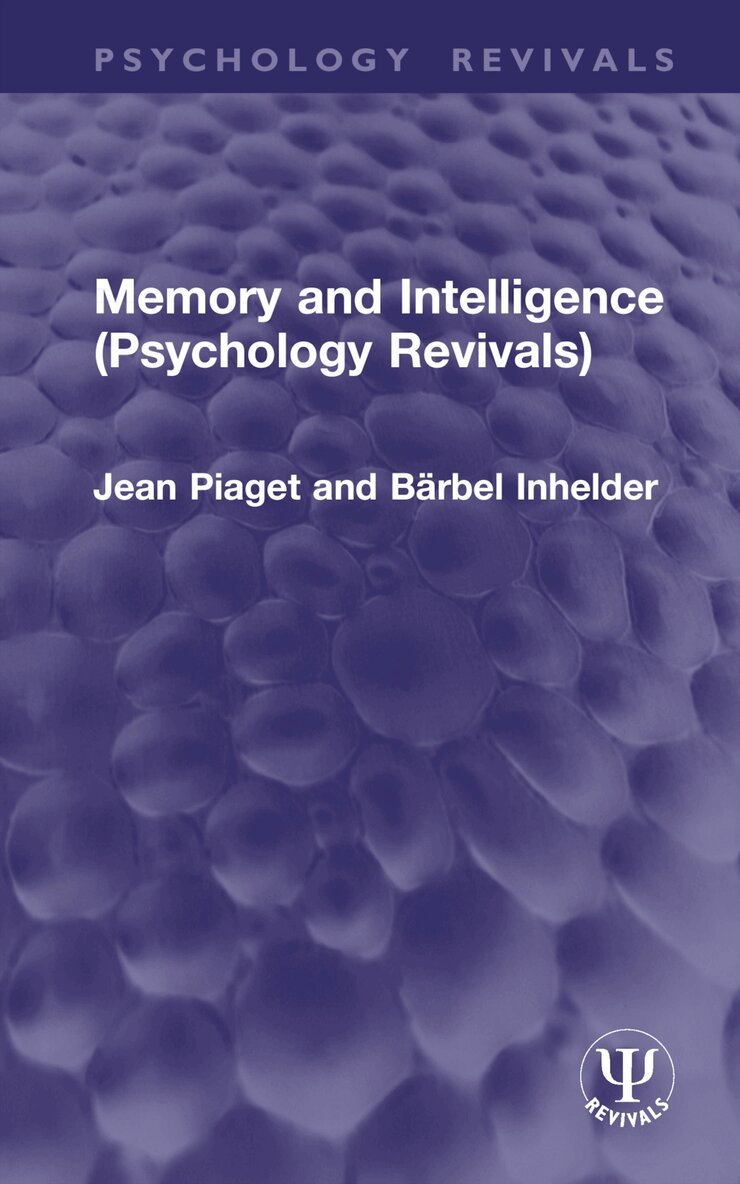
In the course of their researches for Mental Imagery in the Child (1971), the authors came to appreciate that action may be more conducive to the formation and conservation of images than is mere perception. This raised the problem of memory and its relation to intelligence, which they examine in this title, originally published in English in 1973.Through the analysis primarily of the child’s capacity for remembering additive and multiplicative logical structures, and his remembrance of causal and spatial structures, the authors investigate whether memories pursue their own course, regardless of the intelligence or whether, in specified conditions, mnemonic improvements may be due to progress in intelligence. They examine the relationship between the memory’s figurative aspects (from perceptive recognition to the memory-image) and its operational aspects (the schemata of the intelligence), and stress the fundamental significance of the mnemonic level known as the ‘reconstructive memory’. This was a pioneering work at the time, presenting illuminating conclusions drawn from extensive research, together with a number of constructive ideas which opened up a fresh approach to an important area of educational psychology.
735 kr
Skickas inom 10-15 vardagar
In the course of their researches for Mental Imagery in the Child (1971), the authors came to appreciate that action may be more conducive to the formation and conservation of images than is mere perception. This raised the problem of memory and its relation to intelligence, which they examine in this title, originally published in English in 1973.Through the analysis primarily of the child’s capacity for remembering additive and multiplicative logical structures, and his remembrance of causal and spatial structures, the authors investigate whether memories pursue their own course, regardless of the intelligence or whether, in specified conditions, mnemonic improvements may be due to progress in intelligence. They examine the relationship between the memory’s figurative aspects (from perceptive recognition to the memory-image) and its operational aspects (the schemata of the intelligence), and stress the fundamental significance of the mnemonic level known as the ‘reconstructive memory’. This was a pioneering work at the time, presenting illuminating conclusions drawn from extensive research, together with a number of constructive ideas which opened up a fresh approach to an important area of educational psychology.
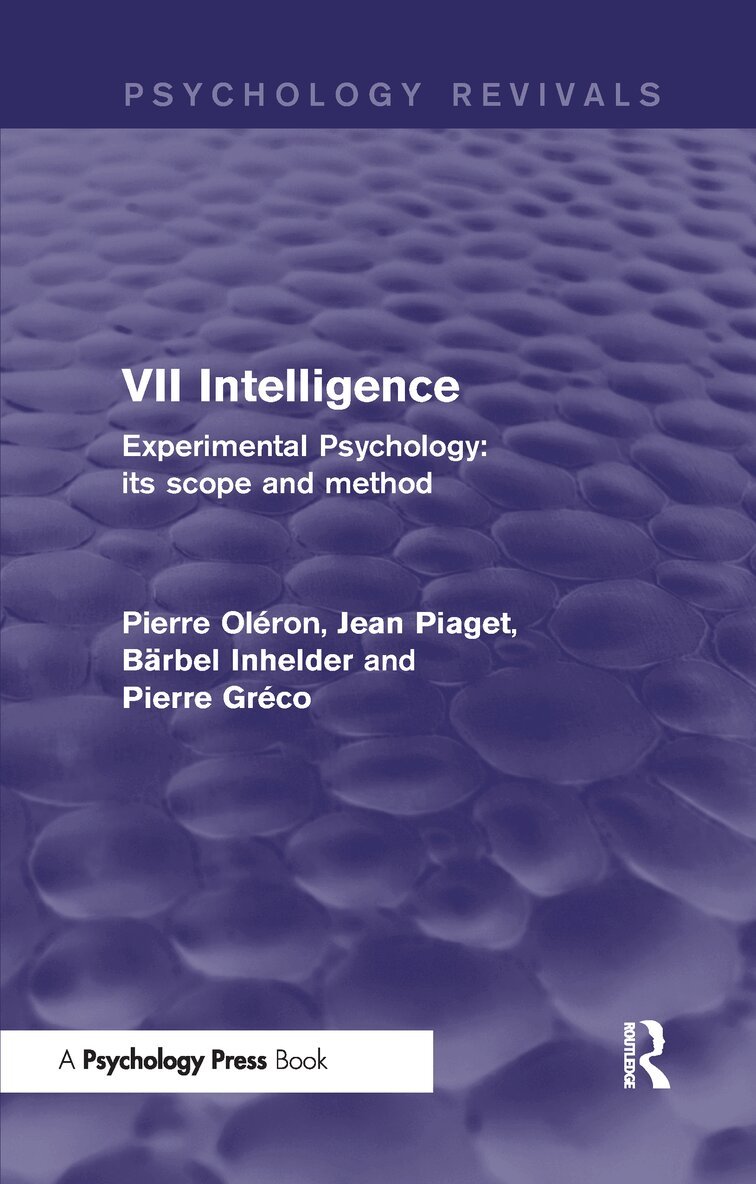
Experimental Psychology Its Scope and Method: Volume VII (Psychology Revivals)
Intelligence
Häftad, Engelska, 2015
483 kr
Skickas inom 10-15 vardagar
First published in English in 1969, the book opens with a chapter by Pierre Oléron on intellectual activities. These fall into three groups: inductive activities (the apprehension of laws, relations and concepts), reasoning and problem solving. It describes typical methods and essential results obtained by relevant experiments. There are two chapters by Jean Piaget and his collaborator Bärbel Inhelder. The first, on mental images, breaks new ground: it describes original experiments carried out by Piaget and associates with children of various ages. Piaget examines the relations between images and motor activity, imitation, drawing and operations. He also classifies images according to their degree of complexity and show why children have inadequate images of some processes. The second chapter is on intellectual operations and Piaget gives a summary of the main findings of a number of his earlier books, on the child’s notions of conservation, classification, seriation, number, measurement, time, speed and chance.In the last chapter, Pierre Gréco discusses learning and intellectual structures. He describes the work of psychologists with rats in mazes and formulating theories of animal learning. Gestalt psychology and various other interpretations are examined and Greco also pays attention to Piaget’s view of ‘structural learning’ based on experience.
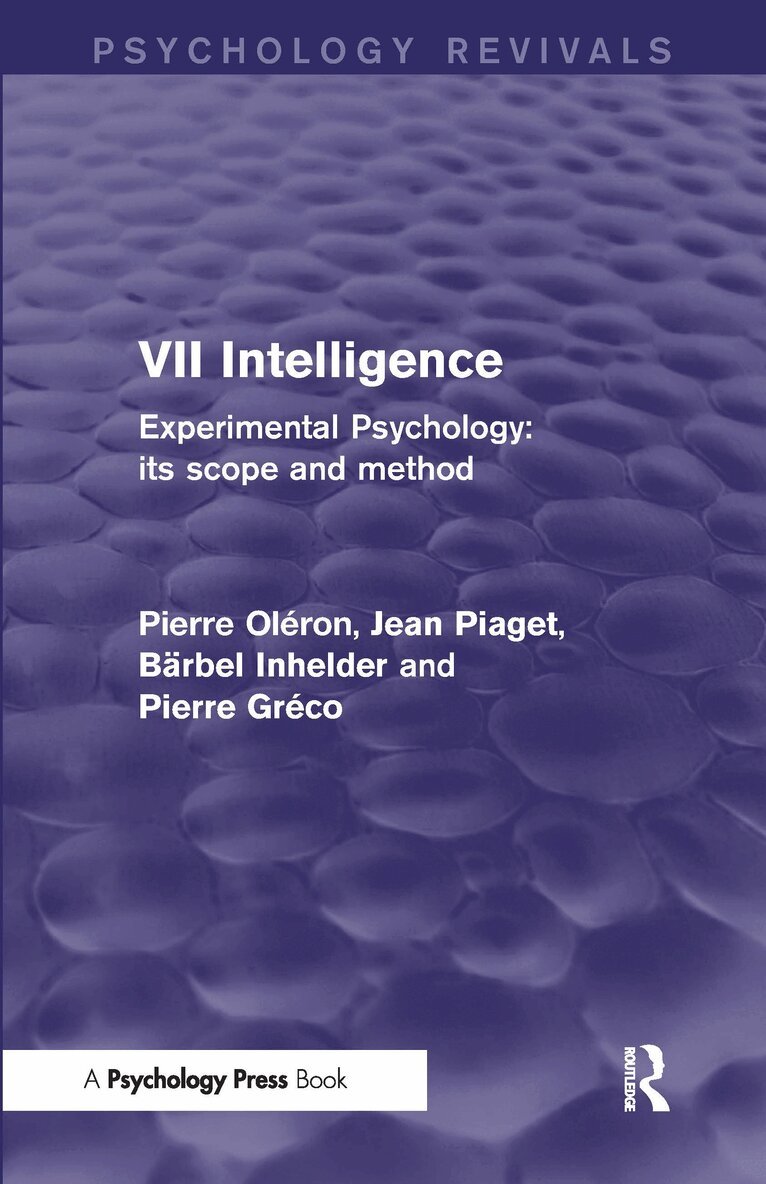
Experimental Psychology Its Scope and Method: Volume VII (Psychology Revivals)
Intelligence
Inbunden, Engelska, 2014
1 330 kr
Skickas inom 10-15 vardagar
First published in English in 1969, the book opens with a chapter by Pierre Oléron on intellectual activities. These fall into three groups: inductive activities (the apprehension of laws, relations and concepts), reasoning and problem solving. It describes typical methods and essential results obtained by relevant experiments. There are two chapters by Jean Piaget and his collaborator Bärbel Inhelder. The first, on mental images, breaks new ground: it describes original experiments carried out by Piaget and associates with children of various ages. Piaget examines the relations between images and motor activity, imitation, drawing and operations. He also classifies images according to their degree of complexity and show why children have inadequate images of some processes. The second chapter is on intellectual operations and Piaget gives a summary of the main findings of a number of his earlier books, on the child’s notions of conservation, classification, seriation, number, measurement, time, speed and chance.In the last chapter, Pierre Gréco discusses learning and intellectual structures. He describes the work of psychologists with rats in mazes and formulating theories of animal learning. Gestalt psychology and various other interpretations are examined and Greco also pays attention to Piaget’s view of ‘structural learning’ based on experience.