Barbel Finkenstadt – författare
Visar alla böcker från författaren Barbel Finkenstadt. Handla med fri frakt och snabb leverans.
8 produkter
8 produkter
E-bok
PDF, Engelska, 20033 082 kr
Läs direkt efter köp
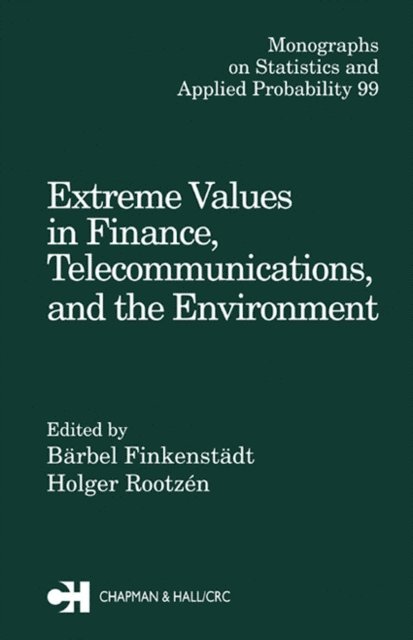
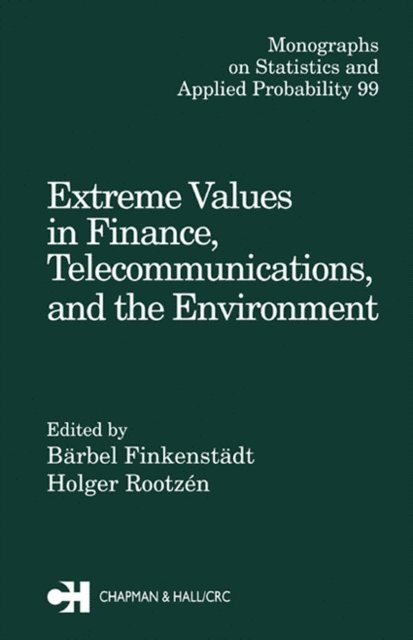
Because of its potential to ...predict the unpredictable,... extreme value theory (EVT) and methodology is currently receiving a great deal of attention from statistical and mathematical researchers. This book brings together world-recognized authorities in their respective fields to provide expository chapters on the applications, use, and theory
Häftad, Engelska, 2019
951 kr
Skickas inom 10-15 vardagar
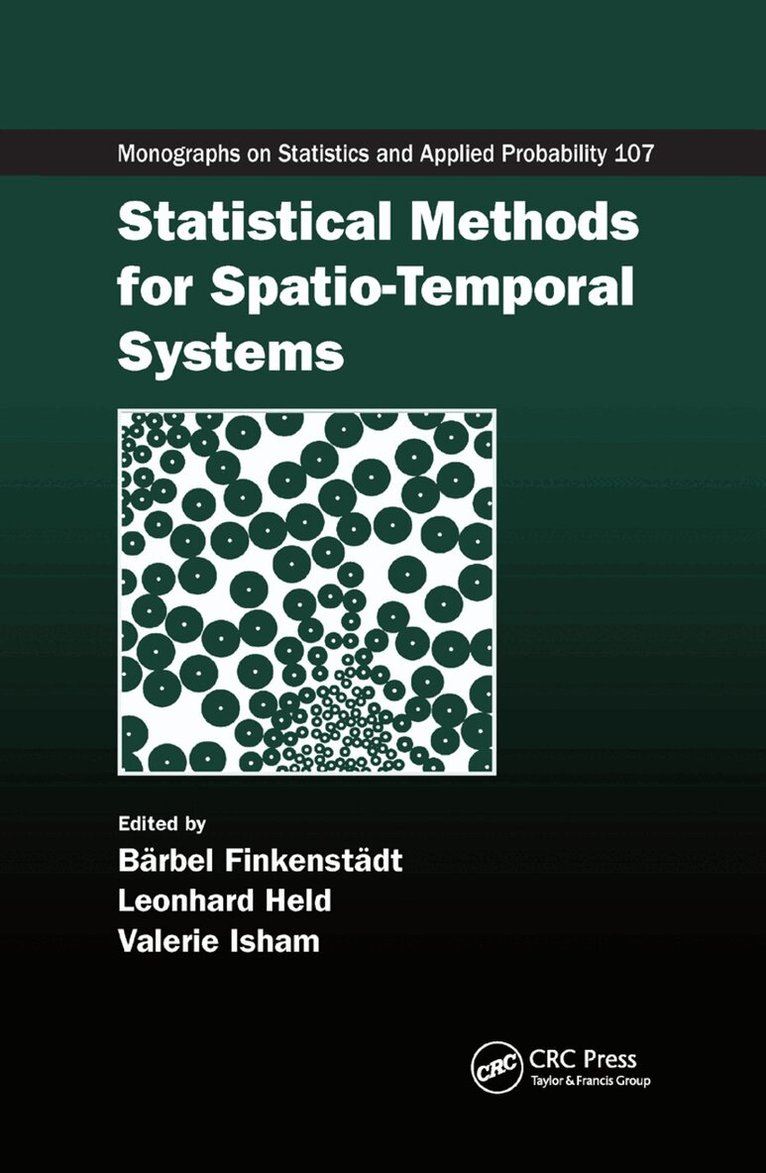
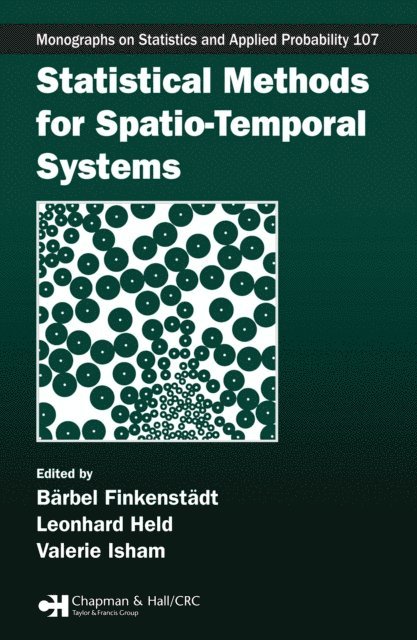
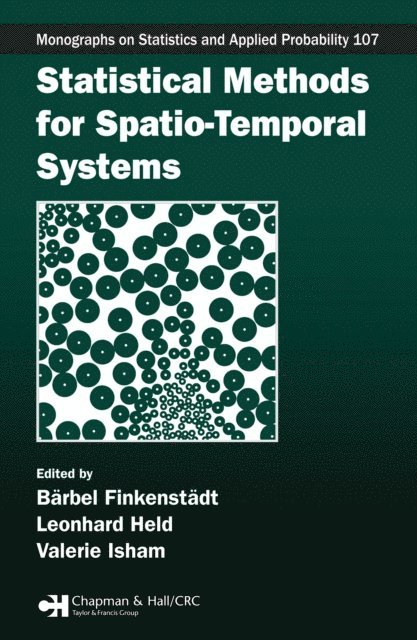
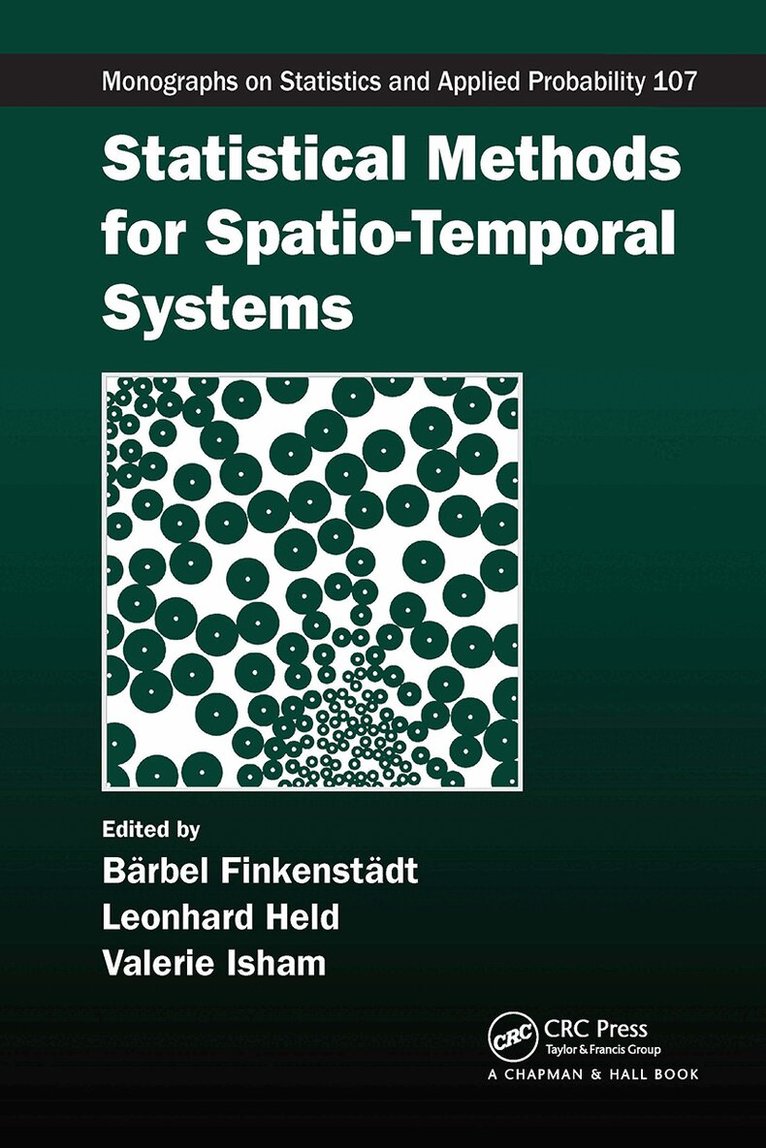
Statistical Methods for Spatio-Temporal Systems presents current statistical research issues on spatio-temporal data modeling and will promote advances in research and a greater understanding between the mechanistic and the statistical modeling communities.Contributed by leading researchers in the field, each self-contained chapter starts with an introduction of the topic and progresses to recent research results. Presenting specific examples of epidemic data of bovine tuberculosis, gastroenteric disease, and the U.K. foot-and-mouth outbreak, the first chapter uses stochastic models, such as point process models, to provide the probabilistic backbone that facilitates statistical inference from data. The next chapter discusses the critical issue of modeling random growth objects in diverse biological systems, such as bacteria colonies, tumors, and plant populations. The subsequent chapter examines data transformation tools using examples from ecology and air quality data, followed by a chapter on space-time covariance functions. The contributors then describe stochastic and statistical models that are used to generate simulated rainfall sequences for hydrological use, such as flood risk assessment. The final chapter explores Gaussian Markov random field specifications and Bayesian computational inference via Gibbs sampling and Markov chain Monte Carlo, illustrating the methods with a variety of data examples, such as temperature surfaces, dioxin concentrations, ozone concentrations, and a well-established deterministic dynamical weather model.
E-bok
Engelska, 20061 113 kr
Läs direkt efter köp
Statistical Methods for Spatio-Temporal Systems presents current statistical research issues on spatio-temporal data modeling and will promote advances in research and a greater understanding between the mechanistic and the statistical modeling communities.Contributed by leading researchers in the field, each self-contained chapter starts w
E-bok
Engelska, 20033 082 kr
Läs direkt efter köp
Because of its potential to ...predict the unpredictable,... extreme value theory (EVT) and methodology is currently receiving a great deal of attention from statistical and mathematical researchers. This book brings together world-recognized authorities in their respective fields to provide expository chapters on the applications, use, and theory
E-bok
PDF, Engelska, 20061 103 kr
Läs direkt efter köp
Statistical Methods for Spatio-Temporal Systems presents current statistical research issues on spatio-temporal data modeling and will promote advances in research and a greater understanding between the mechanistic and the statistical modeling communities.Contributed by leading researchers in the field, each self-contained chapter starts w
Inbunden, Engelska, 2003
2 643 kr
Skickas inom 10-15 vardagar
Because of its potential to ...predict the unpredictable,... extreme value theory (EVT) and methodology is currently receiving a great deal of attention from statistical and mathematical researchers. This book brings together world-recognized authorities in their respective fields to provide expository chapters on the applications, use, and theory of extreme values in the areas of finance, insurance, the environment, and telecommunications. The comprehensive introductory chapter by Richard Smith ensures a high level of cohesion for this volume.
Inbunden, Engelska, 2006
2 158 kr
Skickas inom 10-15 vardagar
Statistical Methods for Spatio-Temporal Systems presents current statistical research issues on spatio-temporal data modeling and will promote advances in research and a greater understanding between the mechanistic and the statistical modeling communities.Contributed by leading researchers in the field, each self-contained chapter starts with an introduction of the topic and progresses to recent research results. Presenting specific examples of epidemic data of bovine tuberculosis, gastroenteric disease, and the U.K. foot-and-mouth outbreak, the first chapter uses stochastic models, such as point process models, to provide the probabilistic backbone that facilitates statistical inference from data. The next chapter discusses the critical issue of modeling random growth objects in diverse biological systems, such as bacteria colonies, tumors, and plant populations. The subsequent chapter examines data transformation tools using examples from ecology and air quality data, followed by a chapter on space-time covariance functions. The contributors then describe stochastic and statistical models that are used to generate simulated rainfall sequences for hydrological use, such as flood risk assessment. The final chapter explores Gaussian Markov random field specifications and Bayesian computational inference via Gibbs sampling and Markov chain Monte Carlo, illustrating the methods with a variety of data examples, such as temperature surfaces, dioxin concentrations, ozone concentrations, and a well-established deterministic dynamical weather model.
E-bok
PDF, Engelska, 20121 367 kr
Läs direkt efter köp
1. 1 Introduction In economics, one often observes time series that exhibit different patterns of qualitative behavior, both regular and irregular, symmetric and asymmetric. There exist two different perspectives to explain this kind of behavior within the framework of a dynamical model. The traditional belief is that the time evolution of the series can be explained by a linear dynamic model that is exogenously disturbed by a stochastic process. In that case, the observed irregular behavior is explained by the influence of external random shocks which do not necessarily have an economic reason. A more recent theory has evolved in economics that attributes the patterns of change in economic time series to an underlying nonlinear structure, which means that fluctua tions can as well be caused endogenously by the influence of market forces, preference relations, or technological progress. One of the main reasons why nonlinear dynamic models are so interesting to economists is that they are able to produce a great variety of possible dynamic outcomes - from regular predictable behavior to the most complex irregular behavior - rich enough to meet the economists'' objectives of modeling. The traditional linear models can only capture a limited number of possi ble dynamic phenomena, which are basically convergence to an equilibrium point, steady oscillations, and unbounded divergence. In any case, for a lin ear system one can write down exactly the solutions to a set of differential or difference equations and classify them.