Bart Verheij - Böcker
Visar alla böcker från författaren Bart Verheij. Handla med fri frakt och snabb leverans.
5 produkter
5 produkter
2 329 kr
Skickas inom 10-15 vardagar
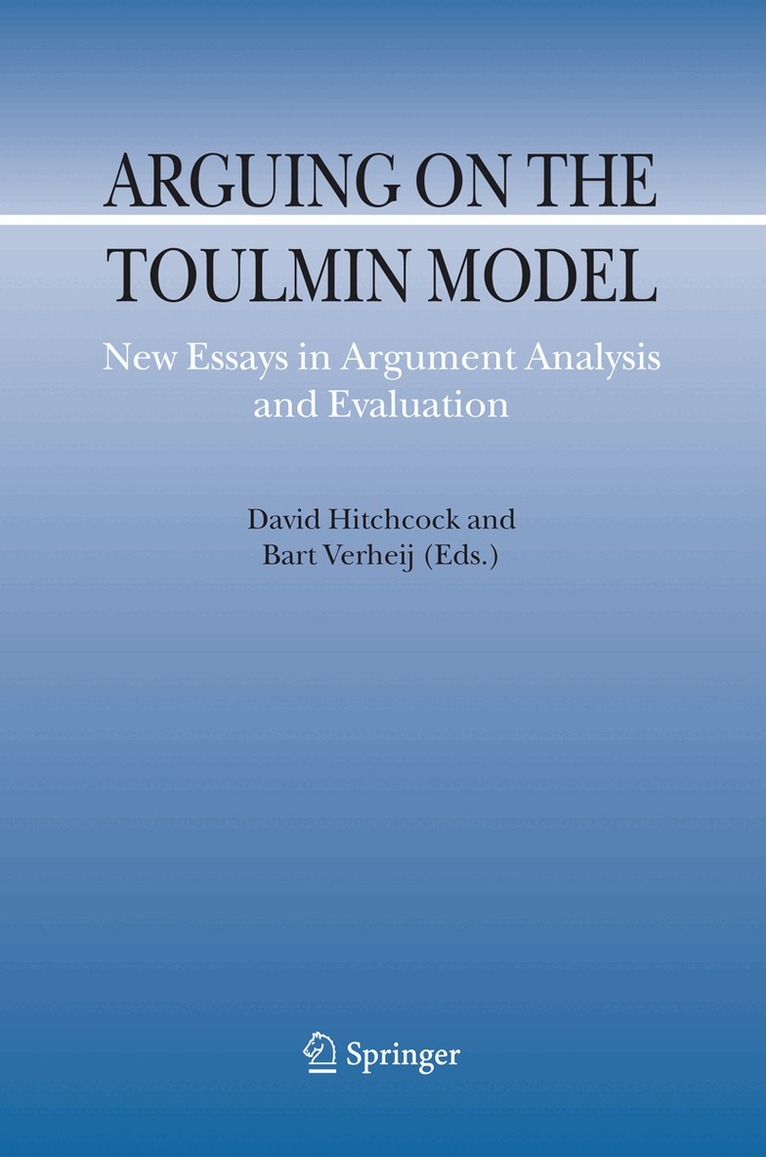
Summarizing, in The Uses of Argument Toulmin emphasized a number of points that are by now familiar, but still deserve attention: 1. Reasoning and argument involve not only support for points of view, but also attack against them. 2. Reasoning can have qualified conclusions. 3. There are other good types of argument than those of standard formal logic. 4. Unstated assumptions linking premisses to a conclusion are better thought of as inference licenses than as implicit premisses. 5. Standards of reasoning can be field dependent, and can be themselves the subject of argumentation. Each of these points is illustrated by his layout of arguments. The rebuttal illustrates the first point, the qualifier the second point, and the warrant and backing the last three points. 2. RECEPTION OF TOULMIN’S BOOK As Toulmin himself notes in his essay in this volume, which was delivered as an address in 2005, his fellow philosophers we re initially hostile to the ideas in his book. They were taken up, however, by specialists in fields like jurisprudence and psychology, who found that they fit the form s of argument and reasoning that they were studying. And Toulmin’s model was embraced by the field of speech communication in the United States, whose textbooks on argumentation now include an obligatory chapter on the Toulmin model of micro arguments.
Artificial Intelligence
29th Benelux Conference, BNAIC 2017, Groningen, The Netherlands, November 8–9, 2017, Revised Selected Papers
Häftad, Engelska, 2018
556 kr
Skickas inom 10-15 vardagar
This book contains a selection of the best papers of the 29th Benelux Conference on Artificial Intelligence, BNAIC 2017, held in Groningen, The Netherlands, in November 2017. The 11 full papers presented in this volume were carefully reviewed and selected from 30 submissions. They address various aspects of artificial intelligence such as natural language processing, agent technology, game theory, problem solving, machine learning, human-agent interaction, AI and education, and data analysis.
2 329 kr
Skickas inom 10-15 vardagar
Summarizing, in The Uses of Argument Toulmin emphasized a number of points that are by now familiar, but still deserve attention: 1. Reasoning and argument involve not only support for points of view, but also attack against them. 2. Reasoning can have qualified conclusions. 3. There are other good types of argument than those of standard formal logic. 4. Unstated assumptions linking premisses to a conclusion are better thought of as inference licenses than as implicit premisses. 5. Standards of reasoning can be field dependent, and can be themselves the subject of argumentation. Each of these points is illustrated by his layout of arguments. The rebuttal illustrates the first point, the qualifier the second point, and the warrant and backing the last three points. 2. RECEPTION OF TOULMIN’S BOOK As Toulmin himself notes in his essay in this volume, which was delivered as an address in 2005, his fellow philosophers we re initially hostile to the ideas in his book. They were taken up, however, by specialists in fields like jurisprudence and psychology, who found that they fit the form s of argument and reasoning that they were studying. And Toulmin’s model was embraced by the field of speech communication in the United States, whose textbooks on argumentation now include an obligatory chapter on the Toulmin model of micro arguments.
7 325 kr
Skickas inom 10-15 vardagar
The Handbook Argumentation Theory provides an up to date survey of the various theoretical contributions to the development of argumentation theory for all scholars interested in argumentation, informal logic and rhetoric. It describes the historical roots of modern argumentation theory that are still an important theoretical background to contemporary approaches. Because of the complexity, diversity and rate of developments in argumentation theory, there is a real need for an overview of the state of the art, the main approaches that can be distinguished and the distinctive features of these approaches. The Handbook covers classical and modern backgrounds to the study of argumentation, the New Rhetoric developed by Perelman and Olbrechts-Tyteca, the Toulmin model, formal approaches, informal logic, communication and rhetoric, pragmatic approaches, linguistic approaches and pragma-dialectics. The Handbook is co-authored by Frans H. van Eemeren, Bart Garssen, Erik C.W. Krabbe, A. Francisca Snoeck Henkemans, Bart Verheij and Jean Wagemans, who are a coherent and prominent writing team whose expertise covers the whole field. The authors are assisted by an international Editorial Board consisting of outstanding argumentation scholars whose fields of interest are represented in the volume.
Virtual Arguments
On the Design of Argument Assistants for Lawyers and Other Arguers
Inbunden, Engelska, 2005
507 kr
Skickas inom 10-15 vardagar
Virtual Arguments examines assistance software; software which supports argumentative tasks and can help with the organization, visualization and evaluation of arguments. The main focus of the book is on defeasible argumentation. Argumentation is defeasible when it is possible that conclusions are withdrawn in the light of further argumentation. The domain of application is the law, where the defeasibility of argumentation is common and often essential. This interdisciplinary study reports on current research in artificial intelligence, legal theory and argumentation theory. It is relevant for all those who are interested in defeasible argumentation, legal reasoning and argument assistance software. The author combines theoretical reflection with illustrative examples and provides an overview of research into the design of argumentation software, which will be of interest both to researchers in the field of artificial intelligence and the law, and to legal practitioners.