Bashar Nuseibeh - Böcker
Visar alla böcker från författaren Bashar Nuseibeh. Handla med fri frakt och snabb leverans.
4 produkter
4 produkter
240 kr
Skickas inom 5-8 vardagar
536 kr
Skickas inom 7-10 vardagar
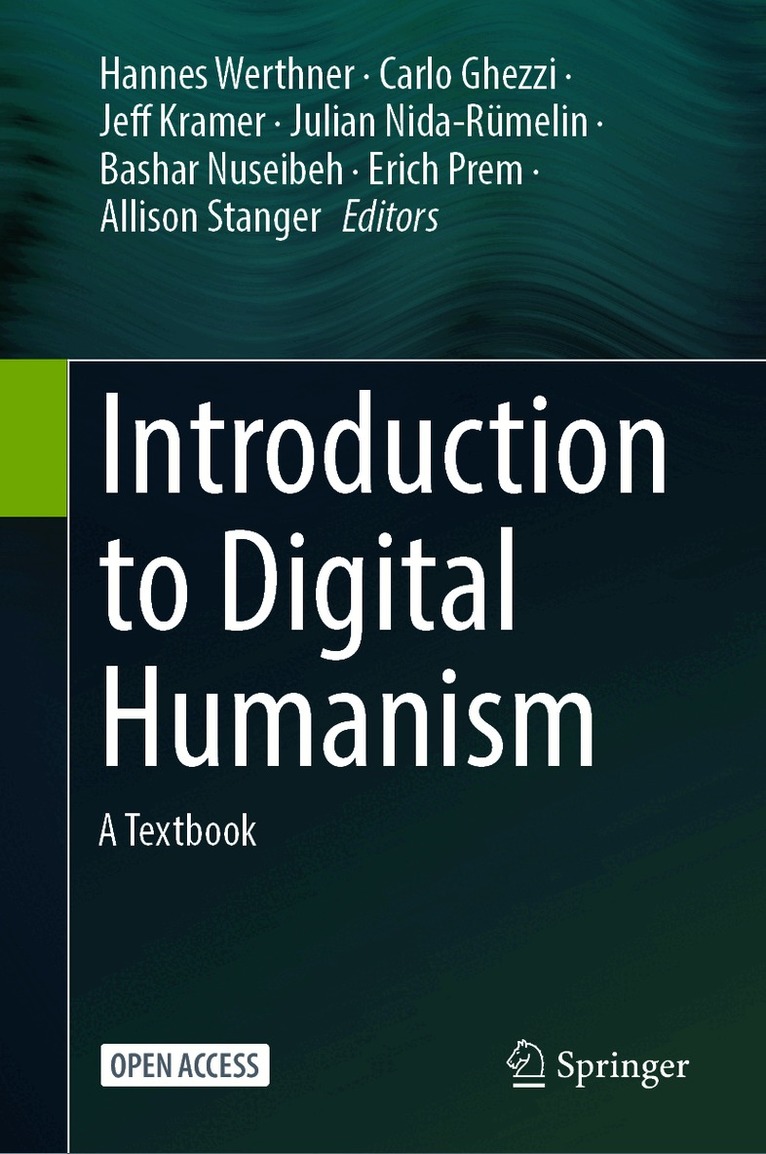
This open access textbook introduces and defines digital humanism from a diverse range of disciplines. Following the 2019 Vienna Manifesto, the book calls for a digital humanism that describes, analyzes, and, most importantly, influences the complex interplay of technology and humankind, for a better society and life, fully respecting universal human rights.The book is organized in three parts: Part I “Background” provides the multidisciplinary background needed to understand digital humanism in its philosophical, cultural, technological, historical, social, and economic dimensions. The goal is to present the necessary knowledge upon which an effective interdisciplinary discourse on digital humanism can be founded. Part II “Digital Humanism – a System’s View” focuses on an in-depth presentation and discussion of the main digital humanism concerns arising in current digital systems. The goal of this part is to make readers aware and sensitive to these issues, including e.g. thecontrol and autonomy of AI systems, privacy and security, and the role of governance. Part III “Critical and Societal Issues of Digital Systems” delves into critical societal issues raised by advances of digital technologies. While the public debate in the past has often focused on them separately, especially when they became visible through sensational events the aim here is to shed light on the entire landscape and show their interconnected relationships. This includes issues such as AI and ethics, fairness and bias, privacy and surveillance, platform power and democracy.This textbook is intended for students, teachers, and policy makers interested in digital humanism. It is designed for stand-alone and for complementary courses in computer science, or curricula in science, engineering, humanities and social sciences. Each chapter includes questions for students and an annotated reading list to dive deeper into the associated chapter material. The book aims to provide readers with as wide an exposure as possible to digital advances and their consequences for humanity. It includes constructive ideas and approaches that seek to ensure that our collective digital future is determined through human agency.
430 kr
Skickas inom 10-15 vardagar
This open access textbook introduces and defines digital humanism from a diverse range of disciplines. Following the 2019 Vienna Manifesto, the book calls for a digital humanism that describes, analyzes, and, most importantly, influences the complex interplay of technology and humankind, for a better society and life, fully respecting universal human rights.The book is organized in three parts: Part I “Background” provides the multidisciplinary background needed to understand digital humanism in its philosophical, cultural, technological, historical, social, and economic dimensions. The goal is to present the necessary knowledge upon which an effective interdisciplinary discourse on digital humanism can be founded. Part II “Digital Humanism – a System’s View” focuses on an in-depth presentation and discussion of the main digital humanism concerns arising in current digital systems. The goal of this part is to make readers aware and sensitive to these issues, including e.g. thecontrol and autonomy of AI systems, privacy and security, and the role of governance. Part III “Critical and Societal Issues of Digital Systems” delves into critical societal issues raised by advances of digital technologies. While the public debate in the past has often focused on them separately, especially when they became visible through sensational events the aim here is to shed light on the entire landscape and show their interconnected relationships. This includes issues such as AI and ethics, fairness and bias, privacy and surveillance, platform power and democracy.This textbook is intended for students, teachers, and policy makers interested in digital humanism. It is designed for stand-alone and for complementary courses in computer science, or curricula in science, engineering, humanities and social sciences. Each chapter includes questions for students and an annotated reading list to dive deeper into the associated chapter material. The book aims to provide readers with as wide an exposure as possible to digital advances and their consequences for humanity. It includes constructive ideas and approaches that seek to ensure that our collective digital future is determined through human agency.
1 096 kr
Skickas inom 10-15 vardagar
This book discusses the problems and challenges in the interdisciplinary research field of self-adaptive software systems. Modern society is increasingly filled with software-intensive systems, which are required to operate in more and more dynamic and uncertain environments. These systems must monitor and control their environment while adapting to meet the requirements at runtime. This book provides promising approaches and research methods in software engineering, system engineering, and related fields to address the challenges in engineering the next-generation adaptive software systems.The contents of the book range from design and engineering principles (Chap. 1) to control–theoretic solutions (Chap. 2) and bidirectional transformations (Chap. 3), which can be seen as promising ways to implement the functional requirements of self-adaptive systems. Important quality requirements are also dealt with by these approaches: parallel adaptation for performance (Chap. 4),self-adaptive authorization infrastructure for security (Chap. 5), and self-adaptive risk assessment for self-protection (Chap. 6). Finally, Chap. 7 provides a concrete self-adaptive robotics operating system as a testbed for self-adaptive systems.The book grew out of a series of the Shonan Meetings on this ambitious topic held in 2012, 2013, and 2015. The authors were active participants in the meetings and have brought in interesting points of view. After several years of reflection, they now have been able to crystalize the ideas contained herein and collaboratively pave the way for solving some aspects of the research problems. As a result, the book stands as a milestone to initiate further progress in this promising interdisciplinary research field.