Basil, Kouvaritakis - Böcker
Visar alla böcker från författaren Basil, Kouvaritakis. Handla med fri frakt och snabb leverans.
3 produkter
3 produkter
1 626 kr
Skickas inom 5-8 vardagar
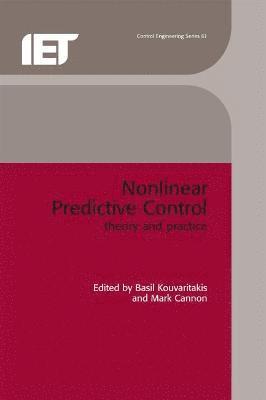
Model-based predictive control (MPC) has proved to be a fertile area of research. It has gained enormous success within industry, especially in the context of process control. Nonlinear model-based predictive control (NMPC) is of particular interest as this best represents the dynamics of most real plant. This book collects together the important results which have emerged in this field, illustrating examples by means of simulations on industrial models. In particular there are contributions on feedback linearisation, differential flatness, control Lyapunov functions, output feedback, and neural networks. The international contributors to the book are all respected leaders within the field, which makes for essential reading for advanced students, researchers and industrialists in the field of control of complex systems.
853 kr
Skickas inom 10-15 vardagar
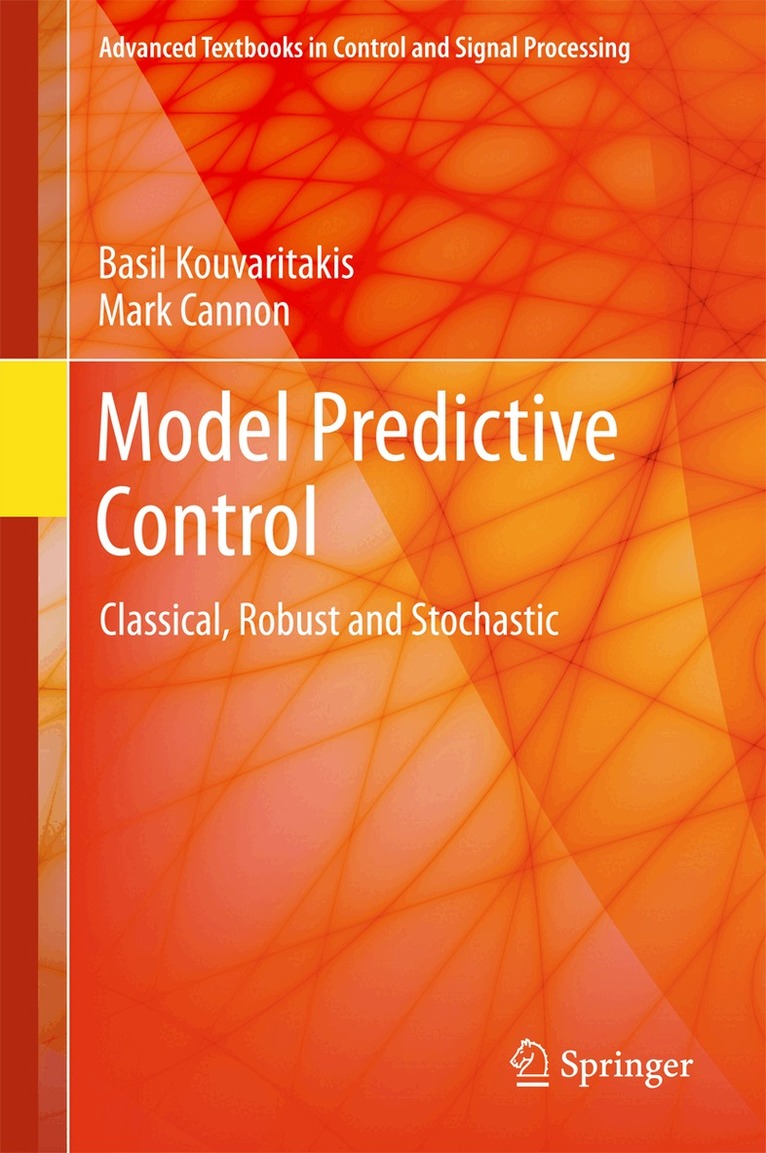
For the first time, a textbook that brings together classical predictive control with treatment of up-to-date robust and stochastic techniques.Model Predictive Control describes the development of tractable algorithms for uncertain, stochastic, constrained systems. The starting point is classical predictive control and the appropriate formulation of performance objectives and constraints to provide guarantees of closed-loop stability and performance. Moving on to robust predictive control, the text explains how similar guarantees may be obtained for cases in which the model describing the system dynamics is subject to additive disturbances and parametric uncertainties. Open- and closed-loop optimization are considered and the state of the art in computationally tractable methods based on uncertainty tubes presented for systems with additive model uncertainty. Finally, the tube framework is also applied to model predictive control problems involving hard or probabilistic constraints for the cases of multiplicative and stochastic model uncertainty. The book provides: extensive use of illustrative examples;sample problems; anddiscussion of novel control applications such as resource allocation for sustainable development and turbine-blade control for maximized power capture with simultaneously reduced risk of turbulence-induced damage.Graduate students pursuing courses in model predictive control or more generally in advanced or process control and senior undergraduates in need of a specialized treatment will find Model Predictive Control an invaluable guide to the state of the art in this important subject. For the instructor it provides an authoritative resource for the construction of courses.
800 kr
Skickas inom 10-15 vardagar
For the first time, a textbook that brings together classical predictive control with treatment of up-to-date robust and stochastic techniques.Model Predictive Control describes the development of tractable algorithms for uncertain, stochastic, constrained systems. The starting point is classical predictive control and the appropriate formulation of performance objectives and constraints to provide guarantees of closed-loop stability and performance. Moving on to robust predictive control, the text explains how similar guarantees may be obtained for cases in which the model describing the system dynamics is subject to additive disturbances and parametric uncertainties. Open- and closed-loop optimization are considered and the state of the art in computationally tractable methods based on uncertainty tubes presented for systems with additive model uncertainty. Finally, the tube framework is also applied to model predictive control problems involving hard or probabilistic constraints for the cases of multiplicative and stochastic model uncertainty. The book provides: extensive use of illustrative examples;sample problems; anddiscussion of novel control applications such as resource allocation for sustainable development and turbine-blade control for maximized power capture with simultaneously reduced risk of turbulence-induced damage.Graduate students pursuing courses in model predictive control or more generally in advanced or process control and senior undergraduates in need of a specialized treatment will find Model Predictive Control an invaluable guide to the state of the art in this important subject. For the instructor it provides an authoritative resource for the construction of courses.