Beatrice Meini – författare
Visar alla böcker från författaren Beatrice Meini. Handla med fri frakt och snabb leverans.
3 produkter
3 produkter
E-bok
PDF, Engelska, 20051 043 kr
Läs direkt efter köp
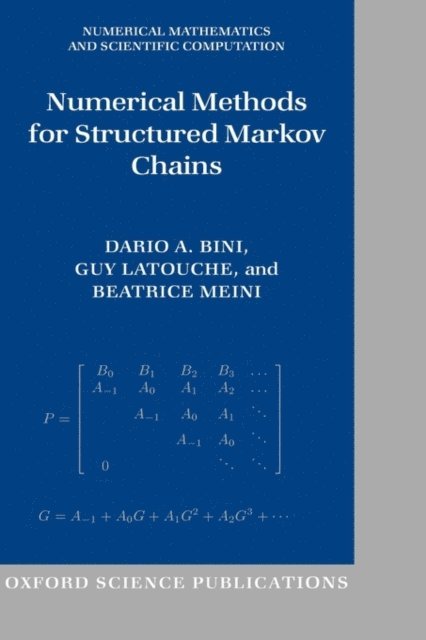
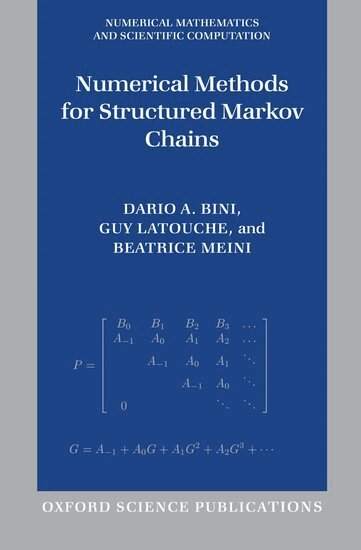
Intersecting two large research areas - numerical analysis and applied probability/queuing theory - this book is a self-contained introduction to the numerical solution of structured Markov chains, which have a wide applicability in queuing theory and stochastic modeling and include M/G/1 and GI/M/1-type Markov chain, quasi-birth-death processes, non-skip free queues and tree-like stochastic processes. Written for applied probabilists and numerical analysts, butaccessible to engineers and scientists working on telecommunications and evaluation of computer systems performances, it provides a systematic treatment of the theory and algorithms for important families of structured Markov chains and a thorough overview of the current literature.The book, consisting of nine Chapters, is presented in three parts. Part 1 covers a basic description of the fundamental concepts related to Markov chains, a systematic treatment of the structure matrix tools, including finite Toeplitz matrices, displacement operators, FFT, and the infinite block Toeplitz matrices, their relationship with matrix power series and the fundamental problems of solving matrix equations and computing canonical factorizations. Part 2 deals with the description andanalysis of structure Markov chains and includes M/G/1, quasi-birth-death processes, non-skip-free queues and tree-like processes. Part 3 covers solution algorithms where new convergence and applicability results are proved. Each chapter ends with bibliographic notes for further reading, and the bookends with an appendix collecting the main general concepts and results used in the book, a list of the main annotations and algorithms used in the book, and an extensive index.
Inbunden, Engelska, 2005
1 612 kr
Skickas inom 5-8 vardagar
Intersecting two large research areas - numerical analysis and applied probability/queuing theory - this book is a self-contained introduction to the numerical solution of structured Markov chains, which have a wide applicability in queuing theory and stochastic modeling and include M/G/1 and GI/M/1-type Markov chain, quasi-birth-death processes, non-skip free queues and tree-like stochastic processes. Written for applied probabilists and numerical analysts, but accessible to engineers and scientists working on telecommunications and evaluation of computer systems performances, it provides a systematic treatment of the theory and algorithms for important families of structured Markov chains and a thorough overview of the current literature. The book, consisting of nine Chapters, is presented in three parts. Part 1 covers a basic description of the fundamental concepts related to Markov chains, a systematic treatment of the structure matrix tools, including finite Toeplitz matrices, displacement operators, FFT, and the infinite block Toeplitz matrices, their relationship with matrix power series and the fundamental problems of solving matrix equations and computing canonical factorizations. Part 2 deals with the description and analysis of structure Markov chains and includes M/G/1, quasi-birth-death processes, non-skip-free queues and tree-like processes. Part 3 covers solution algorithms where new convergence and applicability results are proved. Each chapter ends with bibliographic notes for further reading, and the book ends with an appendix collecting the main general concepts and results used in the book, a list of the main annotations and algorithms used in the book, and an extensive index.
Häftad, Engelska, 2012
946 kr
Skickas inom 5-8 vardagar
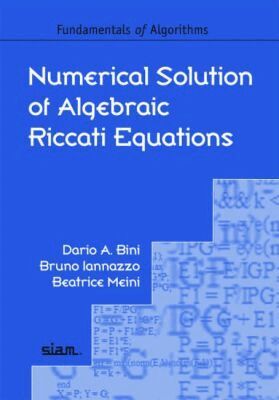
This concise and comprehensive treatment of the basic theory of algebraic Riccati equations describes the classical as well as the more advanced algorithms for their solution in a manner that is accessible to both practitioners and scholars. It is the first book in which nonsymmetric algebraic Riccati equations are treated in a clear and systematic way. Some proofs of theoretical results have been simplified and a unified notation has been adopted.Readers will find a discussion of doubling algorithms, which are effective in solving algebraic Riccati equations, and a detailed description of all classical and advanced algorithms for solving algebraic Riccati equations, along with their MATLAB® codes. This will help the reader gain understanding of the computational issues and provide ready-to-use implementation of the different solution techniques.