Bede The Venerable – författare
Visar alla böcker från författaren . Handla med fri frakt och snabb leverans.
8 produkter
8 produkter
Del 110 - Cistercian Studies Series
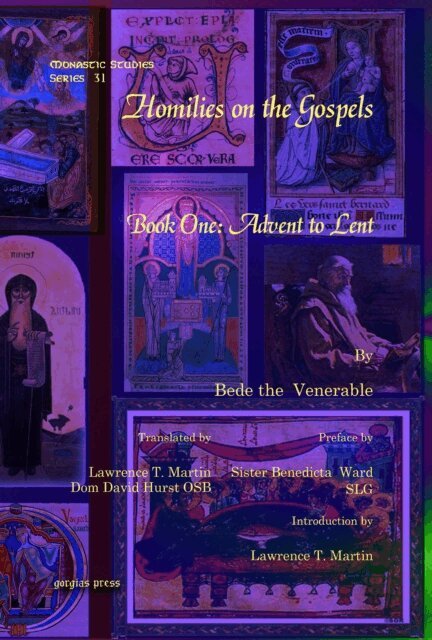
Homilies on the Gospels Book One - Advent to Lent
Häftad, Engelska, 1991
463 kr
Skickas inom 3-6 vardagar
'I have spent all my life in this monastery', wrote Bede from his isolated Northumbrian cell, 'applying myself entirely to the study of the Scriptures...I have made it my business, for my own benefit and that of my brothers, to make brief extracts from the works of the Venerable fathers on the holy Scripture, or to add notes of my own to clarify their sense and interpretation.'From the eighth to the fifteenth centuries, Bede's authority as a scriptural exegete was second only to that of the Doctors of the Latin Church. His influence was enormous. Yet modern readers associate this remarkable scholar-monk only with his History of the English Church and Nation and ignore the works he saw as his chief accomplishment.
Del 111 - Cistercian Studies Series
Homilies on the Gospels Book Two - Lent to the Dedication of the Church
Häftad, Engelska, 1991
463 kr
Skickas inom 3-6 vardagar
'I have spent all my life in this monastery', wrote Bede from his isolated Northumbrian cell, 'applying myself entirely to the study of the Scriptures...I have made it my business, for my own benefit and that of my brothers, to make brief extracts from the works of the Venerable fathers on the holy Scripture, or to add notes of my own to clarify their sense and interpretation.'From the eighth to the fifteenth centuries, Bede's authority as a scriptural exegete was second only to that of the Doctors of the Latin Church. His influence was enormous. Yet modern readers associate this remarkable scholar-monk only with his History of the English Church and Nation and ignore the works he saw as his chief accomplishment.
Del 117 - Cistercian Studies Series
Commentary on the Acts of the Apostles
Häftad, Engelska, 1989
415 kr
Skickas inom 3-6 vardagar
In his monastery in a remote corner of Europe, the grandson of Anglo-Saxon pagans quietly spent his life studying and writing, passing the wisdom of christian antiquity on to generations of latin readers. And in the process, this most learned and the least proud of men came to be acknowledged as a Doctor of the Church.Bede's commentary on the Book of Acts is one of his earliest exegetical works (usually dated between 709 and 710) and one of his most popular and influential. None of the Latin Fathers of the Church had written a commentary on this book, and those which existed in Greek were unlikely to have been known in the West. Bede became the authority on Acts for countless subsequent students of Scripture.The breadth of Bede's mind, the diversity of his interests, and the thoroughness of his research are all mirrored in this work. Allegory is freely interspersed with practical commentary, textual analysis with mystical interpretation. Far from being a quaint relic of outdated exegesis, the commentary can be of practical use to modern Christians who read it in the spirit in which it was written: meditation on the workings of God.
Del 82 - Cistercian Studies Series
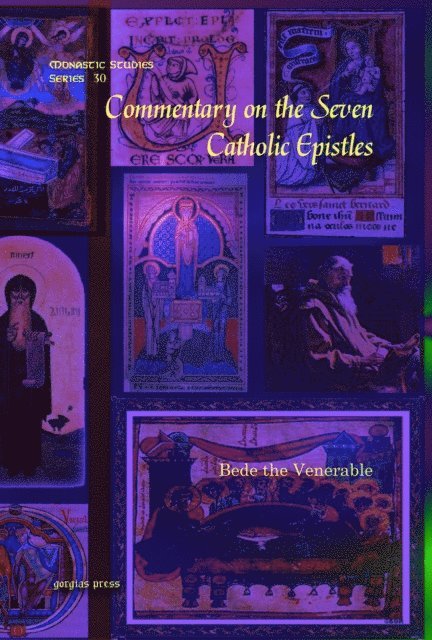
Commentary on the Seven Catholic Epistles
Häftad, Engelska, 1985
367 kr
Skickas inom 3-6 vardagar
Best known in the Middle Ages as a scriptural exegete, Bede here provides a running gloss on the Letters of James, Peter, John, and Jude. Why he chose these `lesser letters' for his first attempt at written exegesis no one knows; perhaps he did so because so few other scriptural commentators had glossed them. They are unique in that he inclined more to the literal interpretation of the text than he did in his more allegorical later commentaries. Preachers will find them useful; readers will find them illuminating.In about 679, Bede, a boy of seven, was presented by his family as an oblate to the monastery of Wearmouth, Northumbria. He spent the rest of his life as a monk, first at Wearmouth, and later at Jarrow, five miles away. Using the monastic library he became ‘the most learned man in Western Europe’, and one of the most influential on future generations. He read, and wrote, in a wide variety of fields–natural science, mathematics, and astronomy, grammar, rhetoric, geography, history, hagiography, theology, and above all interpretations of Holy Scripture. Bede combined his great learning with sanctity and a personal charm which still shines through his writings. ‘I have spent all my life in this monastery’, he wrote, ‘applying myself entirely to the study of the Scriptures; and amid the observances of the discipline of the Rule - [of St benedict] and the daily task of chanting in the church, it has always been my delight to learn or to teach or to write’. (A History of the English Church and People). His command of the Fathers of the Church and profane knowledge belie the name commonly given his age; despite invasions, privations, and limitations, Bede demonstrates that one corner of the European north was far from dark.
E-bok
PDF, Engelska, 20191 939 kr
Läs direkt efter köp
Best known in the Middle Ages as a scriptural exegete, Bede here provides a running gloss on the Letters of James, Peter, John, and Jude. Why he chose these `lesser letters' for his first attempt at written exegesis no one knows; perhaps he did so because so few other scriptural commentators had glossed them. They are unique in that he inclined more to the literal interpretation of the text than he did in his more allegorical later commentaries. Preachers will find them useful; readers will find them illuminating.
E-bok
PDF, Engelska, 20191 682 kr
Läs direkt efter köp
From the eighth to the fifteenth centuries, Bede's authority as a scriptural exegete was second only to that of the Doctors of the Latin Church. Yet modern readers associate this remarkable scholar-monk only with his History of the English Church and Nation and ignore the works he saw as his chief accomplishment.
E-bok
Engelska, 2025674 kr
Läs direkt efter köp
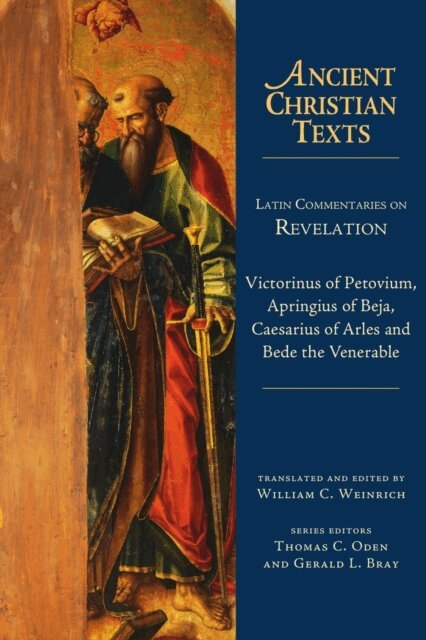
Interest in the book of Revelation in the Western tradition is stronger and earlier than that in the East. The earliest full commentary on the Apocalypse is that of Victorinus of Petovium written in the mid to late third century by the earliest exegete to write in Latin. Victorinus interpreted Revelation in millennialist terms, a mode of interpretation already evident in works by Irenaeus, as well as in modest allegorical terms. Caesarius of Arles wrote in the early sixth century and offered a thoroughgoing allegorical-ecclesial interpretation of the Apocalypse. Apringius of Beja in Portugal, writing in the mid sixth century, drew on Jerome's edition of Victorinus's commentary yet understood the seven seals christologically as theincarnation, birth, passion, death, resurrection, glory and kingdom. Bede the Venerable, who died in 735, is the last commentator to be included in this collection. Characteristically, he passes on commentary from earlier exegetes, here including that of Augustine, Gregory the Great, Victorinus, Tyconius and Primasius. William Weinrich renders a particular service to readers interested in ancient commentary on the Apocalypse by drawing together these significant Latin commentaries. The work of translating these texts was begun in preparing the volume on Revelation in the Ancient Christian Commentary on Scripture. We are indebted to William Weinrich for completing this work with his able and fresh translation and notes on these texts. Ancient Christian Texts are new English translations of full-length commentaries or sermon series from ancient Christian authors that allow you to study key writings of the early church fathers in a fresh way.
E-bok
Engelska, 2025674 kr
Läs direkt efter köp
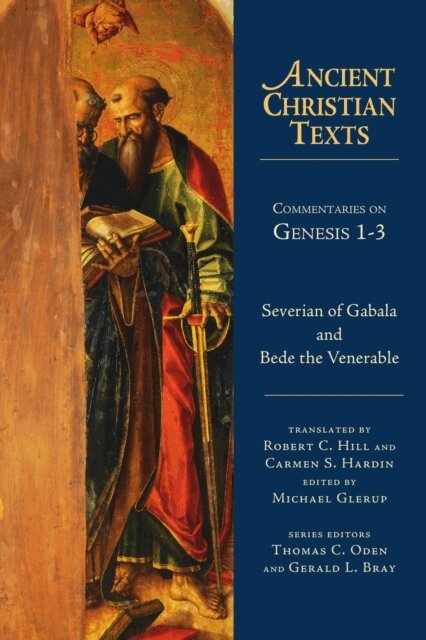
The church fathers displayed considerable interest in the early chapters of Genesis, and often wrote detailed commentaries or preached series of homilies on the Hexameron--the Six Days of Creation--among them Eustathius of Antioch, Basil the Great, Gregory of Nyssa, Theodore of Mopsuestia, Ambrose, John Chrysostom and Augustine. This volume of Ancient Christian Texts offers a first-time English translation of Severian of Gabala's In cosmogoniam and a fresh translation of a portion of Bede the Venerable's Libri quatuor in principium Genesis. Severian, bishop of Gabala in Syria, who early on was a friend of John Chrysostom, later turned against him and opposed him at the Synod of Oak in 403. Though displaying his own strengths, weaknesses and idiosyncrasies, Severian still represents the so-called Antiochene school with its preference for literal over allegorical interpretation of texts. The text derives from the six homilies found in Migne?s Patrologia graeca,volume 56, together with a seventh homily found only in the 1613 Eton edition of John Chrysostom?s works, edited by Henry Savile, and falsely attributed to Chrysostom. These homilies have been ably translated with explanatory notes by Robert C. Hill. The commentary from Bede the Venerable derives from Book I of his four-book commentary on Genesis from the account of creation to the casting out of Ishmael. Bede was a polymath--teacher, computist, exegete, historian--and one of the foremost scholars from Anglo-Saxon England. As a teacher, Bede strove to hand on the tradition of the church in a form easily understood by those who might not be well educated. These early chapters in Genesis provided teaching on creation, human origins, sin and redemption. The text deriving from Corpus Christianorum Latina is ably translated with explanatory notes by Carmen Hardin. Ancient Christian Texts are new English translations of full-length commentaries or sermon series from ancient Christian authors that allow you to study key writings of the early church fathers in a fresh way.