Beeching Kate Beeching – författare
Visar alla böcker från författaren . Handla med fri frakt och snabb leverans.
2 produkter
2 produkter
E-bok
Engelska, 20181 353 kr
Läs direkt efter köp
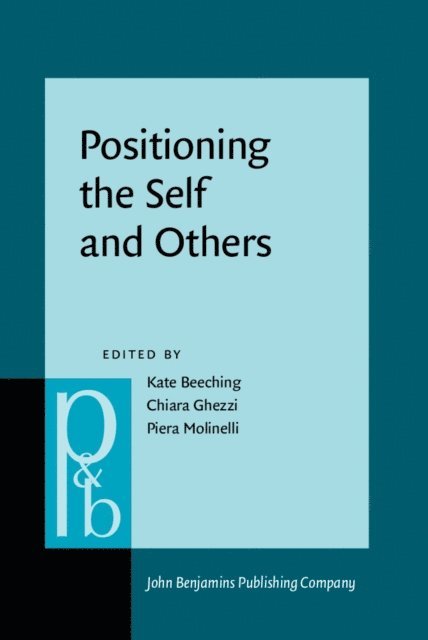
Though positioning has been addressed in social psychology and in identity construction, less attention has been paid to the specific linguistic markers which are drawn upon in discourse to position the self and other(s). This volume focusses on address terms, pragmatic markers, code switching/choice and orthography, the indexicalities of which are explored in different communicative activities. The volume is unusual in: i) the range of languages which are covered: Bergamasco, Brazilian Portuguese, English, Finnish, French, Georgian, Greek, Italian, Latin, Russian, Spanish and Swedish; ii) the inclusion of different communicative settings and text-types: workplace emails, everyday and institutional conversations, interviews, migrant narratives, radio phone-ins, dyadic and group settings, road-signs, service encounters; iii) its consideration of both synchronic and diachronic factors; iv) its mix of theoretical and methodological approaches.The volume illustrates some of the linguistic means speakers draw on to position themselves and others and hopes to stimulate further research studies in this vein.
E-bok
PDF, Engelska, 20021 447 kr
Läs direkt efter köp
This study aims to investigate politeness in women’s and men’s speech, with a particular focus on the use of c’est-à-dire, enfin, hein and quoi in contemporary spoken French. Politeness is defined as going beyond the notion of the face-threatening act, englobing both everyday ideas of politeness and the creation of sociability in face-to-face interaction.The pragmatic particles studied are demonstrated to serve both psycholinguistic and sociolinguistic purposes: they lubricate reformulation and contribute to both sociability and social indexation.The study, which combines qualitative and quantitative analysis, is based on a corpus of spontaneous spoken French, comprising 155,000 words, 95 interviews and subjects ranging in age from 7 to 88 years. The sample contains speakers from a broader range of educational backgrounds than is often the case: a butcher, a video-salesman and a toiletteur canin rub shoulders with counter assistants, teachers and doctors.