Bela H. Banathy - Böcker
Visar alla böcker från författaren Bela H. Banathy. Handla med fri frakt och snabb leverans.
9 produkter
9 produkter
2 320 kr
Skickas inom 10-15 vardagar
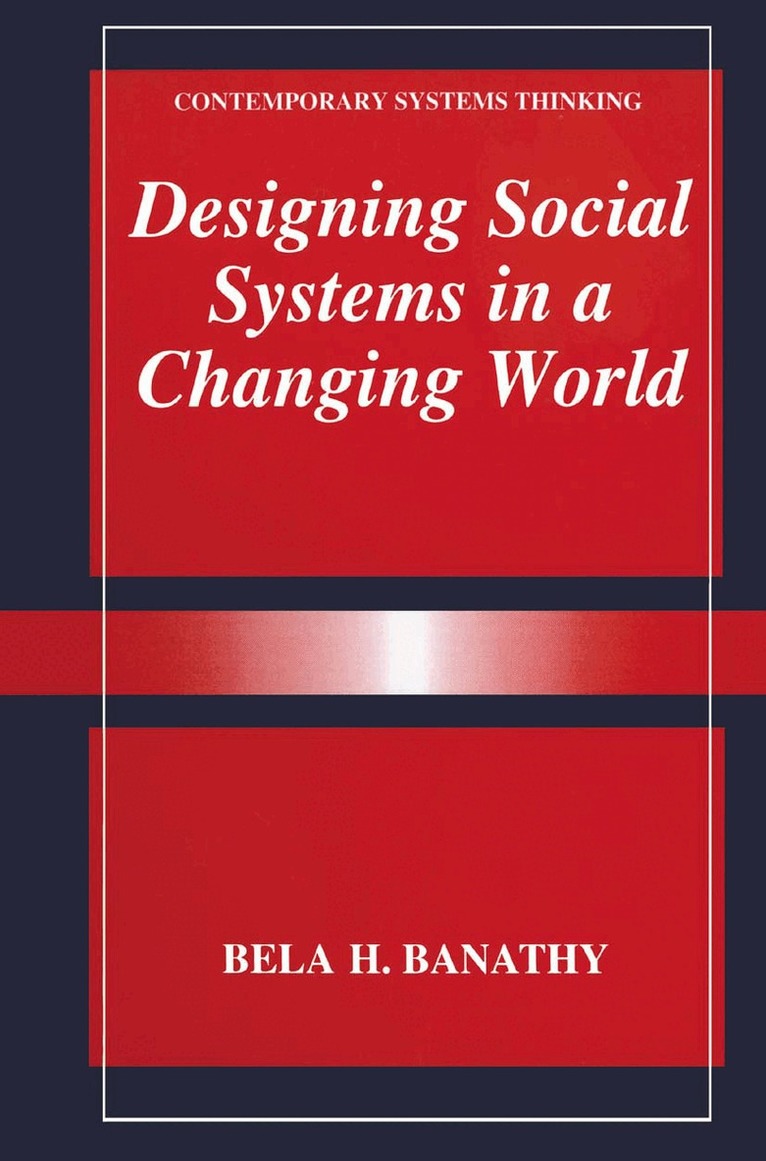
In this original text/reference, Bela H. Banathy discusses a broad range of design approaches, models, methods, and tools, together with the theoretical and philosophical bases of social systems design. he explores the existing knowledge bases of systems design; introduces and integrates concepts from other fields that contribute to design thinking and practice; and thoroughly explains how competence in social systems design empowers people to direct their progress and create a truly participative democracy. Based on advanced learning theory and practice, the text's material is enhanced by helpful diagrams that illustrate novel concepts and problem sets that allow readers to apply these concepts.
1 584 kr
Skickas inom 10-15 vardagar
Based on a comprehensive review of human and societal evolution, this work develops an approach to conscious, self-guided evolution. In the course of the evolutionary journey of our species, there have been three seminal events. The first happened some seven million yeas ago, when our humanoid ancestors entered on the evolutionary scene. Their journey toward the second crucial event lasted over six million years when - as the greatest event of our evolutionary history - homo sapiens sapiens, started the revolutionary process of cultural evolution. Today, we have arrived at the threshold of the third major event, "the revolution of conscious evolution," when it becomes our responsibility to enter into the evolutionary design space and guide the evolutionary journey of our species. The book tells the story of the first six million years of the journey in just enough detail to understand how evolution had worked in times when it was primarily biological, driven by natural selection. With the human revolution some 50 thousand years ago, with the emergence of self-reflective consciousness, the evolutionary process transformed from biological into cultural.From this point on, the book follows the journey with detailed attention, in order to learn how cultural evolution works. It is organized in three parts. Part one commences with an exposition of a brief history of the evolutionary idea through time with a focus on a review of the science of general evolution and specifically social and societal evolution. Next, the book unfolds the "evolutionary story" of our species from the time when the first humanoids entered the evolutionary scene to our current era. Part two develops a systems view of evolution, explores the ways and means of how evolution works, characterizes evolutionary consciousness and develops the idea of conscious evolution. Part three builds upon the knowledge developed in the first two parts and sets forth the key conditions of conscious, self-guided evolution, elaborating the core condition, which is the acquisition of evolutionary competence through evolutionary learning. The focus of this part is on an approach to the design of evolutionary guidance systems that our families, neighborhoods, communities, organizations, social and societal systems can use to design the future they aspire to attain.The work provides: (1) a comprehensive review of how evolution has worked with a focus on socio-cultural evolution, (2) an explanation of evolutionary consciousness and the conditions of engaging in conscious evolution, and (3) most significantly, it develops a detailed approach and a methodology to the design of evolutionary guidance systems.
1 039 kr
Skickas inom 10-15 vardagar
Dialogue as a Means of Collective Communication offers a cross-disciplinary approach to examining dialogue as a communicative medium. Presented in five parts, the book takes the reader on a journey of exploring the power and potential of dialogue as a means for communication. In particular, this volume comes at a time when the global society's attention has been directed to creating more productive conversations in the name of world peace and harmony. It provides a unique new work on dialogue that brings the reader into a "dialogue with dialogue", offering an opportunity to understand the communicative potential of dialogue. In the book, readers are introduced to five sections: Section I examines the historical and cultural perspectives of conversation. This examination helps to create a foundation for a deeper study of the emergent and salient aspects of conversation as it relates to cultural creativity and human systems design. Sections II offers the reader an examination of dialogue through different philosophical and theoretical perspectives as well as methodological ideas related to conversation.Section III explores different modalities of conversation and the application of design conversation within and across various types of design settings and human experiences. Section IV examines the field of practice as related to use of different forms of conversation. Here various authors will share their different approaches to conversation and their reflections and insights in using conversation in a variety of settings. Concluding the book, Section V reflectively examines the authors' contributions to the book and provides the reader with a focus on the future.
1 101 kr
Skickas inom 10-15 vardagar
Dialogue as a Collective Means of Design Conversation is the second volume edited by Patrick M. Jenlink and Bela H. Banathy to offer a cross-disciplinary approach to examining dialogue as a communicative medium. In this Compendium, the contributing authors set forth their ideas, experiences, and perspectives as the path of a learning journey—a journey of new meaning, of new understanding, and of becoming self-aware of design conversation as future creating and consciousness evolving. In particular, this volume comes at a time when we as a global society are faced with the question of how we shape our actions and in turn shape our future, through conversation that is focused on resolving global conflict and fostering world peace. The volume evokes in the reader a realization that our greatest potential rests, in no small measure, with our collective capacity for cultural creativity and in our capacity to achieve new levels of consciousness through dialogue and design conversation.
1 584 kr
Skickas inom 10-15 vardagar
Based on a comprehensive review of human and societal evolution the book develops an approach to conscious, self-guided evolution. In the course of the evolutionary journey of our species, there have been three seminal events. The first happened some seven million yeas ago, when our humanoid ancestors entered on the evolutionary scene. Their journey toward the second crucial event lasted over six million years when - as the greatest event of our evolutionary history - homo sapiens sapiens, started the revolutionary process of cultural evolution. Today, we have arrived at the threshold of the third major event, 'the revolution of conscious evolution,' when it becomes our responsibility to enter into the evolutionary design space and guide the evolutionary journey of our species. The book tells the story of the first six million years of the journey in just enough detail to understand how evolution had worked in times when it was primarily biological, driven by natural selection. With the human revolution some fifty thousand years ago, with the emergence of self-reflective consciousness, the evolutionary process transformed from biological into cultural.From this point on, the book follows the journey with detailed attention, in order to learn how cultural evolution works. The book is organized in three parts. Part One commences with an exposition of a brief history of the evolutionary idea through time with a focus on a review of the science of general evolution and specifically social and societal evolution. Next, the book unfolds the 'evolutionary story' of our species from the time when the first humanoids entered the evolutionary scene to our current era. Part Two develops a systems view of evolution, explores the ways and means of how evolution works, characterizes evolutionary consciousness and develops the idea of conscious evolution. Part Three builds upon the knowledge developed in the first two parts and sets forth the key conditions of conscious, self-guided evolution, elaborating the core condition, which is the acquisition of evolutionary competence through evolutionary learning.The focus of this part is on an approach to the design of evolutionary guidance systems that our families, neighborhoods, communities, organizations, social and societal systems can use to design the future they aspire to attain. The work is set aside from other statements in three important ways. It provides: (1) a comprehensive review of how evolution has worked with a focus on socio-cultural evolution, (2) an explanation of evolutionary consciousness and the conditions of engaging in conscious evolution, and (3) most significantly, it develops a detailed approach and a methodology to the design of evolutionary guidance systems.
1 479 kr
Skickas inom 10-15 vardagar
Dialogue as a Collective Means of Design Conversation is the second volume edited by Patrick M. Jenlink and Bela H. Banathy to offer a cross-disciplinary approach to examining dialogue as a communicative medium. In this Compendium, the contributing authors set forth their ideas, experiences, and perspectives as the path of a learning journey—a journey of new meaning, of new understanding, and of becoming self-aware of design conversation as future creating and consciousness evolving. In particular, this volume comes at a time when we as a global society are faced with the question of how we shape our actions and in turn shape our future, through conversation that is focused on resolving global conflict and fostering world peace. The volume evokes in the reader a realization that our greatest potential rests, in no small measure, with our collective capacity for cultural creativity and in our capacity to achieve new levels of consciousness through dialogue and design conversation.
2 390 kr
Skickas inom 10-15 vardagar
In this original text/reference, Bela H. Banathy discusses a broad range of design approaches, models, methods, and tools, together with the theoretical and philosophical bases of social systems design. he explores the existing knowledge bases of systems design; introduces and integrates concepts from other fields that contribute to design thinking and practice; and thoroughly explains how competence in social systems design empowers people to direct their progress and create a truly participative democracy. Based on advanced learning theory and practice, the text's material is enhanced by helpful diagrams that illustrate novel concepts and problem sets that allow readers to apply these concepts.
2 051 kr
Skickas inom 10-15 vardagar
Educational technology in the broadest sense is knowledgeand competence forimproving the educational process: forusing hardware (equipment), software (methods), and"underware" (underlying organizational structures). This volume in the Special Programme on Advanced EducationalTechnology presents the results of a NATO Advanced ResearchWorkshop on educational systems design as a new educationaltechnology. The objective of the workshop was toadvance ourknowledge about the comprehensive systems design approachfor improving educational systems. The workshop wasorganized for the transdisciplinary interaction of threescientific groups representing design science,organizational/systems science, and educationaltechnology. Participants were selected based on their scholarship asmembers of one or more of these three groups. The book opens with theframing papers sent by the editorsto participants prior to the workshop, then presents fivesets of thematic contributions: the conceptual and empiricalcontexts of comprehensive systems design, the systems designfocus, a systems view of designing educational systems, theeducational context of systems design, and high technologyfocus in systems design.
2 051 kr
Skickas inom 10-15 vardagar
Educational technology in the broadest sense is knowledgeand competence forimproving the educational process: forusing hardware (equipment), software (methods), and"underware" (underlying organizational structures).This volume in the Special Programme on Advanced EducationalTechnology presents the results of a NATO Advanced ResearchWorkshop on educational systems design as a new educationaltechnology. The objective of the workshop was toadvance ourknowledge about the comprehensive systems design approachfor improving educational systems. The workshop wasorganized for the transdisciplinary interaction of threescientific groups representing design science,organizational/systems science, and educationaltechnology.Participants were selected based on their scholarship asmembers of one or more of these three groups.The book opens with theframing papers sent by the editorsto participants prior to the workshop, then presents fivesets of thematic contributions: the conceptual and empiricalcontexts of comprehensive systems design, the systems designfocus, a systems view of designing educational systems, theeducational context of systems design, and high technologyfocus in systems design.