
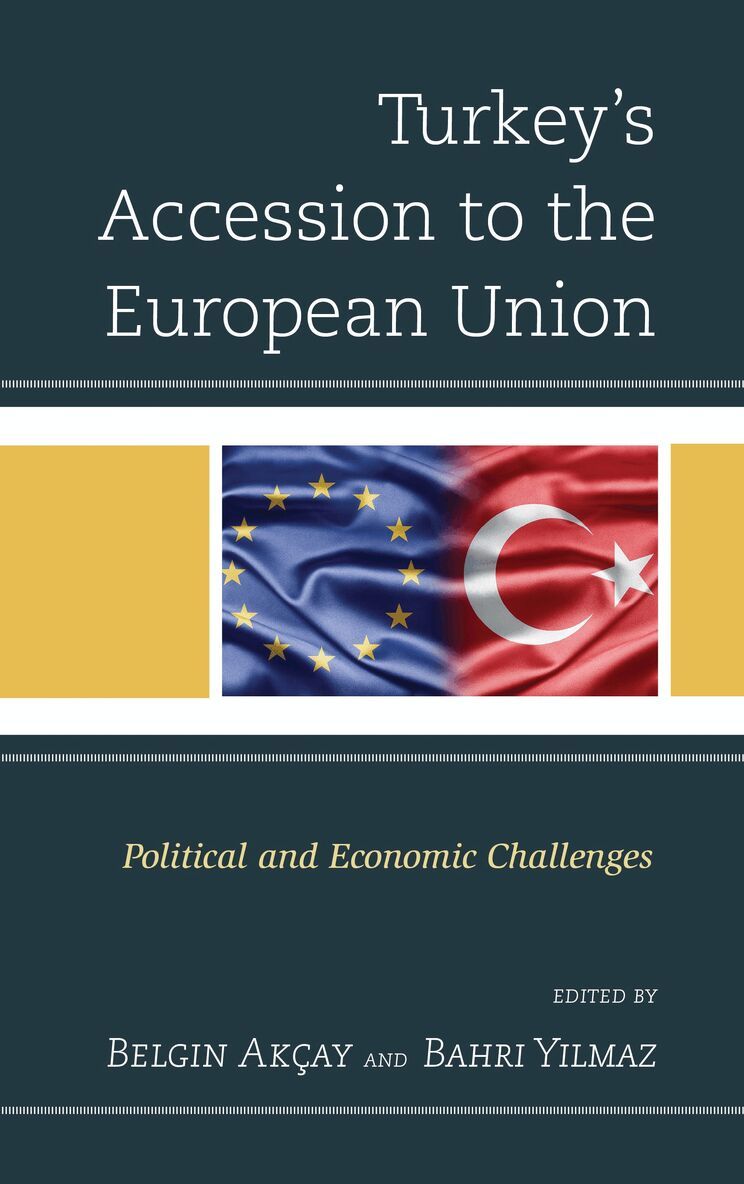
Although Turkey has a long-held aspiration for European Union membership and has been a candidate for more than a decade, relations between the EU and Turkey have not received the attention it deserves from non-Turkish researchers thus far, and consequently the international literature on EU-Turkey relations is rather limited. In light of recent global economic and political challenges for the EU and Turkey, a need has emerged for an interdisciplinary approach to study EU-Turkey relations within the wider international political and economic context.Turkey’s Accession to the European Union: Political and Economic Challenges, edited by Belgin Akçay and Bahri Yilmaz, provides a timely overview of some of the most important issues and debates in the changing context of Europe, the change in domestic politics and foreign policy in Turkey, and the likely implications of these changes and developments for EU-Turkey relations. Within this framework, this collection includes articles emphasizing Turkey’s reform process with a view to EU accession, despite EU’s reservations about “absorbing” Turkey and the eventual decoupling of the Turkish reform process from European integration, as well as searching for alternative forms of cooperation or transitional arrangements which may be possible for Turkey at the time of accession.

Relations between Turkey and the European Union have a very long history. Officially, they began with the Ankara Agreement. Following the signature of this Agreement, the relationship has undergone many developments. Some authors compare this relation to a turbulent marriage; though it has its share of problems, it remains an ongoing one, and both parties have managed to stay together. The book is designed to include discussion of consumer protection law, competition law, the dispute settlement procedures, the principle of non-discrimination on grounds of nationality with regard to Turkish workers in the European Union and Union workers in Turkey, as well as an overview of Turkey-EU relations that consists of legal, political and economic assessments on Turkish accession to the European Union.This book aims to draw a framework regarding the Turkish Law and enable the readers to learn about Turkish Law. Though it could easily be stated that though there are certain points to be completed, most aspects of Turkish Law are in harmony with EU Law. Turkey has taken many important steps in the past 50 year history with the EU, and especially from the legal perspective, has fulfilled most of the important goals. Thus, readers will also have a vision of this development, and of Turkish Law as a whole, after reading this book.
Although Turkey has a long-held aspiration for European Union membership and has been a candidate for more than a decade, relations between the EU and Turkey have not received the attention it deserves from non-Turkish researchers thus far, and consequently the international literature on EU-Turkey relations is rather limited. In light of recent global economic and political challenges for the EU and Turkey, a need has emerged for an interdisciplinary approach to study EU-Turkey relations within the wider international political and economic context.Turkey’s Accession to the European Union: Political and Economic Challenges, edited by Belgin Akçay and Bahri Yilmaz, provides a timely overview of some of the most important issues and debates in the changing context of Europe, the change in domestic politics and foreign policy in Turkey, and the likely implications of these changes and developments for EU-Turkey relations. Within this framework, this collection includes articles emphasizing Turkey’s reform process with a view to EU accession, despite EU’s reservations about “absorbing” Turkey and the eventual decoupling of the Turkish reform process from European integration, as well as searching for alternative forms of cooperation or transitional arrangements which may be possible for Turkey at the time of accession.
Relations between Turkey and the European Union have a very long history. Officially, they began with the Ankara Agreement. Following the signature of this Agreement, the relationship has undergone many developments. Some authors compare this relation to a turbulent marriage; though it has its share of problems, it remains an ongoing one, and both parties have managed to stay together. The book is designed to include discussion of consumer protection law, competition law, the dispute settlement procedures, the principle of non-discrimination on grounds of nationality with regard to Turkish workers in the European Union and Union workers in Turkey, as well as an overview of Turkey-EU relations that consists of legal, political and economic assessments on Turkish accession to the European Union.This book aims to draw a framework regarding the Turkish Law and enable the readers to learn about Turkish Law. Though it could easily be stated that though there are certain points to be completed, most aspects of Turkish Law are in harmony with EU Law. Turkey has taken many important steps in the past 50 year history with the EU, and especially from the legal perspective, has fulfilled most of the important goals. Thus, readers will also have a vision of this development, and of Turkish Law as a whole, after reading this book.