Benjamin Arditi - Böcker
Visar alla böcker från författaren Benjamin Arditi. Handla med fri frakt och snabb leverans.
7 produkter
7 produkter
Politics on the Edges of Liberalism
Difference, Populism, Revolution, Agitation
Häftad, Engelska, 2008
385 kr
Skickas inom 7-10 vardagar
New in PaperbackThis innovative exploration of ways of thinking about and doing politics presents a challenge to liberal assumptions. The author tackles four key areas in contemporary politics which work at 'the edges of liberalism': difference, populism, revolution and agitation. Each of these phenomena is selected on the basis that they push the envelope of liberalism or seek to go against and beyond it.Each chapter takes on one of these ideas, discussing the intellectual background and considering its position in relation to liberalism. Difference is explored in the context of the politics of the culture wars and its celebration of particularism over universalism. Populism is seen as a spectre of liberal democracy, able to both accompany it and haunt it. Agitation is considered in tandem with emancipatory politics and in relation to revolutionary politics. The final chapter aims to vindicate the use of revolution for contemporary thought, challenging the existing liberal-democratic consensus. The argument is interspersed with many examples drawn from history and contemporary politics to illustrate the author's claims. Arditi's engagement with the main thinkers in the field leads him to develop a novel interpretation of contemporary politics.
1 409 kr
Skickas inom 5-8 vardagar
At the cutting edge of political theory, this first volume in the Taking on the Political Series reflects the conceptual foundations of the series, opening up space to the political by engaging in and redefining polemics. In recognition of the collapse of the traditional belief in strong foundations for the political domain and the ungrounding of politics generally, the authors introduce and map the concept of afoundationalism while tackling such themes as social structure, ethical argumentation and political organization. Provocative and engaging, this book will change ways of thinking about and approaching political theory both in teaching and research.
433 kr
Skickas inom 5-8 vardagar
At the cutting edge of political theory, this first volume in the Taking on the Political Series reflects the conceptual foundations of the series, opening up space to the political by engaging in and redefining polemics. In recognition of the collapse of the traditional belief in strong foundations for the political domain and the ungrounding of politics generally, the authors introduce and map the concept of afoundationalism while tackling such themes as social structure, ethical argumentation and political organization. Provocative and engaging, this book will change ways of thinking about and approaching political theory both in teaching and research.
552 kr
Skickas inom 10-15 vardagar
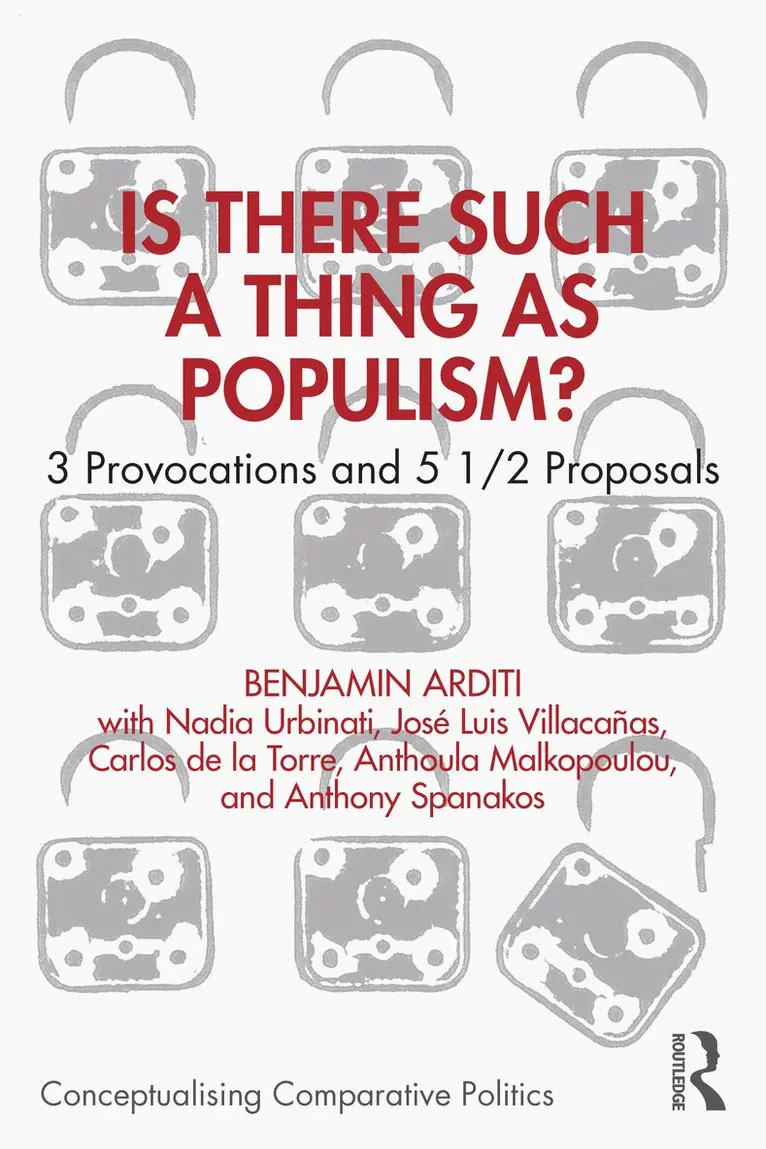
Is There Such a Thing as Populism? calls into question our common understanding of populism. Taken on their own, commonplace references to the people, leaders, or elites are more like dog whistles or false positives of populism than part of a serious attempt to address the phenomenon. Scholars asked themselves, “What is populism?” without realizing that this assumed there was such a thing and that we just needed to figure out what it meant. That was a mistake. Benjamin Arditi proposes that we put this certainty on hold and start from a different premise, asking, “Is there such a thing as populism?” This doesn’t rule out its existence or take it for granted.Structured as a set of polemical interventions and theoretical proposals, Arditi addresses key theoretical, methodological, and comparative questions in the study of populism. These include the limitations of formal definitions of populism, the importance of context and the conjuncture, polemics, the situated gaze, and issues concerning strategic relations and governing from below. Five subject experts, Nadia Urbinati, José Luis Villacañas, Carlos de la Torre, Anthoula Malkopoulou, and Anthony Spanakos, react to Arditi’s theses in captivating conversations on how to study populism and the way in which populism has been used in contemporary comparative analysis. Refreshingly different and thought-provoking, Is There Such a Thing as Populism? is the ideal departure for the exploration of this diverse and fascinating political movement.
1 900 kr
Skickas inom 10-15 vardagar
Is There Such a Thing as Populism? calls into question our common understanding of populism. Taken on their own, commonplace references to the people, leaders, or elites are more like dog whistles or false positives of populism than part of a serious attempt to address the phenomenon. Scholars asked themselves, “What is populism?” without realizing that this assumed there was such a thing and that we just needed to figure out what it meant. That was a mistake. Benjamin Arditi proposes that we put this certainty on hold and start from a different premise, asking, “Is there such a thing as populism?” This doesn’t rule out its existence or take it for granted.Structured as a set of polemical interventions and theoretical proposals, Arditi addresses key theoretical, methodological, and comparative questions in the study of populism. These include the limitations of formal definitions of populism, the importance of context and the conjuncture, polemics, the situated gaze, and issues concerning strategic relations and governing from below. Five subject experts, Nadia Urbinati, José Luis Villacañas, Carlos de la Torre, Anthoula Malkopoulou, and Anthony Spanakos, react to Arditi’s theses in captivating conversations on how to study populism and the way in which populism has been used in contemporary comparative analysis. Refreshingly different and thought-provoking, Is There Such a Thing as Populism? is the ideal departure for the exploration of this diverse and fascinating political movement.
575 kr
Skickas inom 10-15 vardagar
In The Book of Others, Benjamin Arditi examines the enduring theoretical influence of four major political thinkers—Carl Schmitt, Louis Althusser, Ernesto Laclau, and Jacques Rancière—whom he frames as “others” central to shaping contemporary understandings of politics. Arditi situates these figures within the terrain of post-foundational thought, emphasizing their skepticism about transcendental grounds in political theory. Through chapters focused on themes like modernity, constituent power, decisionism, ideology, hegemony, post-hegemony, populism, and dissensus, the book explores how each thinker redefines the political as a space of contestation rather than a settled domain.This is no exegetical exercise. Arditi challenges canonical interpretations by exposing the internal tensions and ambivalences in each thinker’s work. He treats their published texts as provisional interventions rather than their last word on a particular subject, approaching them as intellectual sparring partners in a form of conceptual shadow boxing. Through this dynamic and polemical approach, Arditi pushes their ideas into directions they either did not anticipate or deliberately avoided. The result is a nuanced understanding of post-foundational political thought and makes a compelling case for thinking both with and against influential theorists.The Book of Others significantly enriches critical political analysis, offering a substantive contribution to post-Marxist, democratic, and critical theory.
2 103 kr
Skickas inom 10-15 vardagar
In The Book of Others, Benjamin Arditi examines the enduring theoretical influence of four major political thinkers—Carl Schmitt, Louis Althusser, Ernesto Laclau, and Jacques Rancière—whom he frames as “others” central to shaping contemporary understandings of politics. Arditi situates these figures within the terrain of post-foundational thought, emphasizing their skepticism about transcendental grounds in political theory. Through chapters focused on themes like modernity, constituent power, decisionism, ideology, hegemony, post-hegemony, populism, and dissensus, the book explores how each thinker redefines the political as a space of contestation rather than a settled domain.This is no exegetical exercise. Arditi challenges canonical interpretations by exposing the internal tensions and ambivalences in each thinker’s work. He treats their published texts as provisional interventions rather than their last word on a particular subject, approaching them as intellectual sparring partners in a form of conceptual shadow boxing. Through this dynamic and polemical approach, Arditi pushes their ideas into directions they either did not anticipate or deliberately avoided. The result is a nuanced understanding of post-foundational political thought and makes a compelling case for thinking both with and against influential theorists.The Book of Others significantly enriches critical political analysis, offering a substantive contribution to post-Marxist, democratic, and critical theory.