Benoit Liquet - Böcker
Visar alla böcker från författaren Benoit Liquet. Handla med fri frakt och snabb leverans.
4 produkter
4 produkter
933 kr
Skickas inom 10-15 vardagar
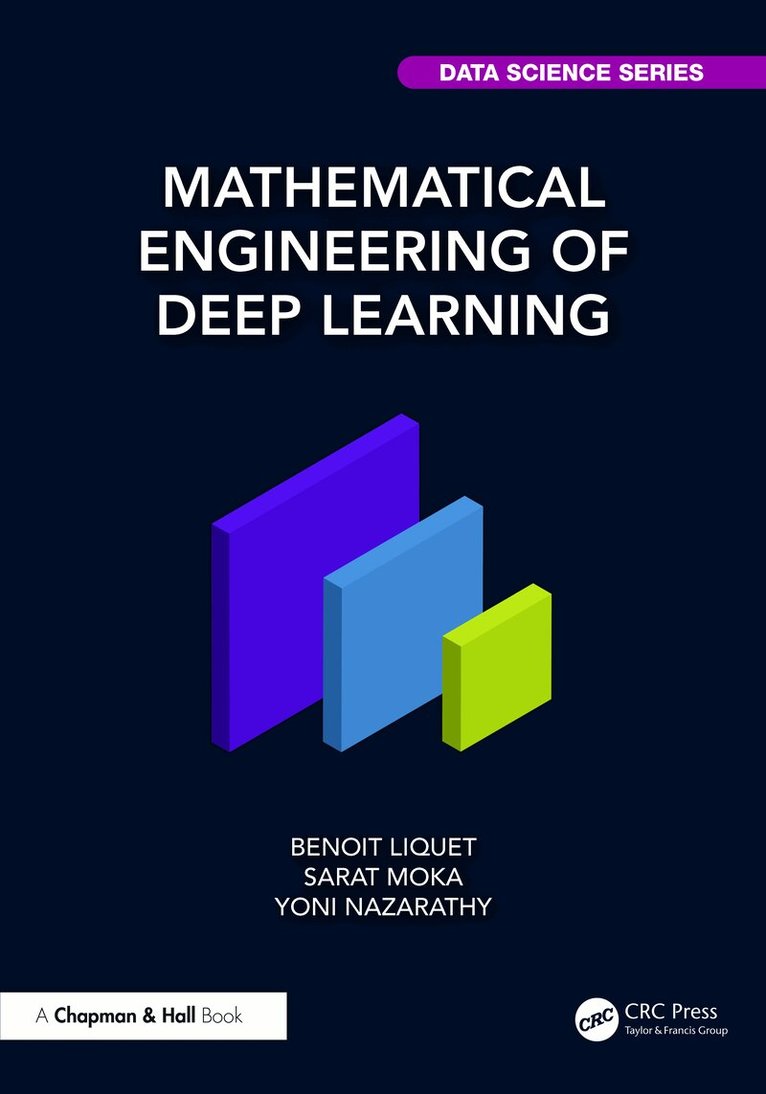
Mathematical Engineering of Deep Learning provides a complete and concise overview of deep learning using the language of mathematics. The book provides a self-contained background on machine learning and optimization algorithms and progresses through the key ideas of deep learning. These ideas and architectures include deep neural networks, convolutional models, recurrent models, long/short-term memory, the attention mechanism, transformers, variational auto-encoders, diffusion models, generative adversarial networks, reinforcement learning, and graph neural networks. Concepts are presented using simple mathematical equations together with a concise description of relevant tricks of the trade. The content is the foundation for state-of-the-art artificial intelligence applications, involving images, sound, large language models, and other domains. The focus is on the basic mathematical description of algorithms and methods and does not require computer programming. The presentation is also agnostic to neuroscientific relationships, historical perspectives, and theoretical research. The benefit of such a concise approach is that a mathematically equipped reader can quickly grasp the essence of deep learning.Key Features:A perfect summary of deep learning not tied to any computer language, or computational framework.An ideal handbook of deep learning for readers that feel comfortable with mathematical notation.An up-to-date description of the most influential deep learning ideas that have made an impact on vision, sound, natural language understanding, and scientific domains.The exposition is not tied to the historical development of the field or to neuroscience, allowing the reader to quickly grasp the essentials.Deep learning is easily described through the language of mathematics at a level accessible to many professionals. Readers from fields such as engineering, statistics, physics, pure mathematics, econometrics, operations research, quantitative management, quantitative biology, applied machine learning, or applied deep learning will quickly gain insights into the key mathematical engineering components of the field.
2 165 kr
Skickas inom 10-15 vardagar
Mathematical Engineering of Deep Learning provides a complete and concise overview of deep learning using the language of mathematics. The book provides a self-contained background on machine learning and optimization algorithms and progresses through the key ideas of deep learning. These ideas and architectures include deep neural networks, convolutional models, recurrent models, long/short-term memory, the attention mechanism, transformers, variational auto-encoders, diffusion models, generative adversarial networks, reinforcement learning, and graph neural networks. Concepts are presented using simple mathematical equations together with a concise description of relevant tricks of the trade. The content is the foundation for state-of-the-art artificial intelligence applications, involving images, sound, large language models, and other domains. The focus is on the basic mathematical description of algorithms and methods and does not require computer programming. The presentation is also agnostic to neuroscientific relationships, historical perspectives, and theoretical research. The benefit of such a concise approach is that a mathematically equipped reader can quickly grasp the essence of deep learning.Key Features:A perfect summary of deep learning not tied to any computer language, or computational framework.An ideal handbook of deep learning for readers that feel comfortable with mathematical notation.An up-to-date description of the most influential deep learning ideas that have made an impact on vision, sound, natural language understanding, and scientific domains.The exposition is not tied to the historical development of the field or to neuroscience, allowing the reader to quickly grasp the essentials.Deep learning is easily described through the language of mathematics at a level accessible to many professionals. Readers from fields such as engineering, statistics, physics, pure mathematics, econometrics, operations research, quantitative management, quantitative biology, applied machine learning, or applied deep learning will quickly gain insights into the key mathematical engineering components of the field.
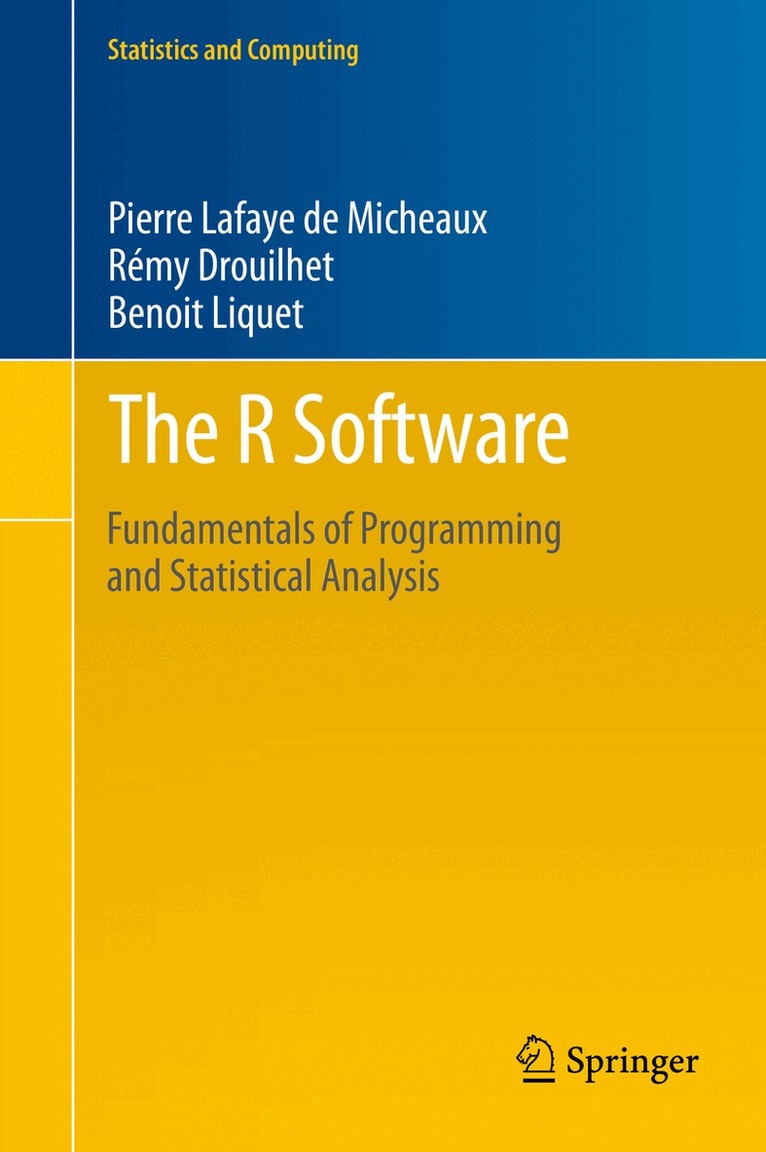
Del 40 - Statistics and Computing
R Software
Fundamentals of Programming and Statistical Analysis
Inbunden, Engelska, 2014
1 900 kr
Skickas inom 7-10 vardagar
The contents of The R Software are presented so as to be both comprehensive and easy for the reader to use. Besides its application as a self-learning text, this book can support lectures on R at any level from beginner to advanced. This book can serve as a textbook on R for beginners as well as more advanced users, working on Windows, MacOs or Linux OSes. The first part of the book deals with the heart of the R language and its fundamental concepts, including data organization, import and export, various manipulations, documentation, plots, programming and maintenance. The last chapter in this part deals with oriented object programming as well as interfacing R with C/C++ or Fortran, and contains a section on debugging techniques. This is followed by the second part of the book, which provides detailed explanations on how to perform many standard statistical analyses, mainly in the Biostatistics field. Topics from mathematical and statistical settings that are included are matrix operations, integration, optimization, descriptive statistics, simulations, confidence intervals and hypothesis testing, simple and multiple linear regression, and analysis of variance. Each statistical chapter in the second part relies on one or more real biomedical data sets, kindly made available by the Bordeaux School of Public Health (Institut de Santé Publique, d'Épidémiologie et de Développement - ISPED) and described at the beginning of the book. Each chapter ends with an assessment section: memorandum of most important terms, followed by a section of theoretical exercises (to be done on paper), which can be used as questions for a test. Moreover, worksheets enable the reader to check his new abilities in R. Solutions to all exercises and worksheets are included in this book.
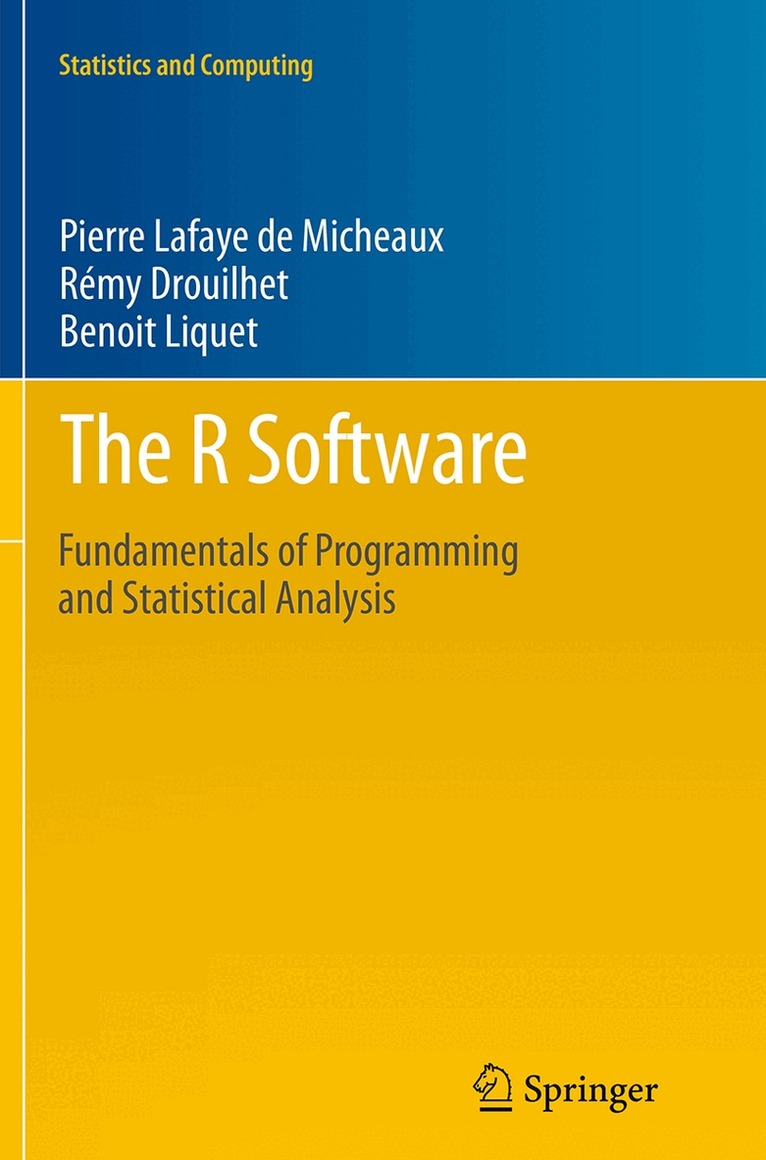
Del 40 - Statistics and Computing
R Software
Fundamentals of Programming and Statistical Analysis
Häftad, Engelska, 2016
1 900 kr
Skickas inom 10-15 vardagar
Each statistical chapter in the second part relies on one or more real biomedical data sets, kindly made available by the Bordeaux School of Public Health (Institut de Santé Publique, d'Épidémiologie et de Développement - ISPED) and described at the beginning of the book.