Bernard Feltz - Böcker
Visar alla böcker från författaren Bernard Feltz. Handla med fri frakt och snabb leverans.
4 produkter
4 produkter
2 110 kr
Skickas inom 10-15 vardagar
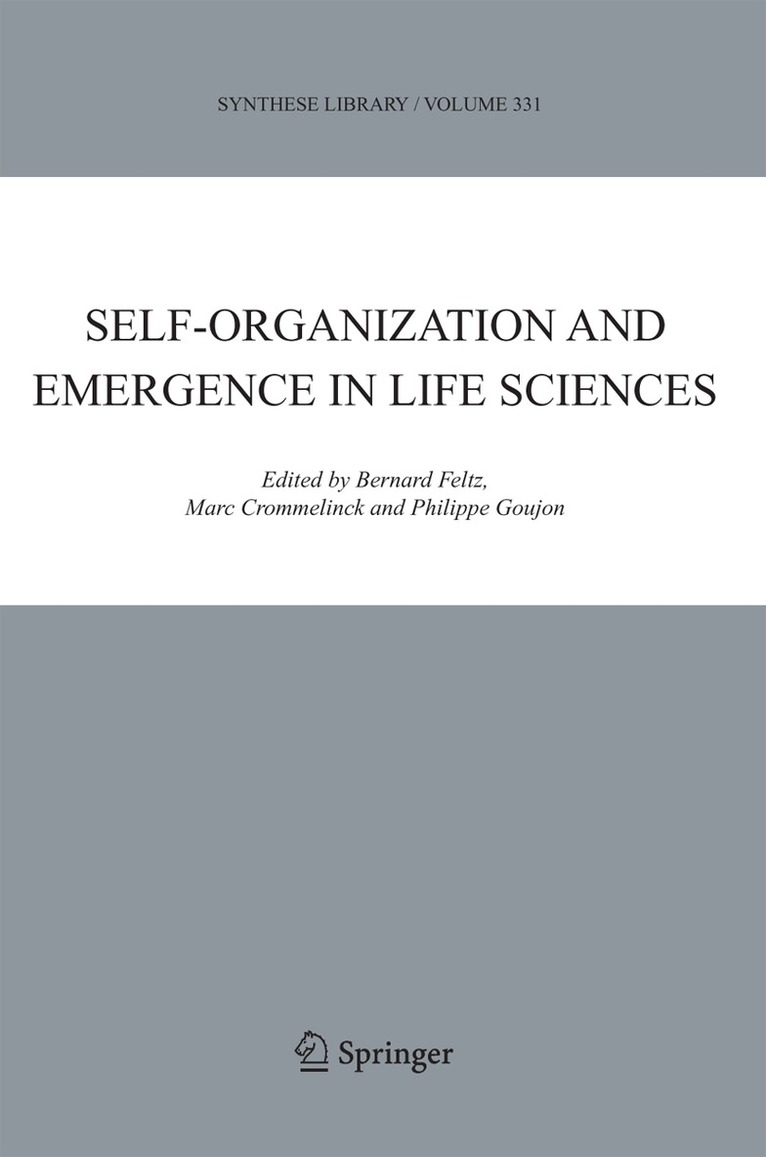
Self-organization constitutes one of the most important theoretical debates in contemporary life sciences. The present book explores the relevance of the concept of self-organization and its impact on such scientific fields as: immunology, neurosciences, ecology and theories of evolution.Historical aspects of the issue are also broached. Intuitions relative to self-organization can be found in the works of such key western philosophical figures as Aristotle, Leibniz and Kant. Interacting with more recent authors and cybernetics, self-organization represents a notion in keeping with the modern world's discovery of radical complexity.The themes of teleology and emergence are analyzed by philosophers of sciences with regards to the issues of modelization and scientific explanation.The implications of self-organization for life sciences are here approached from an interdisciplinary angle, revealing the notion as already rewarding and full of promise for the future.
632 kr
Skickas inom 5-8 vardagar
1 688 kr
Skickas inom 5-8 vardagar
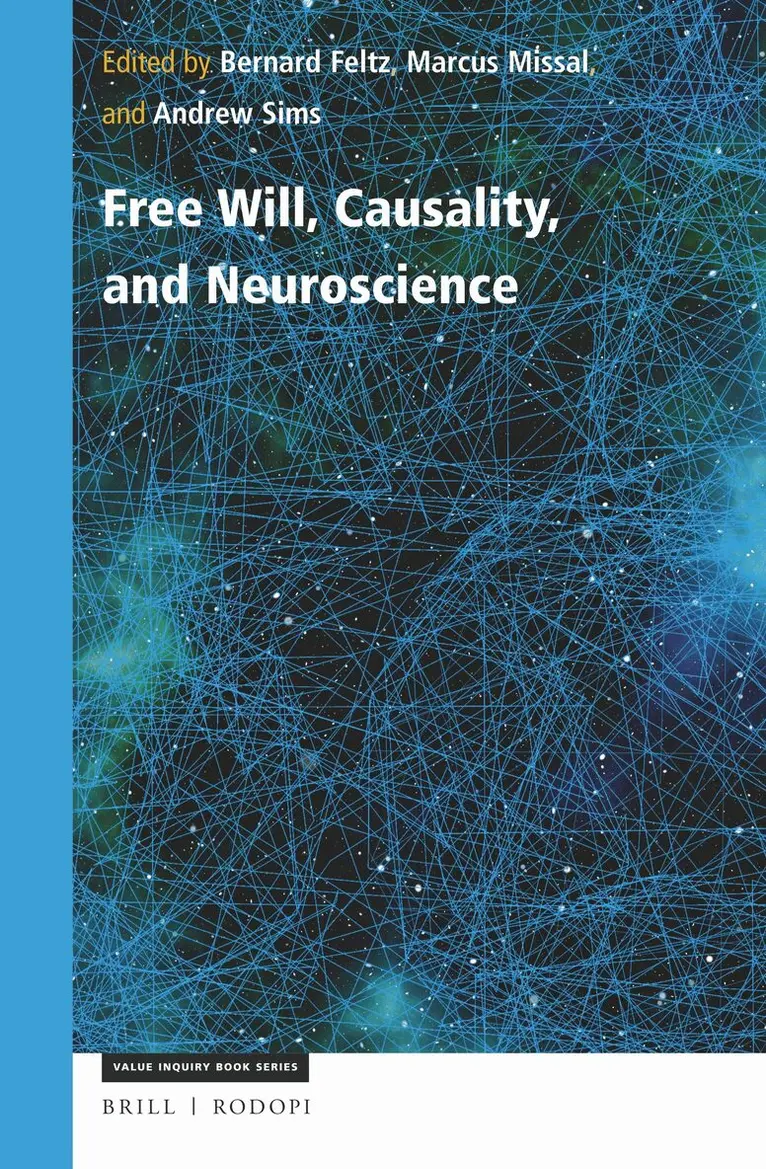
Neuroscientists often consider free will to be an illusion. Contrary to this hypothesis, the contributions to this volume show that recent developments in neuroscience can also support the existence of free will. Firstly, the possibility of intentional consciousness is studied. Secondly, Libet’s experiments are discussed from this new perspective. Thirdly, the relationship between free will, causality and language is analyzed. This approach suggests that language grants the human brain a possibility to articulate a meaningful personal life. Therefore, human beings can escape strict biological determinism.Contributing author Sofia Bonicalzi has received funding from the European Union’s Framework Programme for Research and Innovation Horizon 2020 (2014-2020) under the Marie Skłodowska-Curie Grant Agreement No. 754388 (LMUResearchFellows) and from LMUexcellent, funded by the Federal Ministry of Education and Research (BMBF) and the Free State of Bavaria under the Excellence Strategy of the German Federal Government and the Länder.
2 110 kr
Skickas inom 10-15 vardagar
Self-organization constitutes one of the most important theoretical debates in contemporary life sciences. The present book explores the relevance of the concept of self-organization and its impact on such scientific fields as: immunology, neurosciences, ecology and theories of evolution.Historical aspects of the issue are also broached. Intuitions relative to self-organization can be found in the works of such key western philosophical figures as Aristotle, Leibniz and Kant. Interacting with more recent authors and cybernetics, self-organization represents a notion in keeping with the modern world's discovery of radical complexity.The themes of teleology and emergence are analyzed by philosophers of sciences with regards to the issues of modelization and scientific explanation.The implications of self-organization for life sciences are here approached from an interdisciplinary angle, revealing the notion as already rewarding and full of promise for the future.