Bernard Gert - Böcker
Visar alla böcker från författaren Bernard Gert. Handla med fri frakt och snabb leverans.
7 produkter
7 produkter
816 kr
Skickas inom 5-8 vardagar
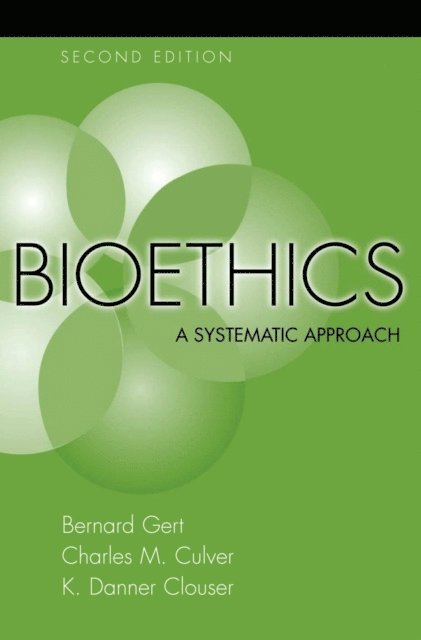
This book is the result of over 30 years of collaboration among its authors. It uses the systematic account of our common morality developed by one of its authors to provide a useful foundation for dealing with the moral problems and disputes that occur in the practice of medicine. The analyses of impartiality, rationality and of morality as a public system not only explain why some bioethical questions, such as the moral acceptability of abortion cannot be resolved, but also provide a method for determining the correct answer for those occasions when a bioethical question has a unique correct answer. This new edition includes an entire chapter that has been added to address the controversial issue of abortion within the authors' distinct framework. This book presents the latest revisions of the authors' original analyses of the concepts of death and disease, analyses that have had a significant impact on the field of bioethics. It also includes an added chapter on mental disorders, where the author's definition influenced what psychiatry classifies as a mental disorder, and so has had an impact that extends beyond the field of bioethics. In this edition, the authors also offer a new, more developed perspective on the concept of valid or informed consent by considering what information physicians should be required to know before proposing screening, diagnostic testing, prescribing medications, or performing surgery. The book also integrates some of the important insights of the field of clinical epidemiology into its discussion of valid consent. Its account of paternalism and its justification, perhaps the most ubiquitous moral problem in medical ethics, has had considerable influence. Its discussion of euthanasia and physician assisted suicide challenges the standard views that have been put forward by both proponents and opponents of physician assisted suicide and voluntary active euthanasia.
738 kr
Skickas inom 5-8 vardagar
Moral problems do not always come in the form of great social controversies. More often, the moral decisions we make are made quietly, constantly, and within the context of everyday activities and quotidian dilemmas. Indeed, these smaller decisions are based on a moral foundation that few of us ever stop to think about but which guides our every action. Here distinguished philosopher Bernard Gert presents a clear and concise introduction to what he calls common morality, the moral system that most thoughtful people implicitly use when making everyday, commonsense moral decisions and judgments. Common Morality is useful in that -- while not resolving every disagreement on controversial issues it is able to distinguish between acceptable and unacceptable answers to moral problems. The distillation of over 40 years' of scholarship, this book is the most accessible version of Gert's influential theory of morality as well as an eye-opening look at the moral foundations of our everyday actions.
2 149 kr
Skickas inom 5-8 vardagar
Bernard Gert's classic work Morality, in which he argues his distinctive and comprehensive moral theory, is now in its sixth edition. Gert argues that morality is an informal system that does not provide answers to every moral question but does always limit the range of morally acceptable options and so explains why some moral questions cannot be resolved. Gert describes the two-step procedure that is used in moral decisions and judgments, and he shows that moral rules cannot be understood independently of the system in which they are embedded. Although his moral theory is sophisticated, it is presented with a clarity that will appeal to undergraduate and graduate students alike, as well as anyone with a general interest in applied ethics. In this new edition, Gert perfects the consistency of his views by presenting his argument in greater detail; he also revises the text in light of a critical book and two symposia dedicated to his theory that have surfaced since the book's last publication. This is the definitive edition to the work that has received so much attention and acclaim.
518 kr
Skickas inom 5-8 vardagar
Bernard Gert's classic work Morality, in which he argues his distinctive and comprehensive moral theory, is now in its sixth edition. Gert argues that morality is an informal system that does not provide answers to every moral question but does always limit the range of morally acceptable options and so explains why some moral questions cannot be resolved. Gert describes the two-step procedure that is used in moral decisions and judgments, and he shows that moral rules cannot be understood independently of the system in which they are embedded. Although his moral theory is sophisticated, it is presented with a clarity that will appeal to undergraduate and graduate students alike, as well as anyone with a general interest in applied ethics. In this new edition, Gert perfects the consistency of his views by presenting his argument in greater detail; he also revises the text in light of a critical book and two symposia dedicated to his theory that have surfaced since the book's last publication. This is the definitive edition to the work that has received so much attention and acclaim.
309 kr
Skickas inom 5-8 vardagar
Moral problems do not always come in the form of great social controversies. More often, the moral decisions we make are made quietly, constantly, and within the context of everyday activities and quotidian dilemmas. Indeed, these smaller decisions are based on a moral foundation that few of us ever stop to think about but which guides our every action. Here distinguished philosopher Bernard Gert presents a clear and concise introduction to what he calls "common morality"--the moral system that most thoughtful people implicitly use when making everyday, common sense moral decisions and judgments. Common Morality is useful in that--while not resolving every disagreement on controversial issues--it is able to distinguish between acceptable and unacceptable answers to moral problems.
715 kr
Skickas inom 7-10 vardagar
Thomas Hobbes was the first great English political philosopher. His work excited intense controversy among his contemporaries and continues to do so in our own time. In this masterly introduction to his work, Bernard Gert provides the first account of Hobbes’s political and moral philosophy that makes it clear why he is regarded as one of the best philosophers of all time in both of these fields. In a succinct and engaging analysis the book illustrates that the commonly accepted view of Hobbes as holding psychological egoism is not only incompatible with his account of human nature but is also incompatible with the moral and political theories that he puts forward. It also explains why Hobbes’s contemporaries did not accept his explicit claim to be providing a natural law account of morality. Gert shows that for Hobbes, civil society is established by a free-gift of their right of nature by the citizens; it does not involve a mutual contract between citizens and sovereign. As injustice involves breaking a contract, the sovereign cannot be unjust; however, the sovereign can be guilty of ingratitude, which is immoral. This distinction between injustice and immorality is part of a sophisticated and nuanced political theory that is in stark contrast to the reading often incorrectly attributed to Hobbes that “might makes right”. It illustrates how Hobbes’s goal of avoiding civil war provides the key to understanding his moral and political philosophy. Hobbes: Prince of Peace is likely to become the classic introduction to the work of Thomas Hobbes and will be a valuable resource for scholars and students seeking to understand the importance and relevance of his work today.
278 kr
Skickas inom 5-8 vardagar
Thomas Hobbes was the first great English political philosopher. His work excited intense controversy among his contemporaries and continues to do so in our own time. In this masterly introduction to his work, Bernard Gert provides the first account of Hobbes’s political and moral philosophy that makes it clear why he is regarded as one of the best philosophers of all time in both of these fields. In a succinct and engaging analysis the book illustrates that the commonly accepted view of Hobbes as holding psychological egoism is not only incompatible with his account of human nature but is also incompatible with the moral and political theories that he puts forward. It also explains why Hobbes’s contemporaries did not accept his explicit claim to be providing a natural law account of morality. Gert shows that for Hobbes, civil society is established by a free-gift of their right of nature by the citizens; it does not involve a mutual contract between citizens and sovereign. As injustice involves breaking a contract, the sovereign cannot be unjust; however, the sovereign can be guilty of ingratitude, which is immoral. This distinction between injustice and immorality is part of a sophisticated and nuanced political theory that is in stark contrast to the reading often incorrectly attributed to Hobbes that “might makes right”. It illustrates how Hobbes’s goal of avoiding civil war provides the key to understanding his moral and political philosophy. Hobbes: Prince of Peace is likely to become the classic introduction to the work of Thomas Hobbes and will be a valuable resource for scholars and students seeking to understand the importance and relevance of his work today.