Bernardo Martín González Rodríguez – författare
Visar alla böcker från författaren Bernardo Martín González Rodríguez. Handla med fri frakt och snabb leverans.
2 produkter
2 produkter
Häftad, Engelska, 2003
1 114 kr
Skickas inom 10-15 vardagar
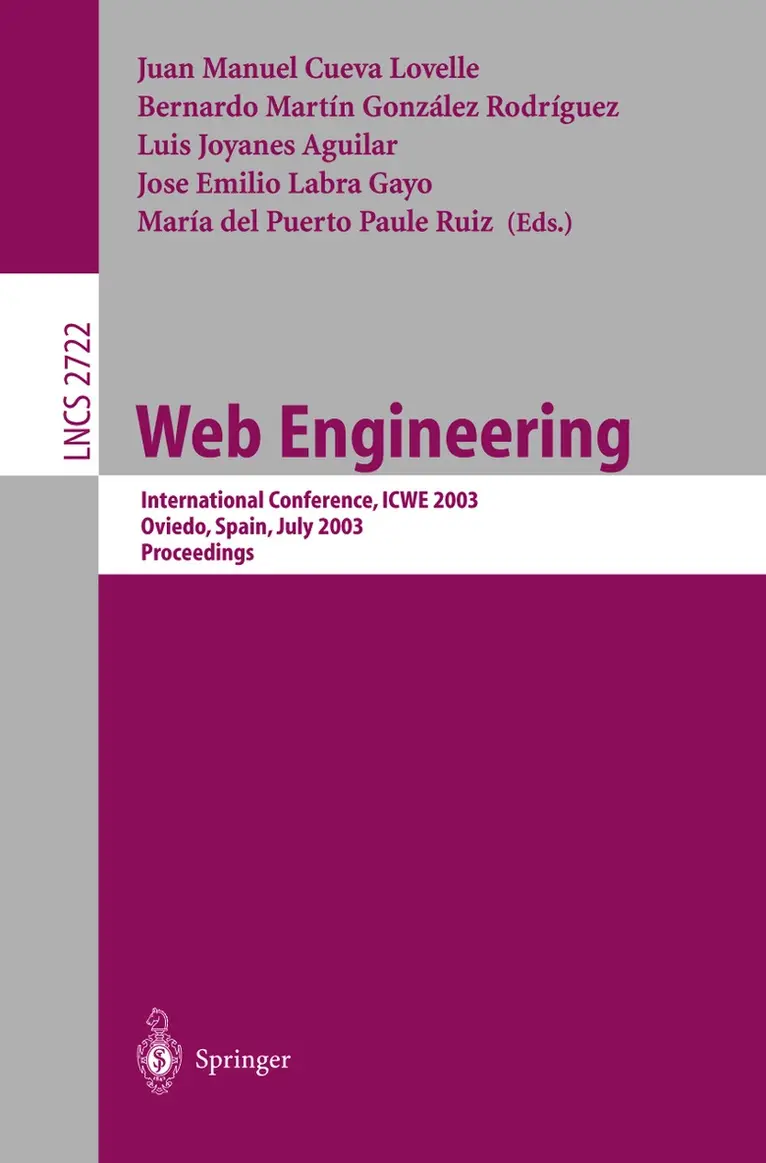
This book constitutes the refereed proceedings of the International Conference on Web Engineering, ICWE 2003, held in Oviedo, Spain in July 2003. The 25 revised full papers and 73 short papers presented together with 2 invited papers were carefully reviewed and selected from 190 submissions. The papers are organized in topical sections on agents on the Web, e-commerce, e-learning, human-computer interaction, languages and tools, mobility and the Web, multimedia techniques and telecommunications, security, Web quality and testing, semantic Web, and Web applications development.
E-bok
PDF, Engelska, 20031 408 kr
Läs direkt efter köp
In the last decade, we have seen tremendous successes in World Wide Web and Internet technologies. Traditional development techniques had to be adapted to thisnewsituation,andatthesametimenewtechniquesemerged.Manyresearch teams began to investigate di?erent ways to adapt classic – but still e?ective – software engineering design and development techniques to the Web and Web engineering emerged as a new research ?eld that relates several subject areas, including agents, e-commerce, e-learning, human-computer interaction, mobile technologies, security, quality and testing, the Semantic Web, etc. The International Conference on Web Engineering (ICWE) continued the tradition of earlier conferences with the aim of bringing together researchers and practitioners in these areas, trying to o?er a good environment where people with di?erent backgrounds could exchange their insights in this area. Thesuccessofthisconferencegeneratedanincredibleamountofworkforthe Program Committee members and the External Reviewers, lead by the Program Committee chairs Oscar Pastor L´ opez, Luis Olsina Santos and Mart´ ?n Gonz´ alez Rodr´ ?guez. We are immensely grateful for the e?ort they put into the process of selecting the very best papers. There were 190 papers submitted, with 25 papers accepted (13%) as long papers. A large number of papers describing ongoing research were included as short papers or posters. Unfortunately, we were forced to reject many good papers. Paper selection is always a di?cult task.