Beryl Williams – författare
Visar alla böcker från författaren Beryl Williams. Handla med fri frakt och snabb leverans.
16 produkter
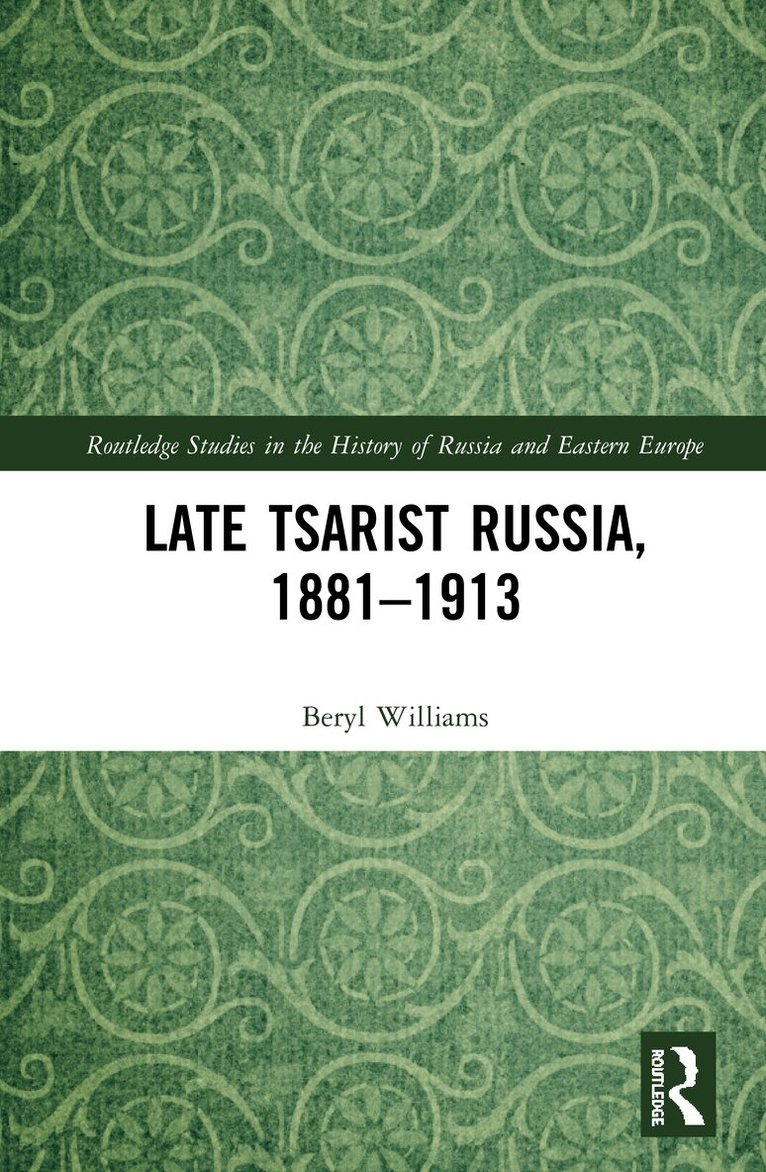
Late Tsarist Russia, 1881–1913
Inbunden, 2020
2818 kr
Lägg i varukorg
This book brings together the large volume of work on late Tsarist Russia published over the last 30 years, to show an overall picture of Russia under the last two tsars - before the war brought down not only the Russian empire but also those of Germany, Austria–Hungary and Turkey. It turns the …
Late Tsarist Russia, 1881–1913
Häftad, 2022
710 kr
Lägg i varukorg
This book brings together the large volume of work on late Tsarist Russia published over the last 30 years, to show an overall picture of Russia under the last two tsars - before the war brought down not only the Russian empire but also those of Germany, Austria–Hungary and Turkey. It turns the …
Communist Indochina
Av R. B. Smith, Beryl Williams
Inbunden, 2008
2586 kr
Lägg i varukorg
This book examines the history of communist Indochina, from the foundation of the Indochinese Communist Party in 1929-30 to the end of the 1970s. It explores the impact of the Japanese invasion of Indochina in 1940, and the subsequent relationship between the Japanese occupiers and the Vichy French …
Pre-Communist Indochina
Inbunden, 2008
2586 kr
Lägg i varukorg
This book explores the history of pre-communist Indochina, from the fourteenth century to the 1940s. It examines the early state of Vietnam, comparing and contrasting its political and social systems, with both those of neighbouring states such as Thailand and those prevalent at the time in Europe. …
Communist Indochina
Av R. B. Smith, Beryl Williams
Häftad, 2013
740 kr
Lägg i varukorg
This book examines the history of communist Indochina, from the foundation of the Indochinese Communist Party in 1929-30 to the end of the 1970s. It explores the impact of the Japanese invasion of Indochina in 1940, and the subsequent relationship between the Japanese occupiers and the Vichy French …
Pre-Communist Indochina
Häftad, 2012
246 kr
Lägg i varukorg
This book explores the history of pre-communist Indochina, from the fourteenth century to the 1940s. It examines the early state of Vietnam, comparing and contrasting its political and social systems, with both those of neighbouring states such as Thailand and those prevalent at the time in Europe. …
Lenin
Häftad, 2000
947 kr
Lägg i varukorg
Drawing on the flood of new material to emerge from Russian and Western sources in recent years, Beryl Williams focuses on Lenin's years in power and provides first-rate introduction to the life, ideology and impact of one of the formative figures of the 20th-century.Within an overall chronological …
Russian Revolution 1917-1921
History Association Studies
Häftad, 1987
596 kr
Lägg i varukorg
This book examines the dramatic and sometimes violent events which accompanied the fall of the Russian czars and the creation of the Soviet nation. In drawing upon the most recent research, especially on the nature of the popular movement during 1917, Beryl Williams examines how and why Bolsheviks …
Late Tsarist Russia, 1881-1913
E-bok, 2020
838 kr
Lägg i varukorg
This book brings together the large volume of work on late Tsarist Russia published over the last 30 years, to show an overall picture of Russia under the last two tsars - before the war brought down not only the Russian empire but also those of Germany, Austria–Hungary and Turkey. It turns the …
Late Tsarist Russia, 1881-1913
E-bok, 2020
838 kr
Lägg i varukorg
This book brings together the large volume of work on late Tsarist Russia published over the last 30 years, to show an overall picture of Russia under the last two tsars - before the war brought down not only the Russian empire but also those of Germany, Austria–Hungary and Turkey. It turns the …
Pre-Communist Indochina
E-bok, 2014
286 kr
Lägg i varukorg
This book explores the history of pre-communist Indochina, from the fourteenth century to the 1940s. It examines the early state of Vietnam, comparing and contrasting its political and social systems, with both those of neighbouring states such as Thailand and those prevalent at the time in Europe. …
Pre-Communist Indochina
E-bok, 2014
286 kr
Lägg i varukorg
This book explores the history of pre-communist Indochina, from the fourteenth century to the 1940s. It examines the early state of Vietnam, comparing and contrasting its political and social systems, with both those of neighbouring states such as Thailand and those prevalent at the time in Europe. …
Communist Indochina
Av R. B. Smith, Beryl Williams
E-bok, 2012
855 kr
Lägg i varukorg
This book examines the history of communist Indochina, from the foundation of the Indochinese Communist Party in 1929-30 to the end of the 1970s. It explores the impact of the Japanese invasion of Indochina in 1940, and the subsequent relationship between the Japanese occupiers and the Vichy French …
Communist Indochina
Av R. B. Smith, Beryl Williams
E-bok, 2012
874 kr
Lägg i varukorg
This book examines the history of communist Indochina, from the foundation of the Indochinese Communist Party in 1929-30 to the end of the 1970s. It explores the impact of the Japanese invasion of Indochina in 1940, and the subsequent relationship between the Japanese occupiers and the Vichy French …
Lenin
E-bok, 2014
963 kr
Lägg i varukorg
Drawing on the flood of new material to emerge from Russian and Western sources in recent years, Beryl Williams focuses on Lenin''s years in power and provides first-rate introduction to the life, ideology and impact of one of the formative figures of the 20th-century. Within an overall …
Lenin
E-bok, 2014
963 kr
Lägg i varukorg
Drawing on the flood of new material to emerge from Russian and Western sources in recent years, Beryl Williams focuses on Lenin''s years in power and provides first-rate introduction to the life, ideology and impact of one of the formative figures of the 20th-century. Within an overall …