Beth Lau – författare
783 kr
Skickas inom 10-15 vardagar
751 kr
Skickas inom 10-15 vardagar
629 kr
Läs direkt efter köp
2 592 kr
Skickas inom 10-15 vardagar
928 kr
Läs direkt efter köp
The essays in this volume interpret Jane Austen’s fiction through the lens of various sciences of the mind and brain, especially the cluster of disciplines implicated in the term cognitive science, including neuroscience, evolutionary biology, evolutionary and developmental psychology, and others. The field of cognitive literary studies has rapidly developed in the last few decades and achieved the status of an established (if still evolving) critical approach. One of the most popular authors to analyze from this perspective is Jane Austen. As numerous critics have noted, Austen was a keen observer of how the mind operates in its interactions with other minds, both when it functions successfully and when, as often happens, it goes awry, and her perceptions are often in synch with current neuroscientific and psychological research. Despite the widespread recognition of the special congruity between Austen’s novels and cognitive science, however, no book has been devoted to this subject. Jane Austen and Sciences of the Mind is the first monograph wholly comprised of readings of Austen’s oeuvre (juvenilia as well as all six completed novels) from cognitive and related psychological approaches. In addition, the volume operates under the assumption that cognitive and historicist approaches are compatible, and many essays situate Austen within the climate of ideas during her era as well as in relation to current research in the sciences and social sciences. Jane Austen and Sciences of the Mind offers a new lens for understanding and illuminating the concerns, techniques, and enduring appeal of Austen’s novels.
928 kr
Läs direkt efter köp
The essays in this volume interpret Jane Austen’s fiction through the lens of various sciences of the mind and brain, especially the cluster of disciplines implicated in the term cognitive science, including neuroscience, evolutionary biology, evolutionary and developmental psychology, and others. The field of cognitive literary studies has rapidly developed in the last few decades and achieved the status of an established (if still evolving) critical approach. One of the most popular authors to analyze from this perspective is Jane Austen. As numerous critics have noted, Austen was a keen observer of how the mind operates in its interactions with other minds, both when it functions successfully and when, as often happens, it goes awry, and her perceptions are often in synch with current neuroscientific and psychological research. Despite the widespread recognition of the special congruity between Austen’s novels and cognitive science, however, no book has been devoted to this subject. Jane Austen and Sciences of the Mind is the first monograph wholly comprised of readings of Austen’s oeuvre (juvenilia as well as all six completed novels) from cognitive and related psychological approaches. In addition, the volume operates under the assumption that cognitive and historicist approaches are compatible, and many essays situate Austen within the climate of ideas during her era as well as in relation to current research in the sciences and social sciences. Jane Austen and Sciences of the Mind offers a new lens for understanding and illuminating the concerns, techniques, and enduring appeal of Austen’s novels.
858 kr
Läs direkt efter köp
890 kr
Läs direkt efter köp
2 785 kr
Skickas inom 10-15 vardagar
1 770 kr
Skickas inom 10-15 vardagar
2 244 kr
Läs direkt efter köp
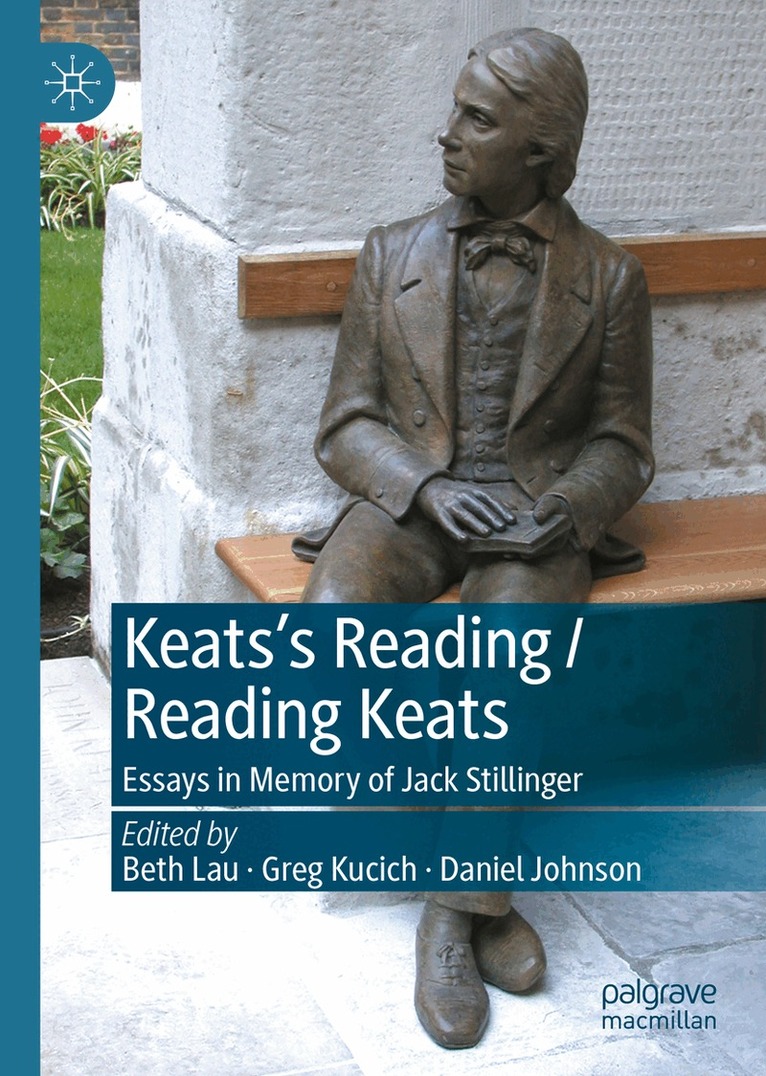
This book explores John Keats’s reading practices and intertextual dialogues with other writers. It also examines later writers’ engagements with Keats’s poetry. Finally, the book honors the distinguished Keats scholar Jack Stillinger and includes an essay surveying his career as well as a bibliography of his major publications. The first section of the volume, “Theorizing Keats’s Reading,” contains four essays that identify major patterns in the poet’s reading habits and responses to other works. The next section, “Keats’s Reading,” consists of six essays that examine Keats’s work in relation to specific earlier authors and texts. The four essays in the third section, “Reading Keats,” consider how Keats’s poetry influenced the work of later writers and became embedded in British and American literary traditions. The final section of the book, “Contemporary Poetic Responses,” features three scholar-poets who, in poetry and/or prose commentary, discuss and exemplify Keats’s impact on their work.
1 770 kr
Skickas inom 10-15 vardagar