
Bhat D.N.S. Bhat – författare
Visar alla böcker från författaren Bhat D.N.S. Bhat. Handla med fri frakt och snabb leverans.
2 produkter
2 produkter
E-bok
PDF, Engelska, 19991 384 kr
Läs direkt efter köp
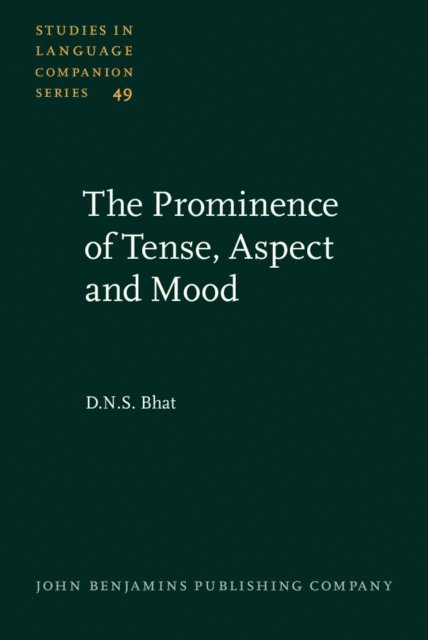
The book puts forth an exciting hypothesis for the typologist. Its major claim is that languages can generally be regarded as belonging to a tense-prominent, aspect-prominent or mood-prominent language type. This grouping can be based upon the relative prominence that languages attach to one or the other of the three verbal categories, namely tense, aspect and mood, by grammaticalizing the chosen category to a greater degree than others, and by making it more obligatory, more systematic and more pervasive than others. The grouping, however, involves a gradation, as is indeed the case with other typological groupings, with some languages manifesting the relevant characteristic more strikingly than others.There are several characteristics that can be correlated with the relative prominence that languages attach to verbal categories. For example, tense-prominent languages tend to have mostly active but not stative verbs. They also tend to keep adjectives as a distinct category, or group them with nouns but not with verbs. Verbal forms used for foregrounding generally belong to the most prominent verbal category. These and other similar correlations make this typological classification worth pursuing. The book also contains a descriptive study of the three verbal categories.
E-bok
PDF, Engelska, 19941 525 kr
Läs direkt efter köp
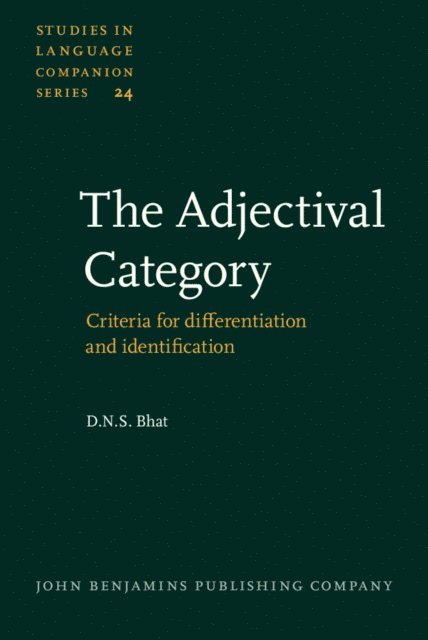
This monograph sets out (i) to establish criteria for differentiating adjectives from other word-classes for languages in which they form a distinct category, and (ii) to establish criteria for determining their (non-)identity with words from other categories for languages in which they do not. As languages show various gradations in the extent to which adjectives can be distinguished from other word-classes, the author discusses idealized language types, thereby providing a model for the analysis of natural languages.The book argues that adjectives do not uniformly show all differentiating characteristics and that these characteristics are semantically relevant and functionally motivated: for instance, when word-classes are used in functions not their own, they manifest characteristics of the categories to which the relevant functions belong.The second part of the book discusses three distinct idealized languages types without a distinct adjectival category in which “property words” remain undifferentiated from (i) nouns, (ii) verbs, and (iii) nouns as well as verbs. These three types are shwon to represent gradations of distinctions between word-classes as they occur in natural languages and to manifest various degrees of the corresponding functional neutralizations.In the final chapter the wider theoretical implications of this work for the study of categories are discussed.