Bi Zhao – författare
Visar alla böcker från författaren Bi Zhao. Handla med fri frakt och snabb leverans.
4 produkter
4 produkter
Häftad, Engelska, 2025
239 kr
Skickas inom 7-10 vardagar
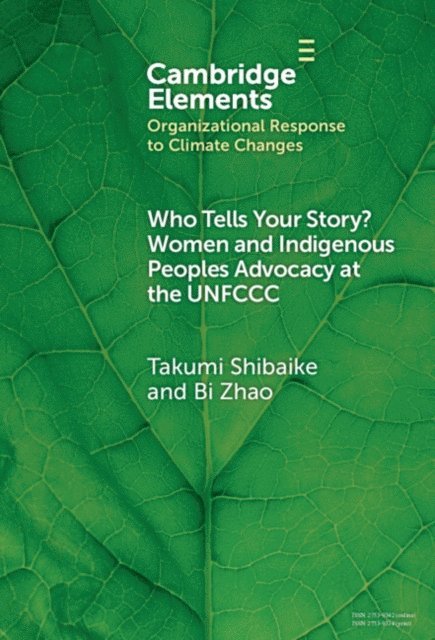
Thousands of civil society organizations (CSOs) attend the Conferences of the Parties (COPs) of the United Nations Framework Convention on Climate Change (UNFCCC) every year. Through their advocacy work, CSOs define and redefine what "climate change" is really about. The Element focuses on climate advocacy for women and Indigenous peoples (IPs), two prominent climate justice frames at the UNFCCC. Which CSOs advocate for women and IPs? How and why do CSOs adopt gender and Indigenous framing? Bridging the literature on framing strategy and organizational ecology, it presents two mechanisms by which CSOs adopt climate justice frames: self-representation and surrogate-representation. The Element demonstrates that, while gender advocacy is developed primarily by women's CSOs, IPs advocacy is developed by a variety of CSOs beyond IPs organizations. It suggests that these different patterns of frame development may have long-term consequences for how we think about climate change in relation to gender and IPs.
E-bok
PDF, Engelska, 2025275 kr
Läs direkt efter köp
E-bok
Engelska, 2025285 kr
Läs direkt efter köp
Inbunden, Engelska, 2025
769 kr
Skickas inom 7-10 vardagar
Thousands of civil society organizations (CSOs) attend the Conferences of the Parties (COPs) of the United Nations Framework Convention on Climate Change (UNFCCC) every year. Through their advocacy work, CSOs define and redefine what "climate change" is really about. The Element focuses on climate advocacy for women and Indigenous peoples (IPs), two prominent climate justice frames at the UNFCCC. Which CSOs advocate for women and IPs? How and why do CSOs adopt gender and Indigenous framing? Bridging the literature on framing strategy and organizational ecology, it presents two mechanisms by which CSOs adopt climate justice frames: self-representation and surrogate-representation. The Element demonstrates that, while gender advocacy is developed primarily by women's CSOs, IPs advocacy is developed by a variety of CSOs beyond IPs organizations. It suggests that these different patterns of frame development may have long-term consequences for how we think about climate change in relation to gender and IPs.