Bienvenido Jiménez - Böcker
Visar alla böcker från författaren Bienvenido Jiménez. Handla med fri frakt och snabb leverans.
4 produkter
4 produkter
1 381 kr
Skickas inom 10-15 vardagar
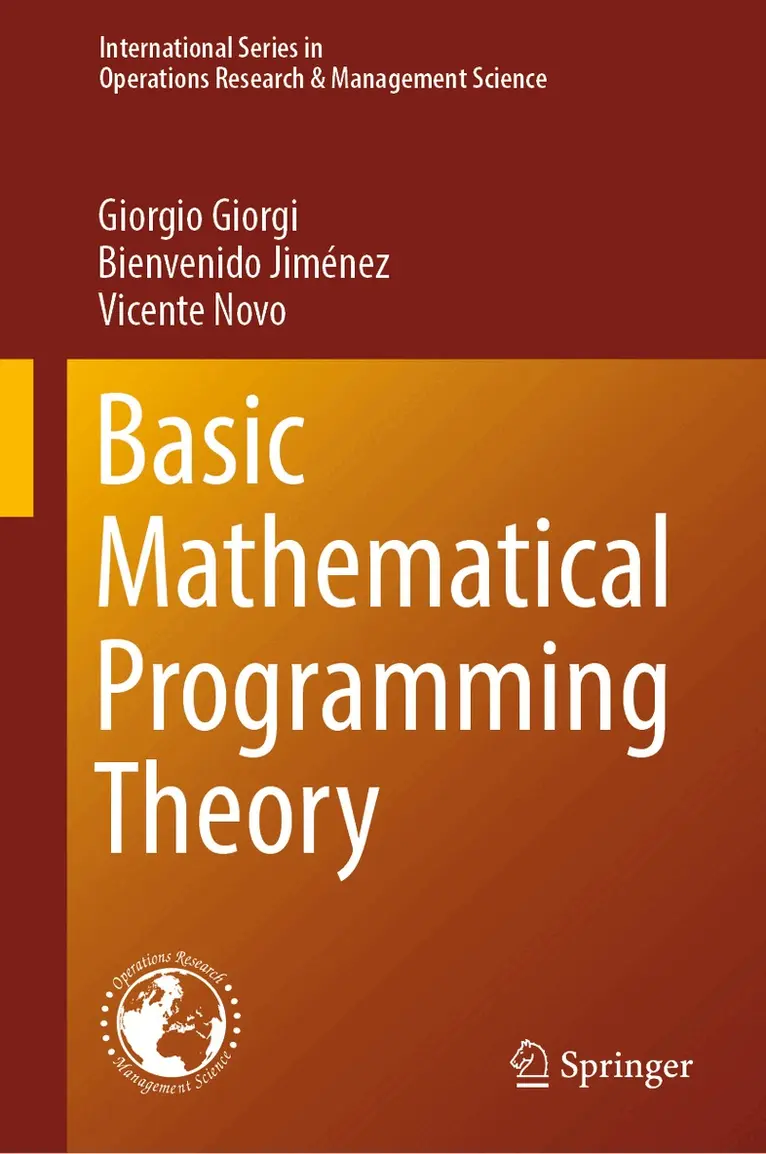
The subject of (static) optimization, also called mathematical programming, is one of the most important and widespread branches of modern mathematics, serving as a cornerstone of such scientific subjects as economic analysis, operations research, management sciences, engineering, chemistry, physics, statistics, computer science, biology, and social sciences. This book presents a unified, progressive treatment of the basic mathematical tools of mathematical programming theory. The authors expose said tools, along with results concerning the most common mathematical programming problems formulated in a finite-dimensional setting, forming the basis for further study of the basic questions on the various algorithmic methods and the most important particular applications of mathematical programming problems. This book assumes no previous experience in optimization theory, and the treatment of the various topics is largely self-contained. Prerequisites are the basic tools of differential calculus for functions of several variables, the basic notions of topology and of linear algebra, and the basic mathematical notions and theoretical background used in analyzing optimization problems. The book is aimed at both undergraduate and postgraduate students interested in mathematical programming problems but also those professionals who use optimization methods and wish to learn the more theoretical aspects of these questions.
634 kr
Skickas inom 5-8 vardagar
1 064 kr
Skickas inom 10-15 vardagar
The subject of (static) optimization, also called mathematical programming, is one of the most important and widespread branches of modern mathematics, serving as a cornerstone of such scientific subjects as economic analysis, operations research, management sciences, engineering, chemistry, physics, statistics, computer science, biology, and social sciences. This book presents a unified, progressive treatment of the basic mathematical tools of mathematical programming theory. The authors expose said tools, along with results concerning the most common mathematical programming problems formulated in a finite-dimensional setting, forming the basis for further study of the basic questions on the various algorithmic methods and the most important particular applications of mathematical programming problems. This book assumes no previous experience in optimization theory, and the treatment of the various topics is largely self-contained. Prerequisites are the basic tools of differential calculus for functions of several variables, the basic notions of topology and of linear algebra, and the basic mathematical notions and theoretical background used in analyzing optimization problems. The book is aimed at both undergraduate and postgraduate students interested in mathematical programming problems but also those professionals who use optimization methods and wish to learn the more theoretical aspects of these questions.
906 kr
Skickas inom 10-15 vardagar
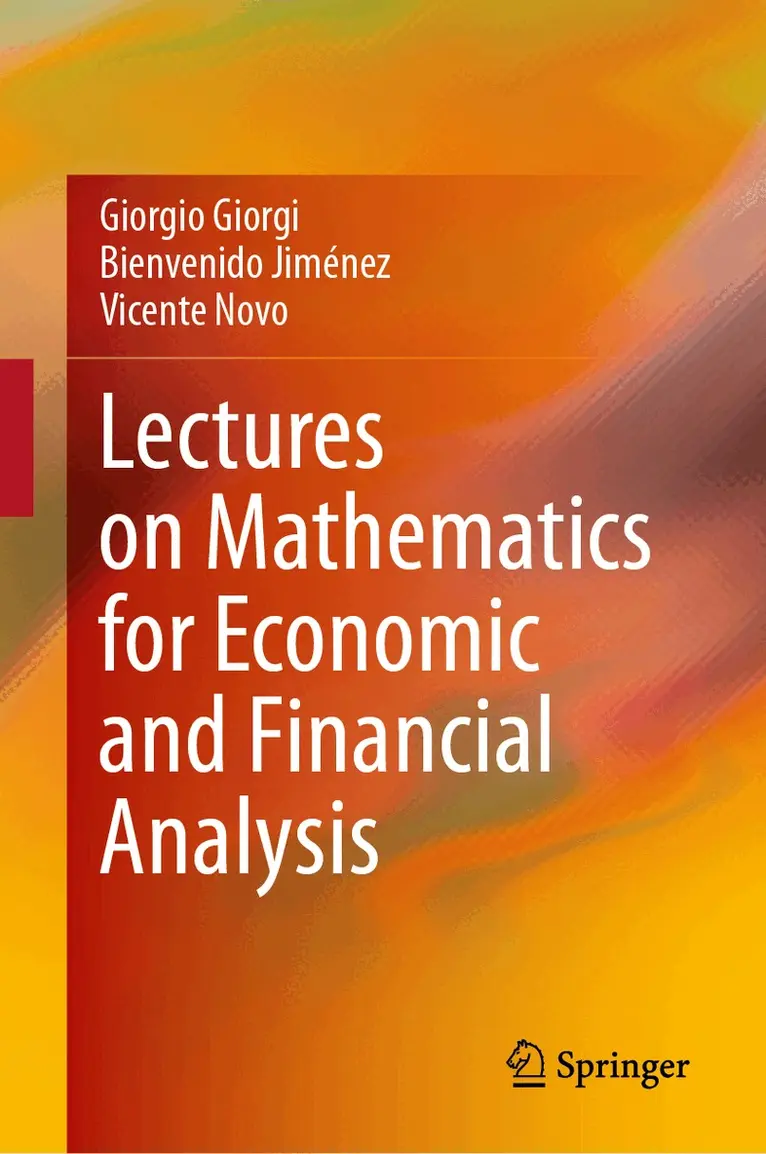
This book offers a comprehensive yet approachable introduction to essential mathematical concepts, tailored specifically for undergraduate and first-year graduate students in Economics and Social Sciences. Based on lectures delivered at the University of Pavia's Department of Economics and Management, and also in UNED’ Department of Applied Mathematics in Madrid, it aims to equip students with the mathematical tools necessary to better understand their courses in economics and finance, where math is applied directly.Unlike texts focused on formalized topics like Mathematical Economics or Operations Research, this book presents basic mathematical principles and methods that are immediately relevant to students. With a clear, accessible approach, it includes numerous examples, some with economic applications, to illustrate key concepts and make them easier to grasp.The authors have carefully chosen proofs that are straightforward and beneficial for students to encounter, offering an introduction to important proof techniques without overwhelming complexity. The book also provides a select bibliography, allowing readers to explore topics in greater depth if desired.Drawing on years of teaching experience, the authors have created a valuable resource that serves as both a foundation and a practical guide for students navigating the mathematical aspects of economics and social science courses.