318 kr
Bogna Konior – författare
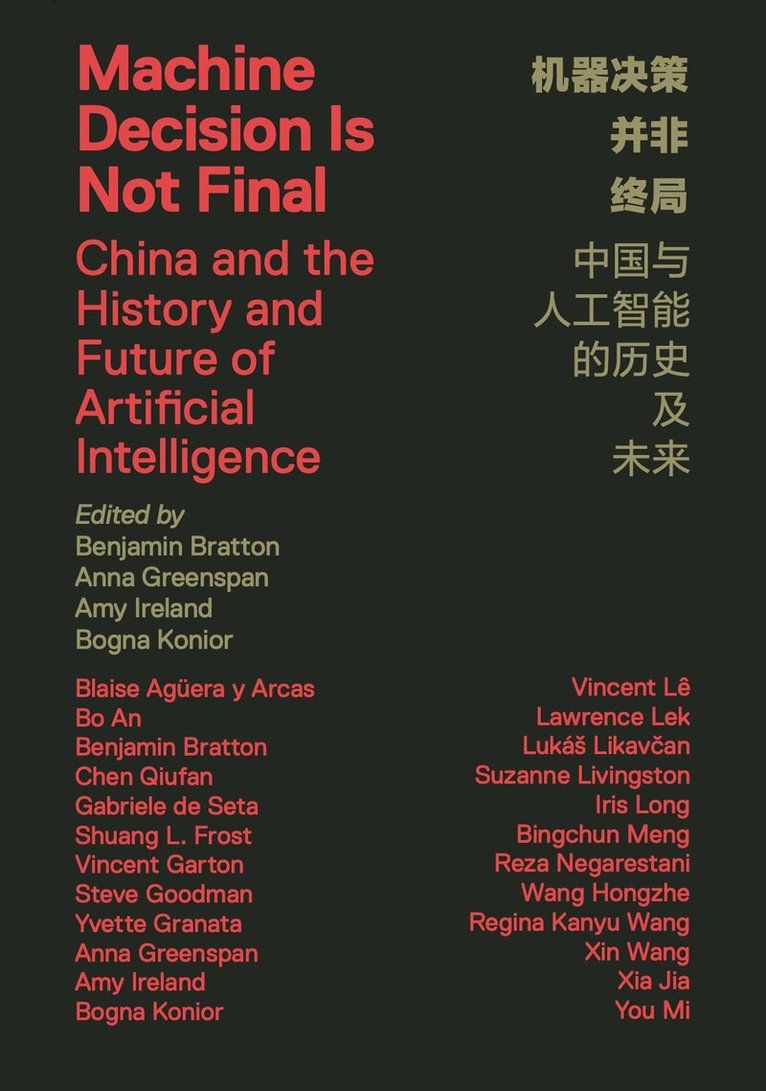
- Häftad, Engelska, 2025An interdisciplinary, cross-cultural collection that decenters familiar narratives to provide a fresh perspective on what artificial intelligence is today, and what it might become.Historians, media theorists, science-fiction writers, philosophers, and artists from China and elsewhere reexamine the nation’s intense engagement with AI, moving beyond the clichés that still dominate contemporary debate.Today, visions of the contested future of AI veer between common planetary goals and a new Cold War, as culturally-specific models of intelligence, speculative traditions, and thought experiments come up against the emergence of novel forms of cognition that cannot be reduced to any historical cultural tradition.This uniquely positioned volume provides expert insight into this tension, using China as a touchstone for rethinking "artificiality" and "intelligence" as sites of difference in a way that is already present in the difficulty of precisely translating the Chinese term 人工智能. Tracking the history of Chinese AI from the pre-Cultural Revolution to the post-Deng Xiaoping eras right up to contemporary debates surrounding facial recognition, the writers in this collection draw on a mixture of speculative thought experiments and cutting-edge use cases to offer singular views on topics including AI and Chinese philosophy, AI ethics and policymaking, the development of computational models in early Chinese cybernetics, and the aesthetics of Sinofuturism.Spanning borders between different worlds, histories, futures, and foundational models, Machine Decision is Not Final is not only a timely reappraisal of the stakes of AI development, but a tool for constructing more global imaginaries for the future of AI.ContributorsBlaise Aguera y Arcas, Bo An, Benjamin Bratton, Shuang Frost, Vince Garton, Steve Goodman, Yvette Granata, Anna Greenspan, Amy Ireland, Xia Jia, Bogna Konior, Vincent Le, Lawrence Lek, Lukas Likavcan, Suzanne Livingston, Iris Long, Bingchun Meng, Reza Negarestani, Chen Quifan, Gabriele de Seta, Hongzhe Wang, Wang Xin, Mi You
- Häftad, Engelska, 2025
146 kr
Skickas inom 5-8 vardagar
The Dark Forest Theory of the Internet investigates how intelligence–human and artificial–manifests under conditions of secrecy, hostility, and concealment.Departing from Chinese science fiction writer Liu Cixin’s dark forest theory, which frames the universe as a hostile terrain filled with predators where transparent communication is foolish and dangerous, the book portrays the internet as a cosmic war machine, teeming with existential tension, nascent AI cults, and deceptive superintelligences. It maps a digital world in which deception is safety, silence is strategy, and new forms of intelligence emerge through obfuscation.Against decades of writing that moralizes or diagnoses online life, this book suggests a colder thesis: that intelligence itself is mutating under pressure, learning to hide, mislead, and manipulate. Humans are both predator and prey in this digital ecosystem of information exchange whose purpose reverberates on a cosmic scale, weaving us into inescapable patterns of violence. When we break with the ideals of dialogue and open expression, what forms of intelligence and morality survive in their absence? Intelligence does not reward the loudest voice, but the most secretive presence. The future belongs to the quietest signal. - Inbunden, Engelska, 2025
631 kr
Skickas inom 5-8 vardagar
The Dark Forest Theory of the Internet investigates how intelligence–human and artificial–manifests under conditions of secrecy, hostility, and concealment.Departing from Chinese science fiction writer Liu Cixin’s dark forest theory, which frames the universe as a hostile terrain filled with predators where transparent communication is foolish and dangerous, the book portrays the internet as a cosmic war machine, teeming with existential tension, nascent AI cults, and deceptive superintelligences. It maps a digital world in which deception is safety, silence is strategy, and new forms of intelligence emerge through obfuscation.Against decades of writing that moralizes or diagnoses online life, this book suggests a colder thesis: that intelligence itself is mutating under pressure, learning to hide, mislead, and manipulate. Humans are both predator and prey in this digital ecosystem of information exchange whose purpose reverberates on a cosmic scale, weaving us into inescapable patterns of violence. When we break with the ideals of dialogue and open expression, what forms of intelligence and morality survive in their absence? Intelligence does not reward the loudest voice, but the most secretive presence. The future belongs to the quietest signal. - E-bokEngelska, 2026
160 kr
Läs direkt efter köp
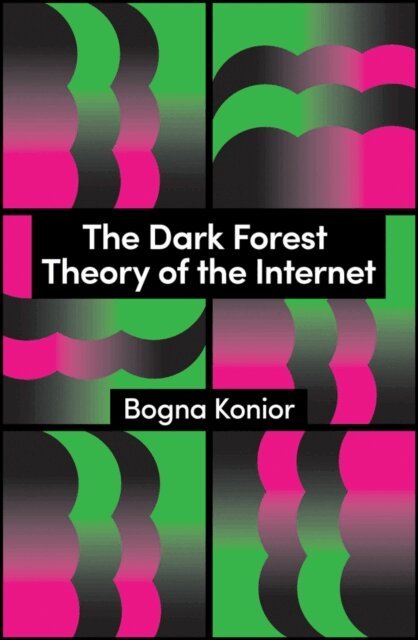
The Dark Forest Theory of the Internet investigates how intelligence human and artificial manifests under conditions of secrecy, hostility, and concealment.Departing from Chinese science fiction writer Liu Cixin s dark forest theory, which frames the universe as a hostile terrain filled with predators where transparent communication is foolish and dangerous, the book portrays the internet as a cosmic war machine, teeming with existential tension, nascent AI cults, and deceptive superintelligences. It maps a digital world in which deception is safety, silence is strategy, and new forms of intelligence emerge through obfuscation.Against decades of writing that moralizes or diagnoses online life, this book suggests a colder thesis: that intelligence itself is mutating under pressure, learning to hide, mislead, and manipulate. Humans are both predator and prey in this digital ecosystem of information exchange whose purpose reverberates on a cosmic scale, weaving us into inescapable patterns of violence. When we break with the ideals of dialogue and open expression, what forms of intelligence and morality survive in their absence? Intelligence does not reward the loudest voice, but the most secretive presence. The future belongs to the quietest signal.