Brent Newman – författare
Visar alla böcker från författaren . Handla med fri frakt och snabb leverans.
15 produkter
15 produkter
Inbunden, Engelska, 2015
305 kr
Skickas inom 5-8 vardagar
E-bok
Engelska, 2026126 kr
Läs direkt efter köp
The Brahmin of BloomsburyThe Final Frontier: The Parallel Worlds of Aldous HuxleyThe Perennial PhychonautThis volume offers a definitive exploration of Aldous Huxley's evolution from the cynical satirist of the Bloomsbury Group to the "e;Perennial Psychonaut"e; who bridged the chasm between Western science and Eastern mysticism.Timed for the 75th anniversary of his seminal psychedelic works, The Doors of Perception and Heaven and Hell, this book maps Huxley's radical journey—a "e;descent"e; from the numbing, state-mandated stability of Soma to the liberation of Moksha.We trace the transformation of a man born into a scientific dynasty (the "e;Brahmin"e;) as he moves beyond the cold, clinical observations of his youth toward a holistic understanding of the human consciousness. The book highlights how Huxley never truly abandoned his grandfather's empirical rigor. Instead, he refined it, seeking a "e;Practical Mysticism"e; where neurobiology and spiritual epiphany could coexist.A deep-dive comparison between the dystopian "e;dead society"e; of Brave New World and the utopian "e;living society"e; of Island. An analysis of Huxley's final fictional world, where the integration of East and West, ancient wisdom and modern pharmacology, created a roadmap for human potential."e;Huxley didn't abandon his grandfather's science; he simply gave it a soul."e;This work serves as both a tribute and a critical analysis of a visionary who spent his life searching for the "e;Final Frontier"e;—not in space, but within the "e;Parallel Worlds"e; of the mind.
Häftad, Engelska, 2026
251 kr
Skickas inom 5-8 vardagar
126 kr
Läs direkt efter köp
E-bok
Engelska, 2026126 kr
Läs direkt efter köp
The dual residency between the lush, spiritual sanctuary of Ojai and the stark, existential laboratory of the Mojave created a new internal topography. He was living in the tension between the garden and the wilderness. Ojai had taught him how to feel, but the Mojave was teaching him how to see. His mind, once a crowded room of mirrors, was becoming a window. He found himself driving the long stretches of highway that connect the two worlds, watching the transition from the green foothills to the scorched earth, and feeling the shift in his own heartbeat.
Häftad, Engelska, 2026
221 kr
Skickas inom 5-8 vardagar
E-bok
Engelska, 2026126 kr
Läs direkt efter köp
While soma reinforces the ego's desire for comfort and isolation from truth, the moksha-medicine is designed to dissolve the ego, allowing the individual to see the world without the filters of conditioning. This represents Huxley's shift from fearing the pharmacological manipulation of the mind to believing in its potential for spiritual liberation. It is the difference between a sedative that puts the conscience to sleep and a catalyst that wakes the spirit up.
Häftad, Engelska, 2026
243 kr
Skickas inom 5-8 vardagar
Häftad, Engelska, 2026
243 kr
Skickas inom 5-8 vardagar
Häftad, Engelska, 2026
251 kr
Skickas inom 5-8 vardagar
E-bok
Engelska, 2026126 kr
Läs direkt efter köp
Aldous, the visionary who had spent a lifetime peering through the doors of perception and mapping the vast territories of the human mind, was now standing at the ultimate threshold.
Häftad, Engelska, 2026
243 kr
Skickas inom 5-8 vardagar
E-bok
Engelska, 2026126 kr
Läs direkt efter köp
The core of Huxley's argument rests on the idea that the brain and nervous system function primarily as a "e;reducing valve."e; Evolution, he posited, did not design the mind to perceive the totality of reality; such an unfiltered flood of information would be biologically useless and likely fatal. Instead, the mind is a biological instrument designed to help us survive on the surface of the planet.
Häftad, Engelska, 2026
423 kr
Skickas inom 5-8 vardagar
E-bok
Engelska, 2026159 kr
Läs direkt efter köp
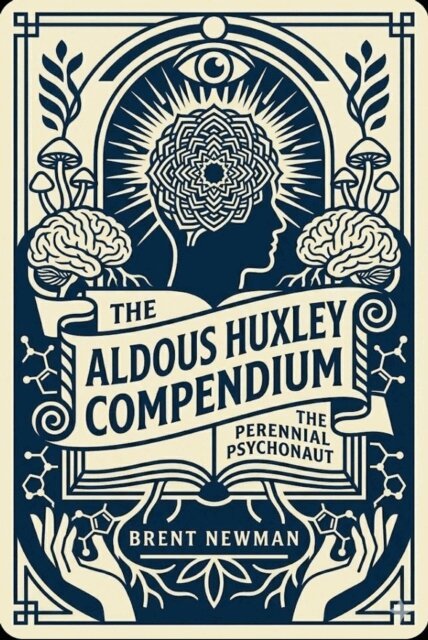
The Aldous Huxley Compendium: The Perennial PsychonautExplore the definitive collection of Aldous Huxley's life and legacy in this comprehensive complete edition. This volume traces the profound intellectual and spiritual migration of one of the twentieth century's most towering figures, moving from the cynical, razor-sharp social satire of his youth to the luminous, participatory mysticism of his final years. Through meticulous analysis and narrative storytelling, the work navigates the parallel worlds Huxley inhabited and created, offering a deep dive into the hereditary "e;Aristocracy of Intellect"e; that shaped his rigorous scientific mind and the personal crises, including a teenage bout with near-blindness, that forced the development of his famous "e;inner eye"e;.Witness the architectural origins of the modern dystopia as the text dissects the influence of Fordism and the American assembly line on the sterile, stable, but empty future of Brave New World. The edition explores the terrifying efficiency of biological engineering, the Bokanovsky Process, and the pharmacological "e;painless cage"e; of Soma—a prototype for the digital and chemical palliatives of our own era. This exploration serves as a haunting warning of a world that loves its servitude more than it fears a dictator, a "e;soft"e; totalitarianism where truth is not suppressed by a censor but drowned in a sea of irrelevant distraction.In a powerful rebuttal to this nightmare, the collection pivots to the utopian blueprints of Huxley's final novel, Island, and the concept of "e;Practical Mysticism"e;. Here, the "e;reducing valve"e; of the brain is not numbed but opened through the "e;reality-revealer"e; of Moksha-medicine and a lifelong training in awareness and somatic interoception. The book meticulously maps the "e;antipodes"e; of the mind—the exotic, remote regions of consciousness that reside beyond daily survival—categorizing the visionary landscapes of both "e;Heaven"e; and "e;Hell"e;.This complete edition connects Huxley's 1950s hypotheses to twenty-first-century neuroscience, proving his "e;Reducing Valve"e; theory was decades ahead of its time. It explores the "e;chemical bridge"e; of psychedelics not as an escape from reality, but as a deeper immersion into the "e;is-ness"e; and "e;suchness"e; of the world. From the clinical trials of the 1950s to the current therapeutic renaissance, the narrative follows Huxley to his final act: a conscious, chemically-assisted transition into the "e;Clear Light"e; on his deathbed, turning his own passing into the ultimate laboratory experiment and a final masterpiece of thematic consistency.