Brett Bowden - Böcker
Visar alla böcker från författaren Brett Bowden. Handla med fri frakt och snabb leverans.
13 produkter
13 produkter
584 kr
Tillfälligt slut
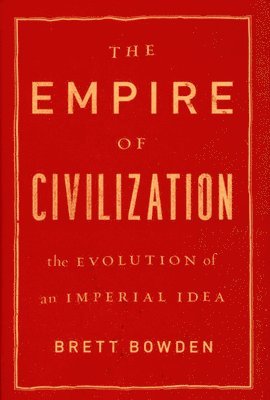
The term civilization comes with considerable baggage, dichotomizing people, cultures, and histories as civilized - or not. While the idea of civilization has been deployed throughout history to justify all manner of interventions and sociopolitical engineering, few scholars have stopped to consider what the concept actually means. Here, Brett Bowden examines how the idea of civilization has informed our thinking about international relations over the course of ten centuries. From the Crusades to the colonial era to the global war on terror, this sweeping volume exposes civilization as a stage-managed account of history that legitimizes imperialism, uniformity, and conformity to Western standards, culminating in a liberal-democratic global order. Along the way, Bowden explores the variety of confrontations and conquests - as well as those peoples and places excluded or swept aside - undertaken in the name of civilization. Concluding that the 'West and the rest' have more commonalities than differences, this provocative and engaging book ultimately points the way toward an authentic intercivilizational dialogue that emphasizes cooperation over clashes.
339 kr
Skickas inom 7-10 vardagar
The term "civilization" comes with considerable baggage, setting up a dichotomy wherein people, cultures, and histories are "civilized" - or not. While the idea of civilization has been deployed throughout history to justify all manner of interventions and socio political engineering, relatively few scholars have stopped to consider what the concept actually means. Here, Brett Bowden examines how the idea of civilization has informed our thinking about international relations over the course of ten centuries. From the Crusades to the colonial era to the global war on terror, this sweeping volume exposes civilization as a stage-managed account of history that legitimizes imperialism, uniformity, and conformity to Western standards, culminating in a liberal-democratic global order. Along the way, Bowden explores the variety of confrontations and conquests - as well as those peoples and places excluded or swept aside - undertaken in the name of civilization.Concluding that "the West and the rest" have more commonalities than differences, this provocative and engaging book ultimately points the way toward an authentic inter civilizational dialogue that emphasizes cooperation over clashes.
2 155 kr
Skickas inom 7-10 vardagar
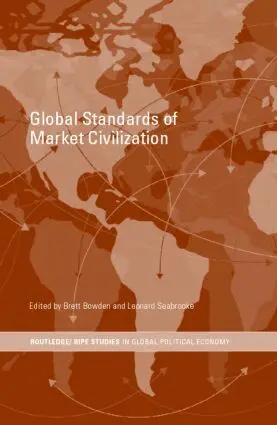
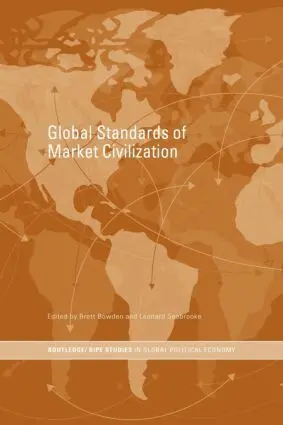
Global Standards of Market Civilization brings together leading scholars, representing a range of political views, to investigate how global 'standards of market civilization' have emerged, their justification, and their political, economic and social impact. Key chapters show how as the modern state system has evolved such standards have also developed, incorporating the capacity for social cooperation and self-government to which states must conform in order to fully participate as legitimate members in international society. This study analyzes their justification, and their political, economic and social impact. Civilization is a term widely used within modern political discourse its meaning, yet it is poorly understood and misused. part I explores the idea of a ‘standard of civilization’, its implications for governance, and the use of such standards in political theory and economic thought, as well as its historical applicationpart II presents original case studies that demonstrate the emergence of such standards and explore the diffusion of liberal capitalist ideas through the global political economy and the consequences for development and governance; the International Monetary Fund’s capacity to formulate a global standard of civilization in its reform programs; and problems in the development of the global trade, including the issue of intellectual property rights. This book will be of strong interest to students and scholars in wide range of fields relating to the study of globalization including: international political economy; international political theory; international relations theory; comparative political economy; international law; historical sociology; and economic history.
671 kr
Skickas inom 10-15 vardagar
Global Standards of Market Civilization brings together leading scholars, representing a range of political views, to investigate how global 'standards of market civilization' have emerged, their justification, and their political, economic and social impact. Key chapters show how as the modern state system has evolved such standards have also developed, incorporating the capacity for social cooperation and self-government to which states must conform in order to fully participate as legitimate members in international society. This study analyzes their justification, and their political, economic and social impact. Civilization is a term widely used within modern political discourse its meaning, yet it is poorly understood and misused. part I explores the idea of a ‘standard of civilization’, its implications for governance, and the use of such standards in political theory and economic thought, as well as its historical applicationpart II presents original case studies that demonstrate the emergence of such standards and explore the diffusion of liberal capitalist ideas through the global political economy and the consequences for development and governance; the International Monetary Fund’s capacity to formulate a global standard of civilization in its reform programs; and problems in the development of the global trade, including the issue of intellectual property rights. This book will be of strong interest to students and scholars in wide range of fields relating to the study of globalization including: international political economy; international political theory; international relations theory; comparative political economy; international law; historical sociology; and economic history.
Civilization
2009
11 500 kr
Skickas inom 10-15 vardagar
Especially since the end of the Cold War, the concept of ‘civilization’ has been frequently deployed by those who seek to describe and explain the world in which we live. The events of 11 September 2001, and the subsequent ‘war on terror’, have further elevated the concept's use in the discourse of politics and international relations. There has, for instance, been feverish speculation and increasingly heated rhetoric about struggles ‘for civilization’ or a possible ‘clash of civilizations’, particularly between the West and the Islamic world. The term is used both to describe—and to cast value-laden judgements about—people, places, and events. It is often misinterpreted and misapplied, with sometimes dangerous consequences.In response to the revival and misuse of ‘civilization’, this new four-volume collection from Routledge Major Works meets the need for an authoritative reference work to make sense of a vast and growing scholarly literature. It brings together canonical and the best cutting-edge research to provide a comprehensive overview of the origins, contested meanings, contextual applications, and general history of this critical concept.Volume I (‘The Origins and Meaning of Civilization’) is made up of the best work from a distinguished line-up of political scientists, philosophers, historians, sociologists, and linguists. It outlines the origins of the concept and its many and disputed meanings. This first volume establishes the foundations on which much of the analysis included in the three subsequent volumes is based. Volume II (‘Civilization, Civilizations, Progress, and History’) includes a range of materials that intimately outline the relationship between the ideal of civilization and the idea of progress, including progress in the social, cultural, moral, scientific, and political realms. Research gathered here further examines how the concepts of civilization and progress in turn relate to the more general passage of history, particularly the idea of history with a purpose. Volume III (‘Civilization and its Others’) brings together the best scholarship to explore what civilization is not. The scholarship collected here comes from some of history’s most distinguished political scientists, leading international lawyers, anthropologists, and controversial ethnologists. Can one, for example, usefully draw a distinction between civilized, savage, and barbarian peoples? The final volume (‘Civilizational Relations: Past, Present, and Future’) enables researchers and students to navigate through the equally sensitive field of historical and contemporary relations between the world’s major civilizations or religio-cultural groups. It includes the catalysts of debates such as ‘the clash-of-civilizations thesis’ and the responses it has provoked.With a full index, together with a comprehensive introduction, newly written by the editor, which places the collected material in its historical and intellectual context, Civilization is an essential work of reference. It is destined to be valued by scholars, students, and researchers of politics, political philosophy, and international relations—as well as those working in allied disciplines such as security studies and international law—as a vital research resource.
The Role of International Law in Rebuilding Societies after Conflict
Great Expectations
Inbunden, Engelska, 2009
733 kr
Skickas inom 7-10 vardagar
International law can create great expectations in those seeking to rebuild societies that have been torn apart by conflict. For outsiders, international law can mandate or militate against intervention, bolstering or undermining the legitimacy of intervention. International legal principles promise equality, justice and human rights. Yet international law's promises are difficult to fulfil. This volume of essays investigates the phenomenon of post-conflict state-building and the engagement of international law in this enterprise. It draws together original essays by scholars and practitioners who consider the many roles international law can play in rehabilitating societies after conflict. The essays explore troubled zones across the world, from Afghanistan to Africa's Great Lakes region, and from Timor-Leste to the Balkans. They identify a range of possibilities for international law in tempering, regulating, legitimating or undermining efforts to rebuild post-conflict societies.
The Role of International Law in Rebuilding Societies after Conflict
Great Expectations
Häftad, Engelska, 2012
491 kr
Skickas inom 7-10 vardagar
International law can create great expectations in those seeking to rebuild societies that have been torn apart by conflict. For outsiders, international law can mandate or militate against intervention, bolstering or undermining the legitimacy of intervention. International legal principles promise equality, justice and human rights. Yet international law's promises are difficult to fulfil. This volume of essays investigates the phenomenon of post-conflict state-building and the engagement of international law in this enterprise. It draws together original essays by scholars and practitioners who consider the many roles international law can play in rehabilitating societies after conflict. The essays explore troubled zones across the world, from Afghanistan to Africa's Great Lakes region, and from Timor-Leste to the Balkans. They identify a range of possibilities for international law in tempering, regulating, legitimating or undermining efforts to rebuild post-conflict societies.
1 626 kr
Skickas inom 7-10 vardagar
Civilization and war were born around the same time in roughly the same place they have effectively grown up together. This challenges the belief that the more civilized we become, the less likely the resort to war in order to resolve differences and disputes. The related assumption that civilized societies are more likely to abide by the rules of war is also in dispute. Where does terrorism fit into debates about civilized and savage war? What are we to make of talk about an impending 'clash of civilizations'? In a succinct yet wide ranging survey of history and of ideas that calls in to question a number of conventional wisdoms, Civilization and War explores these issues and more whilst outlining the two-way relationship between civilization and war.Providing an alternative perspective to conventional thinking, this book will appeal to a wide interdisciplinary audience across all regions of the globe. The material is both original and highly topical and is written in a sharp, snappy style that makes it accessible to a wide readership, including upper-level undergraduates, postgraduates, academic specialists and informed general readers. Civilization and War makes important contributions to the fields of international relations, peace and conflict studies, political theory and the history of ideas, and will be of interest to people with a curiosity about world history and current affairs.
389 kr
Skickas inom 7-10 vardagar
Civilization and war were born around the same time in roughly the same place they have effectively grown up together. This challenges the belief that the more civilized we become, the less likely the resort to war in order to resolve differences and disputes. The related assumption that civilized societies are more likely to abide by the rules of war is also in dispute. Where does terrorism fit into debates about civilized and savage war? What are we to make of talk about an impending 'clash of civilizations'? In a succinct yet wide ranging survey of history and of ideas that calls in to question a number of conventional wisdoms, Civilization and War explores these issues and more whilst outlining the two-way relationship between civilization and war.Providing an alternative perspective to conventional thinking, this book will appeal to a wide interdisciplinary audience across all regions of the globe. The material is both original and highly topical and is written in a sharp, snappy style that makes it accessible to a wide readership, including upper-level undergraduates, postgraduates, academic specialists and informed general readers. Civilization and War makes important contributions to the fields of international relations, peace and conflict studies, political theory and the history of ideas, and will be of interest to people with a curiosity about world history and current affairs.
96 kr
Skickas inom 7-10 vardagar
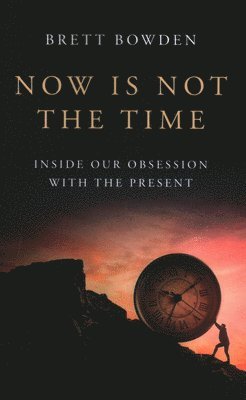
Human beings have an overwhelming tendency to overemphasize the significance of the present without considering context or historical perspective. For many, here and now is as good as it gets -�we have steadily progressed from a savage past, and all we have to look forward to is the great unknown. But if our literature and cinema are anything to go by, many are convinced that the future will indeed be dystopian. At the same time, arguments abound that living in the moment is a key to happiness and success. However, to privilege the present over the past or future, Brett Bowden argues, is to engage in tempocentrism. More than a mere preoccupation with the present, tempocentrism involves comparing and judging the past in relation to the present, with the tendency to assume that the present isn�t only materially and qualitatively different from the past but also superior to it, often morally so. Yet tempocentrism, a mistaken belief in the unprecedented nature of events going on around us, brings with it a skewed perspective loaded with bias and prejudice. Requiring just as much ignorance and arrogance as Eurocentrism -�tempocentrism implies that the present is somehow superior to the past because we live in it now. The point, however, is not to suggest that there is not�something special about the present -�there might well be -�but now is not the time to decide whether it is more significant than previous moments, or those still to come. Depending on the issue or event in question, the time for that is later � possibly hundreds or thousands of years later.
Sailing To Win: Guaranteed Winning Strategies To Navigate From The Back To The Front Of The Fleet
Häftad, Engelska, 2019
246 kr
Skickas inom 5-8 vardagar
588 kr
Skickas inom 10-15 vardagar
This book explores and explains the reasons why the idea of universal history, a form of teleological history which holds that all peoples are travelling along the same path and destined to end at the same point, persists in political thought.
588 kr
Skickas inom 10-15 vardagar
This book explores and explains the reasons why the idea of universal history, a form of teleological history which holds that all peoples are travelling along the same path and destined to end at the same point, persists in political thought.