Bretton A. Varga - Böcker
Visar alla böcker från författaren Bretton A. Varga. Handla med fri frakt och snabb leverans.
6 produkter
6 produkter
516 kr
Skickas inom 7-10 vardagar
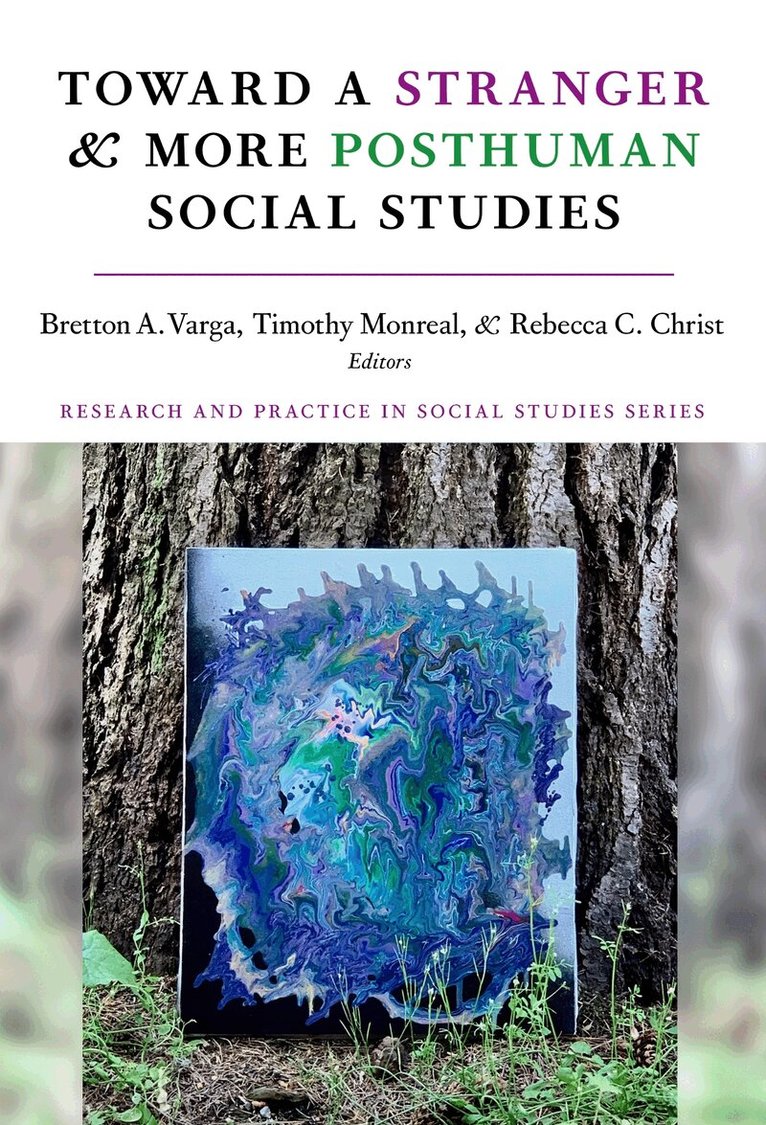
Posthumanism has seen a surge across the humanities and offers a unique perspective, seeking to illuminate the role that more-than-human actors (e.g., affect, artifacts, objects, flora, fauna, other materials) play in the human experience . This book challenges the field of social studies education to think differently about the precarious status of the world (i.e., climate crisis, ongoing fights for racial equity, and Indigenous sovereignty). By cultivating a greater sense of attunement to the more-than-human, educators and scholars can foster more ethical ways of teaching, learning, researching, being, and becoming. In an effort to push the boundaries of what constitutes social studies, chapter authors engage with a wide range of disciplines and offer unique perspectives from various locations across the globe. This volume asks: How can thinking with posthumanism disrupt normative approaches to social studies education and research in ways that promote imaginativeness, speculation, and nonconformity? How can a posthumanist lens be used to interrogate neoliberal, systemic, and oppressive conditions that reproduce and perpetuate in-humanness? Book Features:● A collection of essays that explore the phenomenon of posthuman approaches to social studies scholarship.● Contributions by many prominent social studies education scholars representing seven countries—Canada, Norway, Russia, Spain, Sweden, the United Kingdom, and the United States.● A foreword by Boni Wozolek and an afterword by Nathan Snaza, both of who have made significant contributions to critical posthumanism in education. ● Provocation chapters that push readers' thinking about the various ways that posthumanism connects to teaching and learning social studies.● Images of more-than-human entanglements (i.e., artwork, photography, poetry).
1 700 kr
Skickas inom 11-20 vardagar
Posthumanism has seen a surge across the humanities and offers a unique perspective, seeking to illuminate the role that more-than-human actors (e.g., affect, artifacts, objects, flora, fauna, other materials) play in the human experience . This book challenges the field of social studies education to think differently about the precarious status of the world (i.e., climate crisis, ongoing fights for racial equity, and Indigenous sovereignty). By cultivating a greater sense of attunement to the more-than-human, educators and scholars can foster more ethical ways of teaching, learning, researching, being, and becoming. In an effort to push the boundaries of what constitutes social studies, chapter authors engage with a wide range of disciplines and offer unique perspectives from various locations across the globe. This volume asks: How can thinking with posthumanism disrupt normative approaches to social studies education and research in ways that promote imaginativeness, speculation, and nonconformity? How can a posthumanist lens be used to interrogate neoliberal, systemic, and oppressive conditions that reproduce and perpetuate in-humanness? Book Features:● A collection of essays that explore the phenomenon of posthuman approaches to social studies scholarship.● Contributions by many prominent social studies education scholars representing seven countries—Canada, Norway, Russia, Spain, Sweden, the United Kingdom, and the United States.● A foreword by Boni Wozolek and an afterword by Nathan Snaza, both of who have made significant contributions to critical posthumanism in education. ● Provocation chapters that push readers' thinking about the various ways that posthumanism connects to teaching and learning social studies.● Images of more-than-human entanglements (i.e., artwork, photography, poetry).
516 kr
Skickas inom 7-10 vardagar
Theory holds the capacity to help educators see the world differently, challenge problematic assumptions and practices that cultivate harm, and illuminate pathways towards access, equity, justice, joy, and love. While it is easy to underestimate the role of theory in such pursuits throughout social studies education, this book shows that theory is always-already present in all productions of teaching and learning. In this collection, well-established scholars highlight a broad range of theories that are currently being used to alter the landscape of social studies instruction. Important to these efforts is the position that theory does not exist in a vacuum but rather is the reflection of a certain set of concepts and the relationship that one holds to those ideas. Taking this further, each chapter author employs storytelling as a means to share their personal history and unpack how they came to understand their selected theoretical topic. They address a breadth of concepts, such as Black feminism, psychoanalysis, racial capitalism, settler colonialism, sustainability, and technoskepticism. Book Features:The only resource of its kind that pairs storying with a far-reaching range of theories actively being used by scholars in the field of social studies education and research.Brief chapters, arranged alphabetically by concept, provide structure while also staying true to the book's framing of theory as being curious, fragmented, nomadic, and discursive.Embedded connections within each chapter meant to help readers understand the relational and entangled nature of theory.
1 534 kr
Skickas inom 7-10 vardagar
Theory holds the capacity to help educators see the world differently, challenge problematic assumptions and practices that cultivate harm, and illuminate pathways towards access, equity, justice, joy, and love. While it is easy to underestimate the role of theory in such pursuits throughout social studies education, this book shows that theory is always-already present in all productions of teaching and learning. In this collection, well-established scholars highlight a broad range of theories that are currently being used to alter the landscape of social studies instruction. Important to these efforts is the position that theory does not exist in a vacuum but rather is the reflection of a certain set of concepts and the relationship that one holds to those ideas. Taking this further, each chapter author employs storytelling as a means to share their personal history and unpack how they came to understand their selected theoretical topic. They address a breadth of concepts, such as Black feminism, psychoanalysis, racial capitalism, settler colonialism, sustainability, and technoskepticism. Book Features:The only resource of its kind that pairs storying with a far-reaching range of theories actively being used by scholars in the field of social studies education and research.Brief chapters, arranged alphabetically by concept, provide structure while also staying true to the book's framing of theory as being curious, fragmented, nomadic, and discursive.Embedded connections within each chapter meant to help readers understand the relational and entangled nature of theory.
1 923 kr
Kommande
Minerals and metals underpin our everyday existence, woven into the creation of nearly all consumer products. Yet the extraction process of ripping them from the earth fuels often toxic global geopolitical relationships, colonization, and conflict. Despite their fundamental importance, these materials are too often unseen, unappreciated, and unnoticed. This lack of awareness occludes critical opportunities for researchers, educators, and students to engage with the complex relationships between people, products, and the environment.Spatial Woundings: Entanglements of Minings, Metals, and Extractions explores how extractivist logics continue to cultivate devastation, plunder, and ecological precarity, focusing on the concept of spatial wounding—the myriad ways landscapes and living systems are subjected to the violence of extraction. This damage is comprehensive, encompassing alterations to the physical landscape as well as injury inflicted upon people, animals, plants, and atmospheres.Featuring a collection of international scholars, this urgent book surveys the contours of these devastating outcomes alongside crucial efforts to resist the logics that perpetuate them, ultimately reimagining the role of metals and extraction in cultural, popular, and social contexts. The volume is structured in three sections: Part I details historical experiences and intimate stories of spatial wounding; Part II offers analytical engagements with mining as a metaphor in media and technology; and Part III considers the broader empires, extraction, and more-than-human damage, addressing colonial legacies and anticolonial ethics in resource governance.
Hauntological Social Studies
More-Than-Human Deviances, Imbrications, and Proliferations of Possibility
Inbunden, Engelska, 2025
1 482 kr
Skickas inom 10-15 vardagar
This edited volume operationalizes the figure of the ghost and subsequent hauntings through Derrida’s framing of 'hauntology'—in an effort to attend to the liminal spaces that exist between presence and absence throughout social studies contexts (and beyond). Traditionally, social studies education and its tenets of economics, civics, geography, government, and history have been concerned with how bodies become (re)produced, (re)located, destroyed, and remembered across vectors of time. However, as this work argues, the maintenance of strict demarcations of time becomes problematic by closing opportunities for students to engage with the complex ways that (material) bodies shift within temporal encounters. As such, this book is primarily concerned with pursuing—and positioning—such haunted encounters as generative lines of inquiry that grant us (e.g., educators, students, researchers) the ability to think differently about history, the present, and the future. In a distinct move toward a 'pastpresentfuture', this volume challenges the boundaries of social studies teaching, learning, and research by interrupting majoritarian temporal/material positionings that stymie how social and ecological justice is narrativized, understood, and perhaps most significantly, attained in the future.