Brian Capon – författare
Visar alla böcker från författaren Brian Capon. Handla med fri frakt och snabb leverans.
3 produkter
3 produkter
Häftad, Engelska, 2022
215 kr
Skickas inom 5-8 vardagar
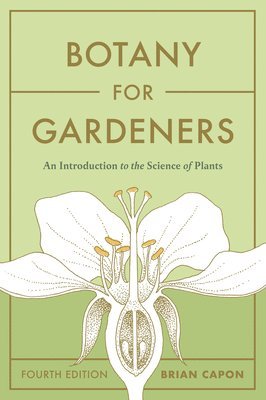
“This should be the cornerstone of every gardener’s library.” —Jeff Gillman, Director of the Botanical Gardens at the University of North Carolina What happens inside a seed after it is planted? How are plants structured? How do plants reproduce? The answers to these and other questions about complex plant processes can be found in the bestselling Botany for Gardeners. First published in 1990 with more than 260,000 copies sold, it has become the go-to introduction to botany for students and gardeners. Now in its fourth edition, Botany for Gardeners has been expanded and updated. It features a revised interior, with new photos and illustrations that clarify the concepts clearer than ever before. Additional updates address scientific advances, changes in nomenclature and taxonomy, and more. As before, Botany for Gardeners shares accessible information about how plants are organized, how they have adapted to nearly all environments on earth, their essential functions, and how they reproduce.
Häftad, Engelska, 2009
178 kr
Skickas inom 5-8 vardagar
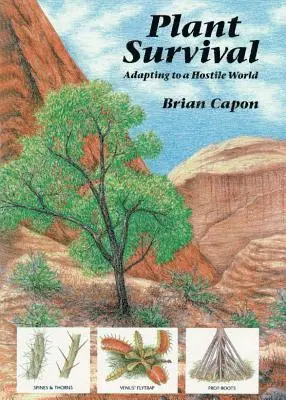
Unlike animals that can run from danger or migrate to a more hospitable environment, plants must rely on adaptations that permit them to survive where they are. The fascinating mechanisms that plants employ to survive in challenging environments are clearly explained and illustrated in this primer, suitable for young and mature readers alike. This book is only available through print on demand. All interior art is black and white.
Häftad, Engelska, 2012
542 kr
Skickas inom 10-15 vardagar
Neighboring group participation is a term which encompasses all intra- molecular reactions and all reactions which involve nonelectrostatic through-space interactions between groups within the same molecule. The term was invented in 1942 by Saul Winstein, whose many contributions to the growth and maturing of the subject are unequaled. Although the inventor of the term, Winstein was not the first worker to study neighboring group participation. An examination of Beilstein will show that many intramolecular reactions were known to the synthetic organic chemist weIl before the turn ofthe century, and as early as 1891 W. P. Evans, working at Giessen, described a kinetic investigation of the base-promoted cycliza- ti on of ethylene chlorohydrins to ethylene oxides-an important intra- molecular reaction. He was followed some twenty years later by Freundlich, whose va1uab1e studies on participation by the amino group began to appear in 1911. Freundlich was later joined by Salomon, who by the mid-thirties had developed a reasonable understanding of the efficiency of the neigh- boring amino group in acyclic systems.In the late twenties to mid-thirties the subject began to expand with the work of Bennett on participation by thioether groups, Nilsson and Smith on neighboring hydroxyl, and Caldin and Wolfenden on neighboring carboxylate, and with discussions of the dependence of cyclization rates on ring size by Ruzicka, Salomon, and Bennett.