Brian Castellani - Böcker
Visar alla böcker från författaren Brian Castellani. Handla med fri frakt och snabb leverans.
9 produkter
9 produkter
652 kr
Skickas inom 10-15 vardagar
The Brexit vote; the election of Trump; the upsurge of European nationalism; the devolution of the Arab Spring; global violence; Chinese expansionism; disruptive climate change; the riotous instabilities of the world capitalist system…While diverse in nature, these events share a common denominator: they are less a failure of policy, and more a complex social psychological reaction to globalization, the result of which presently threatens our survival on Earth.Based on a critical reading of Freud’s Civilization and its discontents, The defiance of global commitment constructs a complex social psychology of how people all over the world are addressing globalization. Drawing on the latest advances in the cognitive, social, and complexity sciences, this timely volume presents a global model of defiance and the triangular tensions between nostalgic retreat, global aggression, and civil society, as manifested in forms ranging from nostalgic resentment and LGBTQI issues to racism and ecological aggression. Revealing how globalization and its discontents manifest the darker reaches of the human psyche and its conflicted relations with others, this insightful monograph will appeal to undergraduate and postgraduate students, as well as postdoctoral researchers, interested in fields such as globalization studies, complexity sciences and social psychology.
1 057 kr
Tillfälligt slut
This first book on the history of gambling examines how it became a major social problem in the United States, and how it was made into a medical disorder.Although pathological gambling has been a field of study and treatment for over forty years, its story has remained unwritten. That is until now. Brian Castellani is the first to write a book on its history and its medicalization.Although pathological gambling has been a field of study and treatment for over forty years, its story has remained unwritten. That is until now. Brian Castellani is the first to write a book on its history and its medicalization.
566 kr
Skickas inom 3-6 vardagar
This first book on the history of gambling examines how it became a major social problem in the United States, and how it was made into a medical disorder.Although pathological gambling has been a field of study and treatment for over forty years, its story has remained unwritten. That is until now. Brian Castellani is the first to write a book on its history and its medicalization.Although pathological gambling has been a field of study and treatment for over forty years, its story has remained unwritten. That is until now. Brian Castellani is the first to write a book on its history and its medicalization.
2 030 kr
Skickas inom 10-15 vardagar
The Brexit vote; the election of Trump; the upsurge of European nationalism; the devolution of the Arab Spring; global violence; Chinese expansionism; disruptive climate change; the riotous instabilities of the world capitalist system…While diverse in nature, these events share a common denominator: they are less a failure of policy, and more a complex social psychological reaction to globalization, the result of which presently threatens our survival on Earth.Based on a critical reading of Freud’s Civilization and its discontents, The defiance of global commitment constructs a complex social psychology of how people all over the world are addressing globalization. Drawing on the latest advances in the cognitive, social, and complexity sciences, this timely volume presents a global model of defiance and the triangular tensions between nostalgic retreat, global aggression, and civil society, as manifested in forms ranging from nostalgic resentment and LGBTQI issues to racism and ecological aggression. Revealing how globalization and its discontents manifest the darker reaches of the human psyche and its conflicted relations with others, this insightful monograph will appeal to undergraduate and postgraduate students, as well as postdoctoral researchers, interested in fields such as globalization studies, complexity sciences and social psychology.
630 kr
Skickas inom 7-10 vardagar
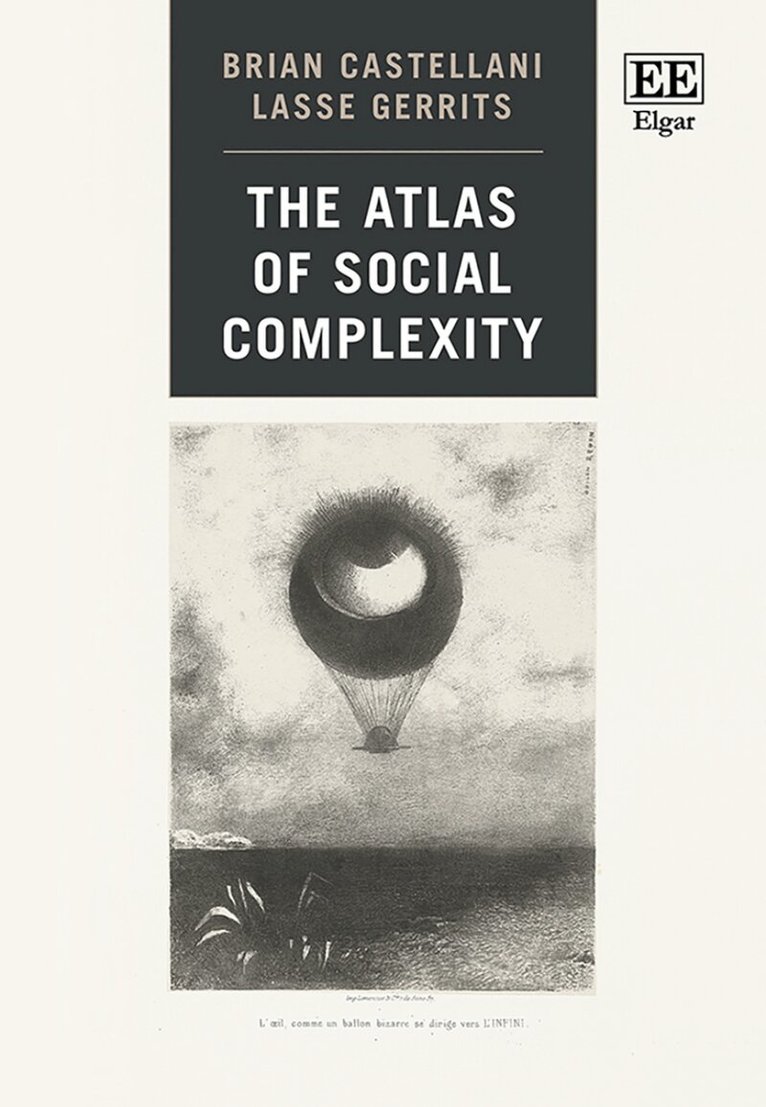
Embark on a riveting journey through the study of social complexity with The Atlas of Social Complexity. Over three decades of scientific exploration unfold, unravelling the enigmatic threads that compose the fabric of society. From the dance of bacteria, to human-machine interactions, to the ever-shifting dynamics of power in social networks, this Atlas maps the evolution of our understanding of social complexity.Brian Castellani’s and Lasse Gerrits’ Atlas is not merely retrospective. It is a compass pointing to uncharted territories: new directions for research and intellectual debate. With wit and insight, they invite the reader to ponder unanswered questions, taking them on a quest for alternative ways to understand the intricate complexities of societies.The Atlas of Social Complexity is a thrilling expedition into the heart of what makes us human: from cognition, emotion, consciousness, the dynamics of human psychology, to social networks, collective behaviour, politics and governance, technology and planning, and the practice of social interventions. The Atlas also visits cross-cutting themes such as intersectionality, configurational complexity, and research methods.Organised around six transdisciplinary themes and twenty-four topics the Atlas is an invaluable resource for all social science and complexity science scholars and students interested in new ideas and new ways of working in social complexity. It paves the way for the next generation of research in the study of social complexity.
2 503 kr
Skickas inom 7-10 vardagar
Embark on a riveting journey through the study of social complexity with The Atlas of Social Complexity. Over three decades of scientific exploration unfold, unravelling the enigmatic threads that compose the fabric of society. From the dance of bacteria, to human-machine interactions, to the ever-shifting dynamics of power in social networks, this Atlas maps the evolution of our understanding of social complexity.Brian Castellani’s and Lasse Gerrits’ Atlas is not merely retrospective. It is a compass pointing to uncharted territories: new directions for research and intellectual debate. With wit and insight, they invite the reader to ponder unanswered questions, taking them on a quest for alternative ways to understand the intricate complexities of societies.The Atlas of Social Complexity is a thrilling expedition into the heart of what makes us human: from cognition, emotion, consciousness, the dynamics of human psychology, to social networks, collective behaviour, politics and governance, technology and planning, and the practice of social interventions. The Atlas also visits cross-cutting themes such as intersectionality, configurational complexity, and research methods.Organised around six transdisciplinary themes and twenty-four topics the Atlas is an invaluable resource for all social science and complexity science scholars and students interested in new ideas and new ways of working in social complexity. It paves the way for the next generation of research in the study of social complexity.
715 kr
Skickas inom 10-15 vardagar
The history of public health has focused on direct relationships between problems and solutions: vaccinations against diseases, ad campaigns targeting risky behaviors. But the accelerating pace and mounting intricacies of our lives are challenging the field to find new scientific methods for studying community health. The complexities of place (COP) approach is emerging as one such promising method. Place and Health as Complex Systems demonstrates how COP works, making an empirical case for its use in for designing and implementing interventions. This brief resource reviews the defining characteristics of places as dynamic and evolving social systems, rigorously testing them as well as the COP approach itself. The study, of twenty communities within one county in the Midwest, combines case-based methods and complexity science to determine whether COP improves upon traditional statistical methods of public health research. Its conclusions reveal strengths and limitations of the approach, immediate possibilities for its use, and challenges regarding future research. Included in the coverage: Characteristics of places and the complexities of place approach.The Definitional Test of Complex Systems.Case-based modeling using the SACS toolkit.Methods, maps, and measures used in the study.Places as nodes within larger networks.Places as power-based conflicted negotiations. Place and Health as Complex Systems brings COP into greater prominence in public health research, and is also valuable to researchers in related fields such asdemography, health geography, community health, urban planning, and epidemiology.
1 064 kr
Skickas inom 10-15 vardagar
By now, most academics have heard something about the new science of complexity. In a manner reminiscent of Einstein and the last hundred years of physics, complexity science has captured the public imagination. ® One can go to Amazon. com and purchase books on complexification (Casti 1994), emergence (Holland 1998), small worlds (Barabási 2003), the web of life (Capra 1996), fuzzy thinking (Kosko 1993), global c- plexity (Urry 2003) and the business of long-tails (Anderson 2006). Even television has incorporated the topics of complexity science. Crime shows ® ® such as 24 or CSI typically feature investigators using the latest advances in computational modeling to “simulate scenarios” or “data mine” all p- sible suspects—all of which is done before the crime takes place. The ® World Wide Web is another example. A simple search on Google. Com using the phrase “complexity science” gets close to a million hits! C- plexity science is ubiquitous. What most scholars do not realize, however, is the remarkable role sociologists are playing in this new science. C- sider the following examples. 0. 1 Sociologists in Complexity Science The first example comes from the new science of networks (Barabási 2003). By now, most readers are familiar with the phenomena known as six-degrees of separation—the idea that, because most large networks are comprised of a significant number of non-random weak-ties, the nodes (e. g. , people, companies, etc.
1 064 kr
Skickas inom 10-15 vardagar
By now, most academics have heard something about the new science of complexity. In a manner reminiscent of Einstein and the last hundred years of physics, complexity science has captured the public imagination. ® One can go to Amazon. com and purchase books on complexification (Casti 1994), emergence (Holland 1998), small worlds (Barabási 2003), the web of life (Capra 1996), fuzzy thinking (Kosko 1993), global c- plexity (Urry 2003) and the business of long-tails (Anderson 2006). Even television has incorporated the topics of complexity science. Crime shows ® ® such as 24 or CSI typically feature investigators using the latest advances in computational modeling to “simulate scenarios” or “data mine” all p- sible suspects—all of which is done before the crime takes place. The ® World Wide Web is another example. A simple search on Google. Com using the phrase “complexity science” gets close to a million hits! C- plexity science is ubiquitous. What most scholars do not realize, however, is the remarkable role sociologists are playing in this new science. C- sider the following examples. 0. 1 Sociologists in Complexity Science The first example comes from the new science of networks (Barabási 2003). By now, most readers are familiar with the phenomena known as six-degrees of separation—the idea that, because most large networks are comprised of a significant number of non-random weak-ties, the nodes (e. g. , people, companies, etc.