Brian Corbitt - Böcker
Visar alla böcker från författaren Brian Corbitt. Handla med fri frakt och snabb leverans.
3 produkter
3 produkter
1 105 kr
Skickas inom 10-15 vardagar
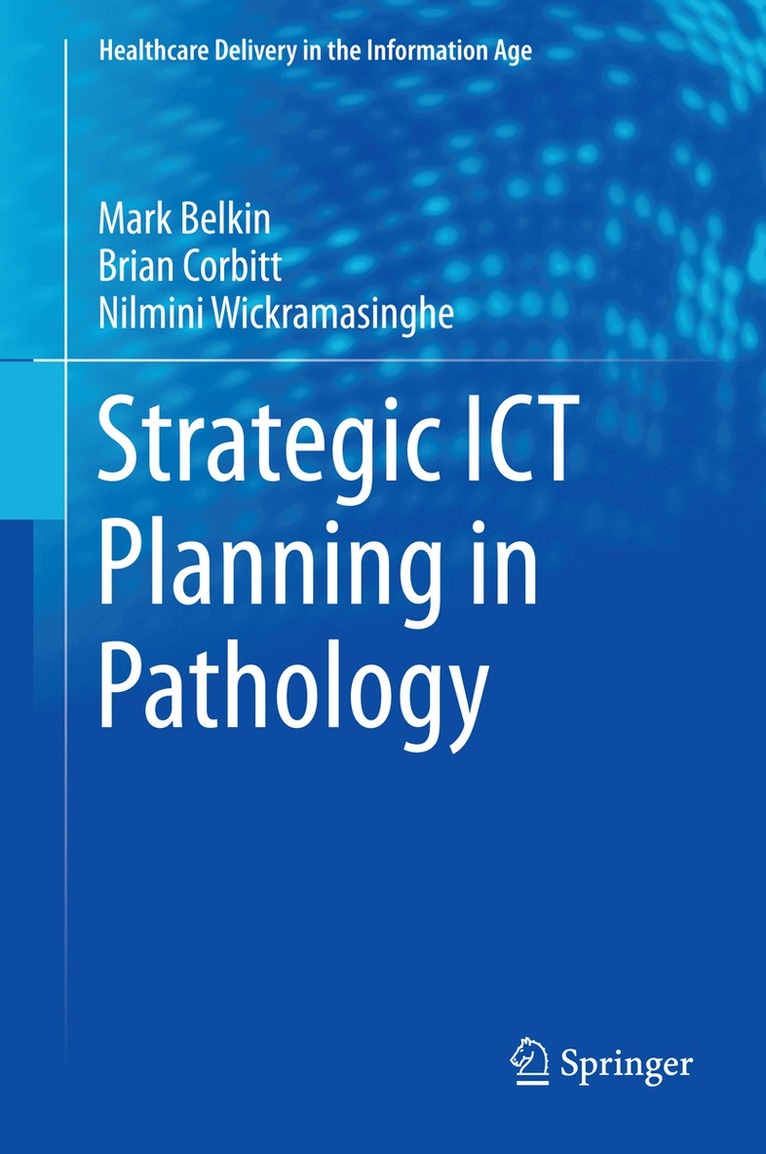
There is little doubt that information technology is a major force in transforming healthcare systems: physicians need to have considerable patient data at hand, even if diagnosis and treatment are relatively straightforward. But data are only as useful as ICT—information communication technology—systems make them. Inefficient handling of data can quickly lead to chaos, and possibly to fatalities. Strategic ICT Planning in Pathology illuminates these problems, as well as their potential solutions, based on a unique body of research from Australia. Focusing on core strategic factors such as laboratory information systems capability and effectiveness, business-IT alignment, strategic spending, research and education, and end-user involvement, the book explains why pathology labs lag behind other hospital departments. Survey and focus group findings pinpoint the importance of Strategic Information System Planning (SISP), and its relationship to quality service delivery and an improved bottom line [ok?]. Among the topics covered: Approaches to SISP and IS effectiveness measurement. The OpenLabs project and pathology practice. Development of a framework for SISP. Focus groups: the view from the hospital laboratory, the private pathology lab, and the experts. Key findings and their implications for strategy, planning, and business outcomes. Future research directions, including reverse SISP. Strategic ICT Planning in Pathology is a go-to resource for healthcare administrators and researchers in healthcare management, health policy, and health services research interested in troubleshooting systems, conducting surveys on IS, or better understanding how quality ICT works.
1 105 kr
Skickas inom 10-15 vardagar
There is little doubt that information technology is a major force in transforming healthcare systems: physicians need to have considerable patient data at hand, even if diagnosis and treatment are relatively straightforward. But data are only as useful as ICT—information communication technology—systems make them. Inefficient handling of data can quickly lead to chaos, and possibly to fatalities. Strategic ICT Planning in Pathology illuminates these problems, as well as their potential solutions, based on a unique body of research from Australia. Focusing on core strategic factors such as laboratory information systems capability and effectiveness, business-IT alignment, strategic spending, research and education, and end-user involvement, the book explains why pathology labs lag behind other hospital departments. Survey and focus group findings pinpoint the importance of Strategic Information System Planning (SISP), and its relationship to quality service delivery and an improved bottom line [ok?]. Among the topics covered: Approaches to SISP and IS effectiveness measurement. The OpenLabs project and pathology practice. Development of a framework for SISP. Focus groups: the view from the hospital laboratory, the private pathology lab, and the experts. Key findings and their implications for strategy, planning, and business outcomes. Future research directions, including reverse SISP. Strategic ICT Planning in Pathology is a go-to resource for healthcare administrators and researchers in healthcare management, health policy, and health services research interested in troubleshooting systems, conducting surveys on IS, or better understanding how quality ICT works.
Advances in Web-Based Learning -- ICWL 2003
Second International Conference, Melbourne, Australia, August 18-20, 2003, Proceedings
Häftad, Engelska, 2003
1 043 kr
Skickas inom 10-15 vardagar
This book constitutes the refereed proceedings of the Second International Conference on Web-based learning, ICWL 2003, held in Melbourne, Australia in August 2003. The 50 revised full papers presented were carefully reviewed and selected from 118 submissions. The papers are organized in topical sections on Web-based learning environments, the virtual university, paedagoical issues, multimedia-based e-learning, interactivity, intelligence in online education, innovative curricula in e-learning, e-learning solutions, and computer supported cooperative learning.