Brian J. Gerber - Böcker
Visar alla böcker från författaren Brian J. Gerber. Handla med fri frakt och snabb leverans.
3 produkter
3 produkter
4 537 kr
Skickas inom 5-8 vardagar
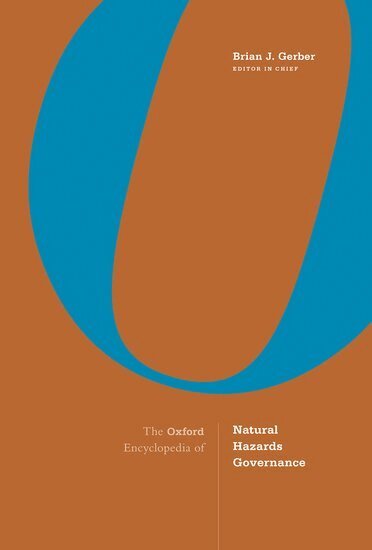
Natural hazards, such as floods, hurricanes, earthquakes, typhoons, and wildfires, present significant challenges for managing risk and vulnerability. It is crucial to understand how communities, nations, and international regimes and organizations attempt to manage risk and promote resilience in the face of major disruption to the built and natural environment and social systems. The Oxford Encyclopedia of Natural Hazards Governance offers an integrated framework for defining, assessing, and understanding natural hazards governance practices, processes, and dynamics - a framework that is essential for addressing these challenges. Through a collection of over 85 peer-reviewed articles, written by global experts in their fields, it provides a uniquely comprehensive treatment and current state of knowledge of the range of key governance issues. Led by Editor in Chief Brian J. Gerber and Associate Editors Thomas A. Birkland, Ann-Margaret Esnard, Bruce Glavovic, Timothy Sim, Christine Wamsler, and Benjamin Wisner, the work addresses key theoretic gaps on hazards governance in general, and clarifies the sometimes disjointed research coverage of hazards governance on different scales, with national, international, local, regional, and comparative perspectives. It provides a comprehensive framework for clarifying how governance processes and practices are related to variations in actual performance in terms of natural hazard events, and explicates a broad range of critical conceptual issues in natural hazards governance by providing syntheses of extant knowledge.
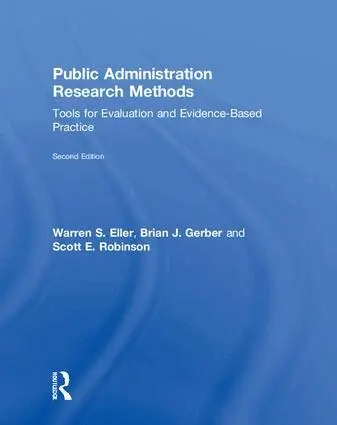
Public Administration Research Methods
Tools for Evaluation and Evidence-Based Practice
Inbunden, Engelska, 2018
2 760 kr
Skickas inom 10-15 vardagar
The best decisions made by public managers are based not on instinct, but on an informed understanding of what’s happening on the ground. Policy may be directed by ideology, but it must also be founded on reality. The challenge of making the right decisions as a public manager is often, therefore, based on the need for rigorous, actionable research. Now in a thoughtfully revised second edition, this textbook shows students of Public Administration exactly how to use both qualitative and quantitative research techniques to give them the best chance to make the right decisions.Uniquely, Eller, Gerber, and Robinson present research methodologies through a series of real-life case studies, with each chapter exploring situations where a public manager can use research to answer specific questions, demonstrating how that research can inform future policy. Taking readers through the key concepts, from research design and sampling to interviews, survey data, and more statistical-based approaches, this new edition provides a complete guide to using research in the public and voluntary sectors. New to this edition:To better orient the student, the second edition is thematically arranged. Five sections, each with a short essay, provide not only previews of the content of each section, but more importantly guide the reader through how the concepts and techniques covered relate to real-world use and application.A new chapter on applied quantitative analyses has been added to offer coverage of several commonly-used and valuable analytic techniques for decision making for policy and management: benefit-cost analysis, risk assessment, and forecasting.The second edition is accompanied by online materials containing suggested course plans and sample syllabi, PowerPoint lecture slides, and student support materials to illustrate the application of key concepts and analytic techniques.Each chapter also includes discussion questions, class exercises, end of chapter review questions, and key vocabulary to provide students with a range of further tools to apply research principles to practical situations.
Public Administration Research Methods
Tools for Evaluation and Evidence-Based Practice
Häftad, Engelska, 2018
1 322 kr
Skickas inom 10-15 vardagar
The best decisions made by public managers are based not on instinct, but on an informed understanding of what’s happening on the ground. Policy may be directed by ideology, but it must also be founded on reality. The challenge of making the right decisions as a public manager is often, therefore, based on the need for rigorous, actionable research. Now in a thoughtfully revised second edition, this textbook shows students of Public Administration exactly how to use both qualitative and quantitative research techniques to give them the best chance to make the right decisions.Uniquely, Eller, Gerber, and Robinson present research methodologies through a series of real-life case studies, with each chapter exploring situations where a public manager can use research to answer specific questions, demonstrating how that research can inform future policy. Taking readers through the key concepts, from research design and sampling to interviews, survey data, and more statistical-based approaches, this new edition provides a complete guide to using research in the public and voluntary sectors. New to this edition:To better orient the student, the second edition is thematically arranged. Five sections, each with a short essay, provide not only previews of the content of each section, but more importantly guide the reader through how the concepts and techniques covered relate to real-world use and application.A new chapter on applied quantitative analyses has been added to offer coverage of several commonly-used and valuable analytic techniques for decision making for policy and management: benefit-cost analysis, risk assessment, and forecasting.The second edition is accompanied by online materials containing suggested course plans and sample syllabi, PowerPoint lecture slides, and student support materials to illustrate the application of key concepts and analytic techniques.Each chapter also includes discussion questions, class exercises, end of chapter review questions, and key vocabulary to provide students with a range of further tools to apply research principles to practical situations.