Brian P. Copenhaver - Böcker
Visar alla böcker från författaren Brian P. Copenhaver. Handla med fri frakt och snabb leverans.
13 produkter
13 produkter
1 146 kr
Skickas inom 5-8 vardagar
Giovanni Pico della Mirandola has been a beacon of progress in modern times, and the Oration on the Dignity of Man has been the engine of his fame. But he never wrote a speech about the dignity of man. The prince's speech announced quite different projects: persuading Christians to become Kabbalists in order to annihilate themselves in God; and convincing philosophers that their path to saving wisdom was concord rather than disputation.Pico della Mirandola On Trial: Heresy, Freedom, and Philosophy shows that Pico's work was in no way progressive - or 'humanist' - and that his main authorities were medieval clerics and theologians, not secular Renaissance intellectuals. The evidence is Pico's Apology, his self-defence against heresy charges: this public polemic reveals more about him than the famous speech that he never gave and that deliberately kept its message secret. The orator's method in the Oration was esoteric, but the defendant in the Apology made his case openly in a voice that was academic and belligerent, not prophetic or poetic.Since the middle of the last century, textbooks written for college students have promoted only one Pico, a hero of progressive humanism. But his Conclusions and Apology, products of late medieval culture, were in no way progressive. The grim scene of the Apology, his report on a battle for life and honor, was the proximate medieval past where human history was despised as the annals of sin. To understand Pico's universe of dismal expectations, our best guide is his Apology, based on lessons learned from medieval teachers.
555 kr
Skickas inom 5-8 vardagar
The Renaissance has long been recognized as a brilliant moment in the development of Western civilization. However, little attention has been devoted to the distinct contributions of philosophy to Renaissance culture. This volume introduces the reader to the philosophy written, read, taught, and debated during the period traditionally credited with the `revival of learning'. The authors examine the relation of Renaissance philosophy to humanism and the universities, the impact of rediscovered ancient sources, the recovery of Plato and the Neoplatonists, and the evolving ascendancy of Aristotle. Renaissance Philosophy also explores the original contributions of major figures including Bruni, Valla, Ficino, Pico della Mirandola, Pomponazzi, Machiavelli, More, Vitoria, Montaigne, Bruno, and Campanella. Renaissance Philosophy demonstrates the uses of ancient and medieval philosophy by Renaissance thinkers, and throws light on the early modern origins of modern philosophy.
Peter of Spain: Summaries of Logic
Text, Translation, Introduction, and Notes
Inbunden, Engelska, 2014
2 214 kr
Skickas inom 7-10 vardagar
For nearly four centuries, when logic was the heart of what we now call the 'undergraduate curriculum', Peter of Spain's Summaries of Logic (c. 1230) was the basis for teaching that subject. Because Peter's students were teenagers, he wrote simply and organized his book carefully. Since no book about logic was read by more people until the twentieth century, the Summaries has extensively and profoundly influenced the distinctly Western way of speaking formally and writing formal prose by constructing well-formed sentences, making valid arguments, and refuting and defending arguments in debate. Some books, like the Authorized Version of the English Bible and the collected plays of Shakespeare, have been more influential in the Anglophone world than Peter's Summaries--but not many. This new English translation, based on an update of the Latin text of Lambertus De Rijk, comes with an extensive introduction that deals with authorship, dating, and the place of the Summaries in the development of logic, before providing a chapter-by-chapter analysis of Peter's book, followed by an analysis of his system from the point of view of modern logic. The Latin text is presented on facing pages with the English translation, accompanied by notes, and the book includes a full bibliography.
Hermetica
The Greek Corpus Hermeticum and the Latin Asclepius in a New English Translation, with Notes and Introduction
Häftad, Engelska, 1995
735 kr
Skickas inom 7-10 vardagar
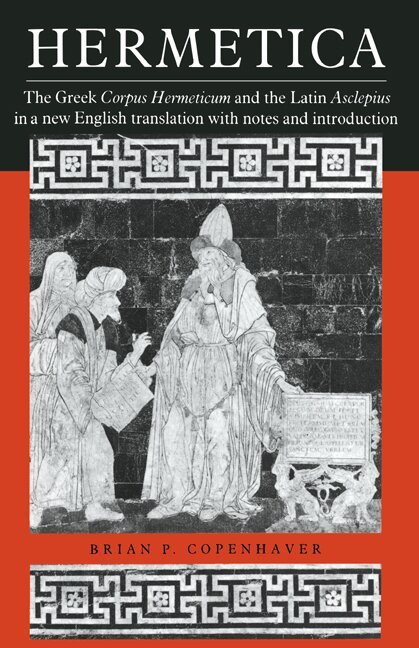
The Hermetica are a body of theological-philosophical texts written in late antiquity, but long believed to be much older. Their supposed author, Hermes Trismegistus, was thought to be a contemporary of Moses, and the Hermetic philosophy was regarded as an ancient theology, parallel to the received wisdom of the Bible. This first English translation based on reliable texts, together with Brian P. Copenhaver's comprehensive introduction, provide an indispensable resource to scholars in ancient philosophy and religion, early Christianity, Renaissance literature, and history, the history of science, and the occultist tradition in which the Hermetica have become canonical texts.
282 kr
Skickas inom 7-10 vardagar
The Italian humanist Polydore Vergil (1470-1555) was born in Urbino but spent most of his life in early Tudor England. His most popular work, On Discovery (De inventoribus rerum, 1499), was the first comprehensive account of discoveries and inventions written since antiquity. Thirty Latin editions of this work were published in Polydore's lifetime, and by the eighteenth century more than a hundred editions had appeared in eight languages, including Russian. On Discovery became a key reference for anyone who wanted to know about "firsts" in theology, philosophy, science, technology, literature, language, law, material culture, and other fields. Polydore took his information from dozens of Greek, Roman, biblical, and Patristic authorities. His main point was to show that many Greek and Roman claims for discovery were false and that ancient Jews or other Asian peoples had priority. This is the first English translation of a critical edition based on the Latin texts published in Polydore Vergil's lifetime.
282 kr
Skickas inom 7-10 vardagar
Lorenzo Valla (1407–1457) ranks among the greatest scholars and thinkers of the Renaissance. He secured lasting fame for his brilliant critical skills, most famously in his exposure of the “Donation of Constantine,” the forged document upon which the papacy based claims to political power. Lesser known in the English-speaking world is Valla’s work in the philosophy of language—the basis of his reputation as the greatest philosopher of the humanist movement.Dialectical Disputations, translated here for the first time into any modern language, is his principal contribution to the philosophy of language and logic. With this savage attack on the scholastic tradition of Aristotelian logic, Valla aimed to supersede it with a new logic based on the actual historical usage of classical Latin and on a commonsense approach to semantics and argument. Valla provides a logic that could be used by lawyers, preachers, statesmen, and others who needed to succeed in public debate—one that was stylistically correct and rhetorically elegant, and thus could dispense with the technical language of the scholastics, a “tribe of Peripatetics, perverters of natural meanings.” Valla’s reformed dialectic became a milestone in the development of humanist logic and contains startling anticipations of modern theories of semantics and language.Volume 1 contains Book I, in which Valla refutes Aristotle’s logical works on the categories, transcendentals, and predicables, with excursions into natural and moral philosophy and theology.
247 kr
Tillfälligt slut
Lorenzo Valla (1407–1457) ranks among the greatest scholars and thinkers of the Renaissance. He secured lasting fame for his brilliant critical skills, most famously in his exposure of the “Donation of Constantine,” the forged document upon which the papacy based claims to political power. Lesser known in the English-speaking world is Valla’s work in the philosophy of language—the basis of his reputation as the greatest philosopher of the humanist movement.Dialectical Disputations, translated here for the first time into any modern language, is his principal contribution to the philosophy of language and logic. With this savage attack on the scholastic tradition of Aristotelian logic, Valla aimed to supersede it with a new logic based on the actual historical usage of classical Latin and on a commonsense approach to semantics and argument. Valla provides a logic that could be used by lawyers, preachers, statesmen, and others who needed to succeed in public debate—one that was stylistically correct and rhetorically elegant, and thus could dispense with the technical language of the scholastics, a “tribe of Peripatetics, perverters of natural meanings.” Valla’s reformed dialectic became a milestone in the development of humanist logic and contains startling anticipations of modern theories of semantics and language.Volume 2 contains Books II–III, in which Valla refutes Aristotle’s logical works on propositions, topics, and the syllogistic.
Magic and the Dignity of Man
Pico della Mirandola and His Oration in Modern Memory
Inbunden, Engelska, 2019
556 kr
Skickas inom 10-15 vardagar
“This book is nothing less than the definitive study of a text long considered central to understanding the Renaissance and its place in Western culture.” —James Hankins, Harvard UniversityPico della Mirandola died in 1494 at the age of thirty-one. During his brief and extraordinary life, he invented Christian Kabbalah in a book that was banned by the Catholic Church after he offered to debate his ideas on religion and philosophy with anyone who challenged him. Today he is best known for a short speech, the Oration on the Dignity of Man, written in 1486 but never delivered. Sometimes called a “Manifesto of the Renaissance,” this text has been regarded as the foundation of humanism and a triumph of secular rationality over medieval mysticism.Brian Copenhaver upends our understanding of Pico’s masterwork by re-examining this key document of modernity. An eminent historian of philosophy, Copenhaver shows that the Oration is not about human dignity. In fact, Pico never wrote an Oration on the Dignity of Man and never heard of that title. Instead he promoted ascetic mysticism, insisting that Christians need help from Jews to find the path to heaven—a journey whose final stages are magic and Kabbalah. Through a rigorous philological reading of this much-studied text, Copenhaver transforms the history of the idea of dignity and reveals how Pico came to be misunderstood over the course of five centuries. Magic and the Dignity of Man is a seismic shift in the study of one of the most remarkable thinkers of the Renaissance.
282 kr
Skickas inom 7-10 vardagar
A groundbreaking edition of controversial theses proposed by the most famous philosopher of the Italian Renaissance.Giovanni Pico della Mirandola (1463–1494), the most famous philosopher of the Italian Renaissance, had ambitions in line with his talents, especially in philosophical theology. His boldest venture urged Christians to save their souls with Jewish mysticism—Kabbalah—while also offering to debate anyone in Italy about his project. In 1486, he announced plans for a disputation in Rome on 900 theses, but Pope Innocent VIII quashed the event with an indictment for crimes against Christian orthodoxy.Pico’s theses cited well-known scholastic authorities: Muslims like Ibn Rushd, Jews like Maimonides, and Christians like John Duns Scotus and Thomas Aquinas. But as Brian Copenhaver demonstrates in Nine Hundred Conclusions, many of Pico’s scholastic sources were filtered through a less renowned Thomist theologian named Jean Cabrol (Capreolus). Pico also sought to enrich Christian theology with newly available authorities from the Platonic and Pythagorean traditions as well as theosophical texts associated with ancient Orphism and Hermetism. Supreme among his authorities were theses taken from medieval Jewish Kabbalah, which Pico regarded as an angelic revelation and tried to appropriate for Christianity. The present volume is a ground-breaking contribution, containing a new critical edition of the Latin text along with a new translation into contemporary English, a detailed introduction, and a commentary discussing each of the 900 theses individually.
324 kr
Skickas inom 7-10 vardagar
Giannozzo Manetti (1396–1459) was a celebrated diplomat, historian, philosopher, and humanist scholar of the early Renaissance who mastered ancient Greek and Hebrew as well as classical Latin. In this treatise, dedicated to Alfonso of Aragon, King of Naples, Manetti addresses a question central to the anthropology of the Renaissance: what are the moral, intellectual, and spiritual capabilities of the unique amalgam of body and soul that constitutes human nature? The treatise takes issue with a popular work of medieval asceticism, On the Misery of the Human Condition, written by none other than Innocent III, one of the greatest of medieval popes. The pope’s diatribe expresses a revulsion against human nature and argues for the futility of ambition, the emptiness of pleasures, and the ultimate worthlessness of human achievements. Manetti’s treatise presents a comprehensive refutation of the pope’s pessimism, sometimes citing the achievements of the Renaissance as evidence for the potential divinity of human nature and its extraordinary capabilities. This edition contains the first complete translation into English.
1 719 kr
Skickas inom 7-10 vardagar
The story of the beliefs and practices called 'magic' starts in ancient Iran, Greece, and Rome, before entering its crucial Christian phase in the Middle Ages. Centering on the Renaissance and Marsilio Ficino - whose work on magic was the most influential account written in premodern times - this groundbreaking book treats magic as a classical tradition with foundations that were distinctly philosophical. Besides Ficino, the premodern story of magic also features Plotinus, Iamblichus, Proclus, Aquinas, Agrippa, Pomponazzi, Porta, Bruno, Campanella, Descartes, Boyle, Leibniz, and Newton, to name only a few of the prominent thinkers discussed in this book. Because pictures play a key role in the story of magic, this book is richly illustrated.
473 kr
Skickas inom 7-10 vardagar
The story of the beliefs and practices called 'magic' starts in ancient Iran, Greece, and Rome, before entering its crucial Christian phase in the Middle Ages. Centering on the Renaissance and Marsilio Ficino - whose work on magic was the most influential account written in premodern times - this groundbreaking book treats magic as a classical tradition with foundations that were distinctly philosophical. Besides Ficino, the premodern story of magic also features Plotinus, Iamblichus, Proclus, Aquinas, Agrippa, Pomponazzi, Porta, Bruno, Campanella, Descartes, Boyle, Leibniz, and Newton, to name only a few of the prominent thinkers discussed in this book. Because pictures play a key role in the story of magic, this book is richly illustrated.
Symphorien Champier and the Reception of the Occultist Tradition in Renaissance France
Inbunden, Engelska, 1978
1 510 kr
Skickas inom 7-10 vardagar
No detailed description available for "Symphorien Champier and the Reception of the Occultist Tradition in Renaissance France".