Brian R. Hunt – författare
Visar alla böcker från författaren Brian R. Hunt. Handla med fri frakt och snabb leverans.
8 produkter
8 produkter
E-bok
PDF, Engelska, 20131 347 kr
Läs direkt efter köp
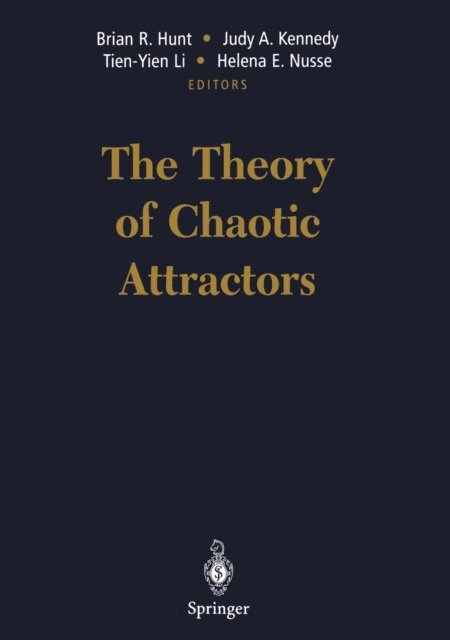
The editors felt that the time was right for a book on an important topic, the history and development of the notions of chaotic attractors and their "natu ral" invariant measures. We wanted to bring together a coherent collection of readable, interesting, outstanding papers for detailed study and comparison. We hope that this book will allow serious graduate students to hold seminars to study how the research in this field developed. Limitation of space forced us painfully to exclude many excellent, relevant papers, and the resulting choice reflects the interests of the editors. Since James Alan Yorke was born August 3, 1941, we chose to have this book commemorate his sixtieth birthday, honoring his research in this field. The editors are four of his collaborators. We would particularly like to thank Achi Dosanjh (senior editor math ematics), Elizabeth Young (assistant editor mathematics), Joel Ariaratnam (mathematics editorial), and Yong-Soon Hwang (book production editor) from Springer Verlag in New York for their efforts in publishing this book.
Inbunden, Engelska, 2004
1 084 kr
Skickas inom 10-15 vardagar
The editors felt that the time was right for a book on an important topic, the history and development of the notions of chaotic attractors and their "natu ral" invariant measures. We wanted to bring together a coherent collection of readable, interesting, outstanding papers for detailed study and comparison. We hope that this book will allow serious graduate students to hold seminars to study how the research in this field developed. Limitation of space forced us painfully to exclude many excellent, relevant papers, and the resulting choice reflects the interests of the editors. Since James Alan Yorke was born August 3, 1941, we chose to have this book commemorate his sixtieth birthday, honoring his research in this field. The editors are four of his collaborators. We would particularly like to thank Achi Dosanjh (senior editor math ematics), Elizabeth Young (assistant editor mathematics), Joel Ariaratnam (mathematics editorial), and Yong-Soon Hwang (book production editor) from Springer Verlag in New York for their efforts in publishing this book.
Häftad, Engelska, 1998
676 kr
Skickas inom 7-10 vardagar
This book is a short, focused introduction to Mathematica, the comprehensive software system for doing mathematics. Written for the beginning user, this engaging book contains an explanation of essential Mathematica commands, as well as the rich Mathematica interface for preparing polished technical documents. Mathematica can be used to graph functions, solve equations, perform statistics tests, and much more. In addition, it incorporates word processing and desktop publishing features for combining mathematical computations with text and graphics, and producing polished, integrated, interactive documents. You can even use it to create documents and graphics for the Web. This book explains everything you need to know to begin using Mathematica to do all these things and more. Written for Mathematica Version 3, this book can also be used with earlier versions of Mathematica, and even intermediate and advanced users may find useful information here, especially if they are making the switch to Version 3 from an earlier version.
Häftad, Engelska, 2014
744 kr
Skickas inom 7-10 vardagar
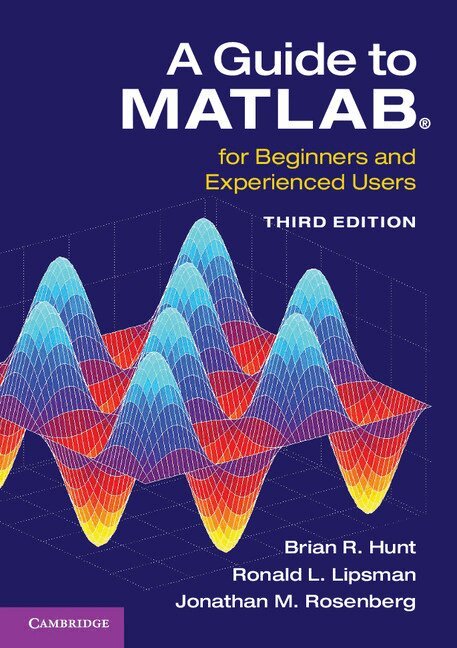
Now in its third edition, this outstanding textbook explains everything you need to get started using MATLAB®. It contains concise explanations of essential MATLAB commands, as well as easily understood instructions for using MATLAB's programming features, graphical capabilities, simulation models, and rich desktop interface. MATLAB 8 and its new user interface is treated extensively in the book. New features in this edition include: a complete treatment of MATLAB's publish feature; new material on MATLAB graphics, enabling the user to master quickly the various symbolic and numerical plotting routines; and a robust presentation of MuPAD® and how to use it as a stand-alone platform. The authors have also updated the text throughout, reworking examples and exploring new applications. The book is essential reading for beginners, occasional users and experienced users wishing to brush up their skills. Further resources are available from the authors' website at www-math.umd.edu/schol/a-guide-to-matlab.html.
Häftad, Engelska, 2012
865 kr
Skickas inom 11-20 vardagar
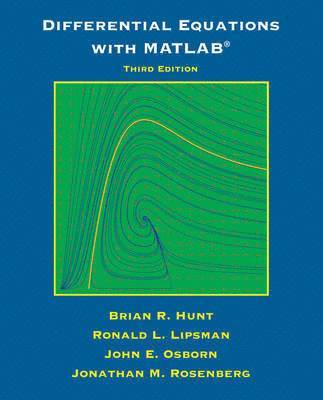
A supplemental text that can enrich and enhance any first course in ordinary differential equationsThis supplement helps instructors move towards an earlier use of numerical and geometric methods, place a greater emphasis on systems (including nonlinear ones), and increase discussions of both the benefits and possible pitfalls in numerical solution of ODEs. By providing an introduction to the software that is integrated with the relevant mathematics, Differential Equations with MATLAB can perfectly complement and enhance other texts from Wiley.Since the third edition of Differential Equations with MATLAB first appeared in 2012, there have been many changes and enhancements to MATLAB and Simulink. These include addition of live scripts, new plotting commands, and major changes to the Symbolic Math Toolbox. This revised version brings the text completely up to date with the 2019a release of MATLAB.
E-bok
Engelska, 2014849 kr
Läs direkt efter köp
Now in its third edition, this outstanding textbook explains everything you need to get started using MATLAB®. It contains concise explanations of essential MATLAB commands, as well as easily understood instructions for using MATLAB''s programming features, graphical capabilities, simulation models, and rich desktop interface. MATLAB 8 and its new user interface is treated extensively in the book. New features in this edition include: a complete treatment of MATLAB''s publish feature; new material on MATLAB graphics, enabling the user to master quickly the various symbolic and numerical plotting routines; and a robust presentation of MuPAD® and how to use it as a stand-alone platform. The authors have also updated the text throughout, reworking examples and exploring new applications. The book is essential reading for beginners, occasional users and experienced users wishing to brush up their skills. Further resources are available from the authors'' website at www-math.umd.edu/schol/a-guide-to-matlab.html.
E-bok
PDF, Engelska, 2014880 kr
Läs direkt efter köp
Now in its third edition, this outstanding textbook explains everything you need to get started using MATLAB®. It contains concise explanations of essential MATLAB commands, as well as easily understood instructions for using MATLAB''s programming features, graphical capabilities, simulation models, and rich desktop interface. MATLAB 8 and its new user interface is treated extensively in the book. New features in this edition include: a complete treatment of MATLAB''s publish feature; new material on MATLAB graphics, enabling the user to master quickly the various symbolic and numerical plotting routines; and a robust presentation of MuPAD® and how to use it as a stand-alone platform. The authors have also updated the text throughout, reworking examples and exploring new applications. The book is essential reading for beginners, occasional users and experienced users wishing to brush up their skills. Further resources are available from the authors'' website at www-math.umd.edu/schol/a-guide-to-matlab.html.
Häftad, Engelska, 2011
1 069 kr
Skickas inom 10-15 vardagar
The editors felt that the time was right for a book on an important topic, the history and development of the notions of chaotic attractors and their "natu ral" invariant measures. We wanted to bring together a coherent collection of readable, interesting, outstanding papers for detailed study and comparison. We hope that this book will allow serious graduate students to hold seminars to study how the research in this field developed. Limitation of space forced us painfully to exclude many excellent, relevant papers, and the resulting choice reflects the interests of the editors. Since James Alan Yorke was born August 3, 1941, we chose to have this book commemorate his sixtieth birthday, honoring his research in this field. The editors are four of his collaborators. We would particularly like to thank Achi Dosanjh (senior editor math ematics), Elizabeth Young (assistant editor mathematics), Joel Ariaratnam (mathematics editorial), and Yong-Soon Hwang (book production editor) from Springer Verlag in New York for their efforts in publishing this book.