Brian Rogers – författare
Visar alla böcker från författaren Brian Rogers. Handla med fri frakt och snabb leverans.
18 produkter
18 produkter
E-bok
Engelska, 20162 044 kr
Läs direkt efter köp
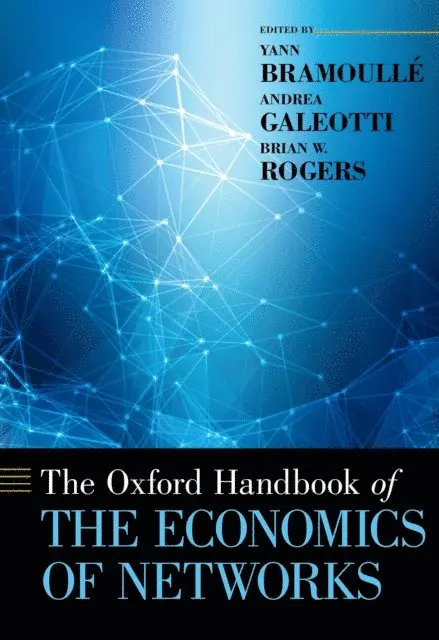
The Oxford Handbook of the Economics of Networks represents the frontier of research into how and why networks they form, how they influence behavior, how they help govern outcomes in an interactive world, and how they shape collective decision making, opinion formation, and diffusion dynamics. From a methodological perspective, the contributors to this volume devote attention to theory, field experiments, laboratory experiments, and econometrics. Theoretical work in network formation, games played on networks, repeated games, and the interaction between linking and behavior is synthesized. A number of chapters are devoted to studying social process mediated by networks. Topics here include opinion formation, diffusion of information and disease, and learning. There are also chapters devoted to financial contagion and systemic risk, motivated in part by the recent financial crises. Another section discusses communities, with applications including social trust, favor exchange, and social collateral; the importance of communities for migration patterns; and the role that networks and communities play in the labor market. A prominent role of networks, from an economic perspective, is that they mediate trade. Several chapters cover bilateral trade in networks, strategic intermediation, and the role of networks in international trade. Contributions discuss as well the role of networks for organizations. On the one hand, one chapter discusses the role of networks for the performance of organizations, while two other chapters discuss managing networks of consumers and pricing in the presence of network-based spillovers. Finally, the authors discuss the internet as a network with attention to the issue of net neutrality.
E-bok
PDF, Engelska, 201787 kr
Läs direkt efter köp
Perception is one of the oldest and most deeply investigated topics in the field of psychology, and it is also raises some profound philosophical questions. It is concerned with how we use the information reaching our senses to guide and control our behaviour as well as to create our particular, subjective experiences of the surrounding world. In this Very Short Introduction, Brian J. Rogers discusses the philosophical question of what it means to perceive, as well as describing how we are able to perceive the particular characteristics of objects and scenes such as their lightness, colour, form, depth, and motion. What we perceive, however, does not always correspond to what exists in the world and, as Rogers shows, the study of illusions can be useful in telling us something about the nature and limitations of our perceptual processes. Rogers also explores perception from an evolutionary perspective, explaining how evolutionary pressures have shaped the perceptual systems of humans and other animals. He shows that perception is not necessarily a separate and independent process but rather part of a ''perceptual system'', involving both the extraction of perceptual information and the control of action. Rogers goes on to cover the significant progress made recently in the understanding of perception through the use of precise and controlled psychophysical methods, single cell recordings, and imaging techniques. There have also been many insights from attempts to model perceptual processes in artificial systems. As Rogers shows, these attempts have revealed how difficult it is to programme machines to perform even the most simple of perceptual tasks that we take for granted. ABOUT THE SERIES: The Very Short Introductions series from Oxford University Press contains hundreds of titles in almost every subject area. These pocket-sized books are the perfect way to get ahead in a new subject quickly. Our expert authors combine facts, analysis, perspective, new ideas, and enthusiasm to make interesting and challenging topics highly readable.
E-bok
Engelska, 201787 kr
Läs direkt efter köp
Perception is one of the oldest and most deeply investigated topics in the field of psychology, and it is also raises some profound philosophical questions. It is concerned with how we use the information reaching our senses to guide and control our behaviour as well as to create our particular, subjective experiences of the surrounding world. In this Very Short Introduction, Brian J. Rogers discusses the philosophical question of what it means to perceive, as well as describing how we are able to perceive the particular characteristics of objects and scenes such as their lightness, colour, form, depth, and motion. What we perceive, however, does not always correspond to what exists in the world and, as Rogers shows, the study of illusions can be useful in telling us something about the nature and limitations of our perceptual processes. Rogers also explores perception from an evolutionary perspective, explaining how evolutionary pressures have shaped the perceptual systems of humans and other animals. He shows that perception is not necessarily a separate and independent process but rather part of a ''perceptual system'', involving both the extraction of perceptual information and the control of action. Rogers goes on to cover the significant progress made recently in the understanding of perception through the use of precise and controlled psychophysical methods, single cell recordings, and imaging techniques. There have also been many insights from attempts to model perceptual processes in artificial systems. As Rogers shows, these attempts have revealed how difficult it is to programme machines to perform even the most simple of perceptual tasks that we take for granted. ABOUT THE SERIES: The Very Short Introductions series from Oxford University Press contains hundreds of titles in almost every subject area. These pocket-sized books are the perfect way to get ahead in a new subject quickly. Our expert authors combine facts, analysis, perspective, new ideas, and enthusiasm to make interesting and challenging topics highly readable.
Häftad, Engelska, 2017
103 kr
Skickas
Perception is one of the oldest and most deeply investigated topics in the field of psychology, and it is also raises some profound philosophical questions. It is concerned with how we use the information reaching our senses to guide and control our behaviour as well as to create our particular, subjective experiences of the surrounding world.In this Very Short Introduction, Brian J. Rogers discusses the philosophical question of what it means to perceive, as well as describing how we are able to perceive the particular characteristics of objects and scenes such as their lightness, colour, form, depth, and motion. What we perceive, however, does not always correspond to what exists in the world and, as Rogers shows, the study of illusions can be useful in telling us something about the nature and limitations of our perceptual processes. Rogers also explores perception from an evolutionary perspective, explaining how evolutionary pressures have shaped the perceptual systems of humans and other animals. He shows that perception is not necessarily a separate and independent process but rather part of a 'perceptual system', involving both the extraction of perceptual information and the control of action. Rogers goes on to cover the significant progress made recently in the understanding of perception through the use of precise and controlled psychophysical methods, single cell recordings, and imaging techniques. There have also been many insights from attempts to model perceptual processes in artificial systems. As Rogers shows, these attempts have revealed how difficult it is to programme machines to perform even the most simple of perceptual tasks that we take for granted.ABOUT THE SERIES: The Very Short Introductions series from Oxford University Press contains hundreds of titles in almost every subject area. These pocket-sized books are the perfect way to get ahead in a new subject quickly. Our expert authors combine facts, analysis, perspective, new ideas, and enthusiasm to make interesting and challenging topics highly readable.
Inbunden, Engelska, 2016
2 596 kr
Skickas inom 5-8 vardagar
The Oxford Handbook of the Economics of Networks represents the frontier of research into how and why networks form, how they influence behavior, how they help govern outcomes in an interactive world, and how they shape collective decision making, opinion formation, and diffusion dynamics. From a methodological perspective, the contributors to this volume devote attention to theory, field experiments, laboratory experiments, and econometrics. Theoretical work in network formation, games played on networks, repeated games, and the interaction between linking and behavior is synthesized. A number of chapters are devoted to studying social process mediated by networks. Topics here include opinion formation, diffusion of information and disease, and learning. There are also chapters devoted to financial contagion and systemic risk, motivated in part by the recent financial crises. Another section discusses communities, with applications including social trust, favor exchange, and social collateral; the importance of communities for migration patterns; and the role that networks and communities play in the labor market. A prominent role of networks, from an economic perspective, is that they mediate trade. Several chapters cover bilateral trade in networks, strategic intermediation, and the role of networks in international trade. Contributions discuss as well the role of networks for organizations. On the one hand, one chapter discusses the role of networks for the performance of organizations, while two other chapters discuss managing networks of consumers and pricing in the presence of network-based spillovers. Finally, the authors discuss the internet as a network with attention to the issue of net neutrality.
E-bok
PDF, Engelska, 20162 044 kr
Läs direkt efter köp
The Oxford Handbook of the Economics of Networks represents the frontier of research into how and why networks they form, how they influence behavior, how they help govern outcomes in an interactive world, and how they shape collective decision making, opinion formation, and diffusion dynamics. From a methodological perspective, the contributors to this volume devote attention to theory, field experiments, laboratory experiments, and econometrics. Theoretical work in network formation, games played on networks, repeated games, and the interaction between linking and behavior is synthesized. A number of chapters are devoted to studying social process mediated by networks. Topics here include opinion formation, diffusion of information and disease, and learning. There are also chapters devoted to financial contagion and systemic risk, motivated in part by the recent financial crises. Another section discusses communities, with applications including social trust, favor exchange, and social collateral; the importance of communities for migration patterns; and the role that networks and communities play in the labor market. A prominent role of networks, from an economic perspective, is that they mediate trade. Several chapters cover bilateral trade in networks, strategic intermediation, and the role of networks in international trade. Contributions discuss as well the role of networks for organizations. On the one hand, one chapter discusses the role of networks for the performance of organizations, while two other chapters discuss managing networks of consumers and pricing in the presence of network-based spillovers. Finally, the authors discuss the internet as a network with attention to the issue of net neutrality.
Inbunden, Engelska, 2016
1 488 kr
Skickas inom 7-10 vardagar
This edition of G. E. Moore's notes taken at Wittgenstein's seminal Cambridge lectures in the early 1930s provides, for the first time, an almost verbatim record of those classes. The presentation of the notes is both accessible and faithful to their original manuscripts, and a comprehensive introduction and synoptic table of contents provide the reader with essential contextual information and summaries of the topics in each lecture. The lectures form an excellent introduction to Wittgenstein's middle-period thought, covering a broad range of philosophical topics, ranging from core questions in the philosophy of language, mind, logic, and mathematics, to illuminating discussions of subjects on which Wittgenstein says very little elsewhere, including ethics, religion, aesthetics, psychoanalysis, and anthropology. The volume also includes a 1932 essay by Moore critiquing Wittgenstein's conception of grammar, together with Wittgenstein's response. A companion website offers access to images of the entire set of source manuscripts.
Häftad, Engelska, 2019
419 kr
Skickas inom 7-10 vardagar
This edition of G. E. Moore's notes taken at Wittgenstein's seminal Cambridge lectures in the early 1930s provides, for the first time, an almost verbatim record of those classes. The presentation of the notes is both accessible and faithful to their original manuscripts, and a comprehensive introduction and synoptic table of contents provide the reader with essential contextual information and summaries of the topics in each lecture. The lectures form an excellent introduction to Wittgenstein's middle-period thought, covering a broad range of philosophical topics, ranging from core questions in the philosophy of language, mind, logic, and mathematics, to illuminating discussions of subjects on which Wittgenstein says very little elsewhere, including ethics, religion, aesthetics, psychoanalysis, and anthropology. The volume also includes a 1932 essay by Moore critiquing Wittgenstein's conception of grammar, together with Wittgenstein's response. A companion website offers access to images of the entire set of source manuscripts.
E-bok
Engelska61 kr
Läs direkt efter köp
Häftad, Tyska, 2023
295 kr
Skickas inom 5-8 vardagar
Del 1 - History for Kids
Lewis and Clark Expedition
A History Just For Kids!
Häftad, Engelska, 2019
129 kr
Skickas inom 5-8 vardagar
E-bok
Engelska, 202354 kr
Läs direkt efter köp
Before there was television, before there were computers, before there was the Internet with its audio and video streaming, before there were cell phones, iPods, and iPads, there was radio. Beginning in the early 1920s, electrical waves—mysterious to many—could be sent from senders or transmitters into boxes called radios in people’s homes. Sometimes the boxes weren’t boxes at all. In radio’s earliest days, hobbyists built radios (called crystal sets) with wire and empty oatmeal boxes or similar materials. By 1930, radios were becoming massive pieces of wooden furniture proudly residing in living rooms. At first, the waves carried talks and music from transmitters in cities into radios nearby. But, in 1926, dependable chains or networks of radio stations were being put together with telephone wires, and people in many cities could listen to the same programs simultaneously. In the 1930s, local vocalists and other performers were being replaced on the air by network shows that informed, entertained, and enlightened. During the Great Depression, free entertainment coming over the radio helped ease evenings spent fretting over lack of employment and unpaid bills. Programs such as Fibber McGee and Molly and Jack Benny brought laughter into millions of homes. Suspense and similar shows inspired terror, and Dragnet and Your FBI in Peace and War brought mystery. As World War II neared, and all through the conflict, radio instantly brought into homes everywhere news of major and minor events. Because of radio’s immediacy, we learned, the same day, when Pearl Harbor was attacked, when Allied soldiers landed in France, and when surrender agreements were signed with Germany and Japan. In his book, Brian Rogers, in a collection of articles based on material he has researched and written for various radio hobby publications, introduces some of the events and personalities that made up the golden age of radio, roughly from 1930 to 1960, and the decade preceding when radio was taking its first electronic baby steps. He also shares his personal story with old-time radio and how, with warmly glowing vacuum tubes, his own hand-me-down radio brought friends to a boy who thought he had no friends.
Häftad, Engelska, 2023
267 kr
Skickas inom 5-8 vardagar
Häftad, Engelska, 2022
2 247 kr
Skickas inom 5-8 vardagar
Effective risk management in law firms has never been more important. Lawyers must contend with the long-standing risks associated with the practice of law, such as anti-money laundering and issues of client confidentiality, as well as new risk areas such as data protection and cybersecurity, and increased regulatory burdens. Poor handling of these risks can lead to reputational damage, diminished client relationships, and even regulatory action, and so it is critical for law firms to remain vigilant and put in place robust risk management policies, processes and systems.Risk Management in Law Firms brings together lawyers, consultants and other risk and compliance professionals to provide expert and practical guidance on essential risk management topics. Chapters cover risks relating to clients, internal operations and law and regulation, and address recent developments including issues arising from the shift to hybrid working, the increased focus on ESG and climate change, and the extended influence of clients through outside counsel guidelines. There is also consideration of the future of risk management with coverage of the proposed changes to the SRA Codes of Conduct to address issues relating to wellbeing and unfair treatment at work, and the commercial opportunities for law firms and individual lawyers presented by the increasingly flexible principles-based regulation.This title aims to help law firm leaders and individual lawyers understand and prepare for the risks they face – as well effectively handle them when issues do arise – whether they occur in the firm’s internal operations or its dealings with clients. In-house counsel and others will also find it useful to understand their law firm colleagues better, enhancing professional relationships. With the comprehensive coverage of key risk areas in this title, lawyers and firms can not only ensure compliance, but also maintain healthy client relationships, educated staff, a positive reputation, and continued success and growth.
E-bok
Engelska, 20222 170 kr
Läs direkt efter köp
Effective risk management in law firms has never been more important. Lawyers must contend with the long-standing risks associated with the practice of law, such as anti-money laundering and issues of client confidentiality, as well as new risk areas such as data protection and cybersecurity, and increased regulatory burdens. Poor handling of these risks can lead to reputational damage, diminished client relationships, and even regulatory action, and so it is critical for law firms to remain vigilant and put in place robust risk management policies, processes and systems.Risk Management in Law Firms brings together lawyers, consultants and other risk and compliance professionals to provide expert and practical guidance on essential risk management topics. Chapters cover risks relating to clients, internal operations and law and regulation, and address recent developments including issues arising from the shift to hybrid working, the increased focus on ESG and climate change, and the extended influence of clients through outside counsel guidelines. There is also consideration of the future of risk management with coverage of the proposed changes to the SRA Codes of Conduct to address issues relating to wellbeing and unfair treatment at work, and the commercial opportunities for law firms and individual lawyers presented by the increasingly flexible principles-based regulation.This title aims to help law firm leaders and individual lawyers understand and prepare for the risks they face – as well effectively handle them when issues do arise – whether they occur in the firm’s internal operations or its dealings with clients. In-house counsel and others will also find it useful to understand their law firm colleagues better, enhancing professional relationships. With the comprehensive coverage of key risk areas in this title, lawyers and firms can not only ensure compliance, but also maintain healthy client relationships, educated staff, a positive reputation, and continued success and growth.
Häftad, Tyska, 2023
258 kr
Skickas inom 5-8 vardagar
Häftad, Engelska, 2023
249 kr
Skickas inom 5-8 vardagar
E-bok
Engelska, 202357 kr
Läs direkt efter köp
In 1988 I flew to Switzerland to visit my son who was studying in Basel. The city is in the German-speaking part of the country and he'd spent the year before he left studying the language. He d reserved a room for me in the same house he stayed and we spent a pleasant week traveling and sight seeing. Flying home it occurred to me that I d been completely dependent on him while I was there. I didn t speak the language, so I couldn t order food. He d gotten me a place to stay. He knew the geography so he could navigate and keep me from getting lost. Our roles had reversed! When he was a baby he d depended on my wife and me for shelter, food and comfort, and now the giver had become the receiver. Maybe I could work these ideas into some sort of writing project, I thought. I d written as an avocation since high school and a girl in my high school class was an editor at the local weekly paper. In 1988 I still used a typewriter, so I clacked out a few pages and sent them to my former classmate now newspaper editor. The following week she phoned and asked if I could send more. Send more are the sweetest words any writer wants to hear. The paper put me on a schedule with other writers and over the next ten years I wrote a column about me, my family, my jobs, etc., every six weeks. In this book I ve shared some of what I think are the best.