Brian S. Krueger - Böcker
Visar alla böcker från författaren Brian S. Krueger. Handla med fri frakt och snabb leverans.
3 produkter
3 produkter
Politics of Cultural Differences
Social Change and Voter Mobilization Strategies in the Post-New Deal Period
Häftad, Engelska, 2002
447 kr
Skickas inom 7-10 vardagar
How did Republicans manage to hold the White House through much of the past half century even as the Democratic Party held the hearts of most American voters? The authors of this groundbreaking study argue that they did so by doing what Democrats have also excelled at: triggering psychological mechanisms that deepen cultural divisions in the other party's coalition, thereby leading many of its voters either to choose the opposing ticket or to stay home. The Politics of Cultural Differences is the first book to develop and carefully test a general theory of cultural politics in the United States, one that offers a compelling new perspective on America's changing political order and political conflict in the post-New Deal period (1960-1996). David Leege, Kenneth Wald, Brian Krueger, and Paul Mueller move beyond existing scholarship by formulating a theory of campaign strategies that emphasizes cultural conflict regarding patriotism, race, gender, and religion. Drawing on National Election Studies data, they find that Republican politicians deployed powerful symbols (e.g., "tax and spend liberals") to channel targeted voters toward the minority party.And as partisanship approached parity in the 1990s, Democratic leaders proved as adept at deploying their own symbols, such as "a woman's right to choose," to disassemble the Republican coalition. A blend of sophisticated theory and advanced empirical tools, this book lays bare the cultural dimensions of American political life.
Del 141 - Quantitative Applications in the Social Sciences
Internet Data Collection
Häftad, Engelska, 2004
804 kr
Skickas inom 3-6 vardagar
Designed for researchers and students alike, the volume describes how to perform each stage of the data collection process on the Internet, including sampling, instrument design, and administration. Through the use of non-technical prose and illustrations, it details the options available, describes potential dangers in choosing them, and provides guidelines for sidestepping them. In doing so, though, it does not simply reiterate the practices of traditional communication modes, but approaches the Internet as a unique medium that necessitates its own conventions.
3 809 kr
Skickas inom 3-6 vardagar
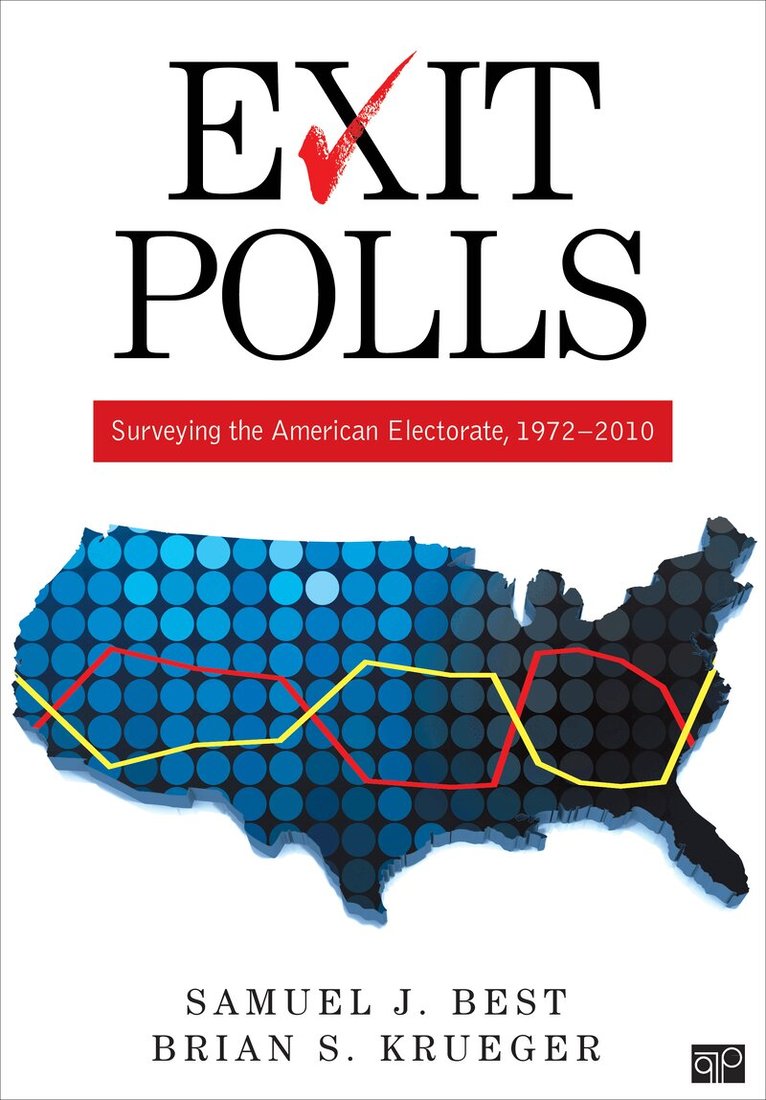
Every two years, exit polls become the most widely analyzed, written about, and discussed data-set in the United States. Although exit polls are known for their use in predicting elections, they are in fact the best tool for explaining election results. Exit polls are taken from actual voters, whereas pre-election polls that tally people’s intended votes tend to overstate the number of people who will actually go to the polls.Exit Polls: Surveying the American Electorate is a groundbreaking new reference work that explores for the first time the trends in longitudinal variables asked in the national Election Day exit polls from their beginning in 1972 to the present. The book documents comparable survey items that have appeared in multiple exit polls over time. Authors Samuel J. Best and Brian S. Krueger—both election commentators for CBS news and statistical experts—present more than 100 tables and 100 figures showing the changes in the American electorate and its voting patterns over time. This work represents the first time exit poll data has been combined to show trends over time.Chapter one: The Exit Poll Phenomenon provides a brief history of exit polls and chronicles how they evolved into their current arrangement. It explains how exit poll questions are developed, the sampling and weighting procedures used, the reporting protocols adopted, and the benefits and limitations of exit polls.Chapter two: Creating and Using Exit Poll Time Series describes how individual exit polls were compiled into a first of its kind cumulative data file and discusses the rationale for selecting specific survey items. The chapter explains the techniques used to merge the data and discusses the framework used to present the data in the subsequent chapters.Chapter three: Composition of Voters in Federal Elections focuses on changes in the demographic and ideological composition of the electorate over almost forty years, including gender, age, race, sexual orientation, education, income, religion, party membership, and military service.Chapter four: The Presidential Voting Preferences of the Active Electorate examines the presidential voting patterns of the various groups that make up the American electorate, from 1972 to 2010.Chapter five: The Congressional Voting Preferences of the Active Electorate examines the congressional voting patterns of the various groups that make up the American electorate from 1972 to 2010.Offering unique insight into the American electorate, this important new work is meant to serve novice and expert researchers alike. Libraries with holdings in American politics and government will want to acquire this one-of-a-kind resource.