Bruce Walsh - Böcker
Visar alla böcker från författaren Bruce Walsh. Handla med fri frakt och snabb leverans.
3 produkter
3 produkter
2 160 kr
Skickas inom 5-8 vardagar
Almost every trait in nature shows variation, both within populations and between populations and species. The field of quantitative genetics is the very broad umbrella that attempts to separate environmental from genetic sources of variation. As a result, it has powerful applications in animal and plant breeding, evolution, ecology, medicine, anthropology, behaviour, population genetics, conservation biology, genomics, and statistics.This second edition of Genetics and Analysis of Quantitative Traits is a fully rewritten and greatly expanded revision of the first edition, published in 1998, which provided the first, modern, unified treatment of quantitative genetics. In the past two decades, there have been massive advancements in the field coupled with explosive growth in new quantitative methods; those developments are covered in this new edition.The book weaves important biological applications with a full development of the theory and appropriate statistical tools. There are extensive discussions of important linear-algebra tools, linear and mixed models, likelihood and Bayesian estimation, as well as false discovery rates, multiple comparisons, and meta-analysis. More than 100 worked examples (ranging from microbes to humans) illustrate the key concepts using real-world applications.This extensive reference will be suitable for graduate-level students and professional researchers (both empiricists and theoreticians) in the fields of evolutionary biology, genetics, and genomics. It will also be of particular relevance and use to applied evolutionary biologists working in breed improvement for agriculture, human geneticists, and statisticians.
2 074 kr
Skickas inom 5-8 vardagar
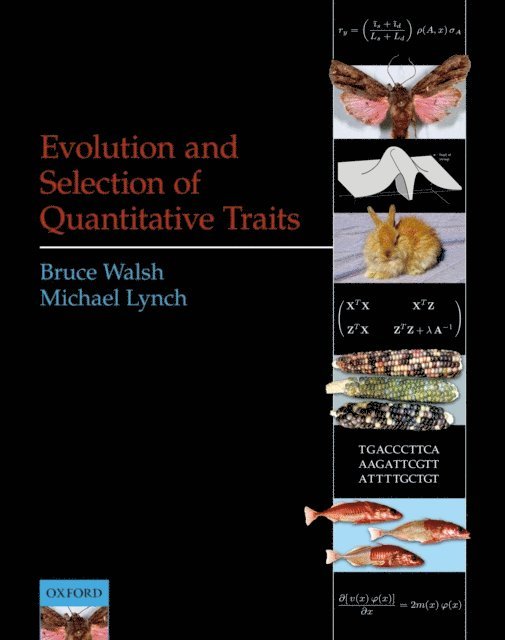
Quantitative traits-be they morphological or physiological characters, aspects of behavior, or genome-level features such as the amount of RNA or protein expression for a specific gene-usually show considerable variation within and among populations. Quantitative genetics, also referred to as the genetics of complex traits, is the study of such characters and is based on mathematical models of evolution in which many genes influence the trait and in which non-genetic factors may also be important. Evolution and Selection of Quantitative Traits presents a holistic treatment of the subject, showing the interplay between theory and data with extensive discussions on statistical issues relating to the estimation of the biologically relevant parameters for these models. Quantitative genetics is viewed as the bridge between complex mathematical models of trait evolution and real-world data, and the authors have clearly framed their treatment as such. This is the second volume in a planned trilogy that summarizes the modern field of quantitative genetics, informed by empirical observations from wide-ranging fields (agriculture, evolution, ecology, and human biology) as well as population genetics, statistical theory, mathematical modeling, genetics, and genomics. Whilst volume 1 (1998) dealt with the genetics of such traits, the main focus of volume 2 is on their evolution, with a special emphasis on detecting selection (ranging from the use of genomic and historical data through to ecological field data) and examining its consequences.
2 950 kr
Skickas inom 7-10 vardagar
Published by Sinauer Associates, an imprint of Oxford University Press. With the emerging recognition that the expression of most characters is influenced by multiple genes and multiple environmental factors, quantitative genetics has become the central paradigm for the analysis of phenotypic variation and evolution.Genetics and Analysis of Quantitative Traits brings together the diverse array of theoretical and empirical applications of quantitative genetics under one cover, in a way that is both comprehensive and accessible to anyone with a rudimentary understanding of statistics and genetics. What was originally envisioned as a single text has now become two, with the focus of this first book being on the basic biology and methods of analysis of quantitative characters. Three major features of Genetics and Analysis of Quantitative Traits distinguish it from earlier work. First, it reflects the explosive influx over the past few years of quantitative-genetic thinking into evolutionary biology. Second, in animal breeding, enormous strides have been made in the development of new techniques for estimating breeding values (for the purposes of identifying elite individuals in selection programs) and for estimating variance components from samples of complex pedigrees. In this text's last two chapters, the authors outline the basic principles of complex pedigree analysis, without getting bogged down in technical details. Third, Genetics and Analysis of Quantitative Traits provides a broad overview of the newly emerging array of techniques for quantitative-trait loci (QTL) analysis, currently one of the most active fields of quantitative-genetic research.Genetics and Analysis of Quantitative Traits contains numerous fully-worked examples and illustrations of theoretical concepts, as well as over 2,000 references with indices by subject, author, and organism. In addition, the authors maintain a World Wide Web site featuring up-to-date lists of computer programs and on-line resources, and added information on various topics presented in the text.