Bruno Vergnes – författare
Visar alla böcker från författaren Bruno Vergnes. Handla med fri frakt och snabb leverans.
4 produkter
4 produkter
E-bok
PDF, Engelska, 20142 156 kr
Läs direkt efter köp
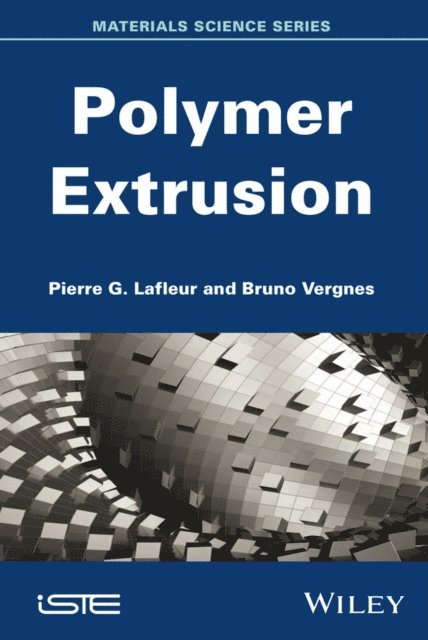
Extrusion is by far the most important and the oldest processing and shaping method for thermoplastic polymers. This process concerns almost all synthetic polymers, as well as elastomers or food materials. Single-screw extrusion is mainly used nowadays to manufacture finished goods or semi-finished products. More than 90 million tons of thermoplastics are therefore processed every year. Twin-screw extrusion may be divided into two systems: contra-rotating systems used within the context of PVC extrusion, for the manufacture of pipes or profiles; and co-rotating systems experiencing nowadays a very significant development, because of their significant adaptability and flexibility, which enables the manufacture of specific materials (polymer alloys, thermoplastic elastomers, filled polymers, nanocomposites). Extrusion is carried out by passing molten polymer through a tool called die that will give the product its final shape (films and sheets, rolled products, and electric cables). Thanks to the design of dies, we obtain at the output a product with controlled dimensions, uniform speeds and homogeneous temperatures. The book will discuss the same production types, but only in the case of coextrusion flows, i.e. multilayer stratified products. First of all, we will present in this book the physics of the mechanisms at stake, then propose more or less complex models in order to describe these mechanisms and then go forward in the interpretation of results and the control of condition flows.
E-bok
Engelska, 20142 137 kr
Läs direkt efter köp
Extrusion is by far the most important and the oldest processing and shaping method for thermoplastic polymers. This process concerns almost all synthetic polymers, as well as elastomers or food materials. Single-screw extrusion is mainly used nowadays to manufacture finished goods or semi-finished products. More than 90 million tons of thermoplastics are therefore processed every year. Twin-screw extrusion may be divided into two systems: contra-rotating systems used within the context of PVC extrusion, for the manufacture of pipes or profiles; and co-rotating systems experiencing nowadays a very significant development, because of their significant adaptability and flexibility, which enables the manufacture of specific materials (polymer alloys, thermoplastic elastomers, filled polymers, nanocomposites). Extrusion is carried out by passing molten polymer through a tool called die that will give the product its final shape (films and sheets, rolled products, and electric cables). Thanks to the design of dies, we obtain at the output a product with controlled dimensions, uniform speeds and homogeneous temperatures. The book will discuss the same production types, but only in the case of coextrusion flows, i.e. multilayer stratified products. First of all, we will present in this book the physics of the mechanisms at stake, then propose more or less complex models in order to describe these mechanisms and then go forward in the interpretation of results and the control of condition flows.
Inbunden, Engelska, 2017
2 732 kr
Skickas inom 5-8 vardagar
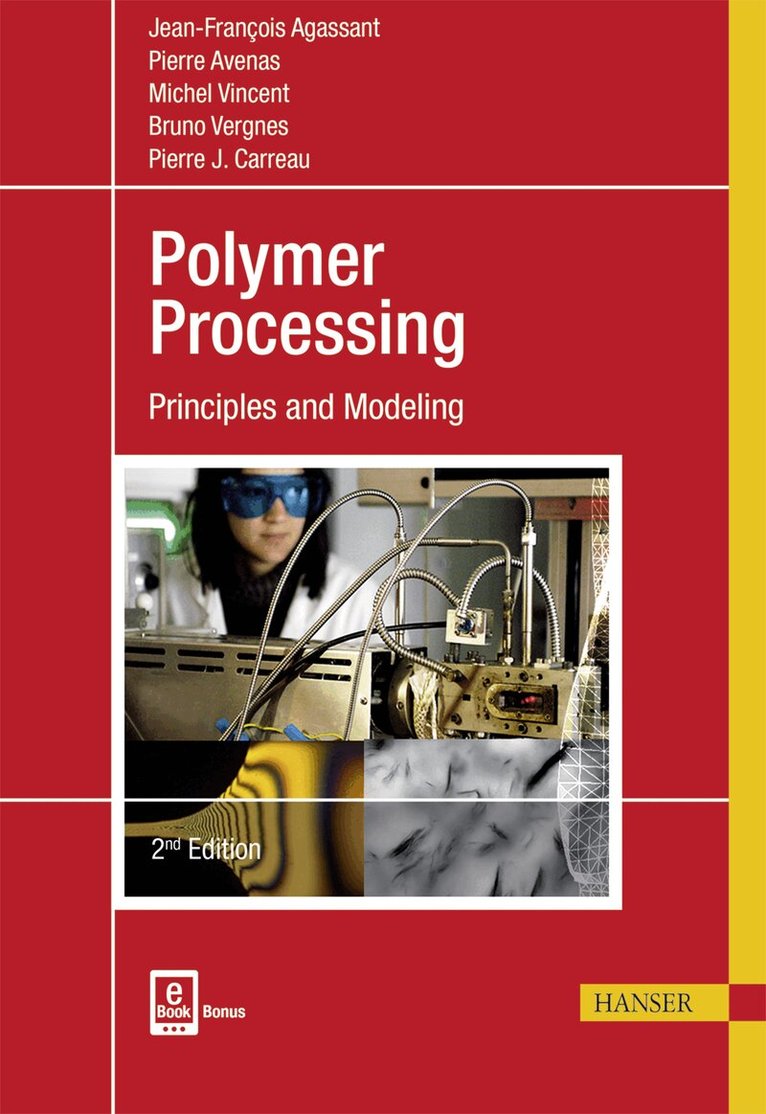
Engineering of polymers is not an easy exercise: with evolving technology, it often involves complex concepts and processes. This book is intended to provide the theoretical essentials: understanding of processes, a basis for the use of design software, and much more.The necessary physical concepts such as continuum mechanics, rheological behavior and measurement methods, and thermal science with its application to heating-cooling problems and implications for flow behavior are analyzed in detail. This knowledge is then applied to key processing methods, including single-screw extrusion and extrusion die flow, twin-screw extrusion and its applications, injection molding, calendering, and processes involving stretching.With many exercises with solutions offered throughout the book to reinforce the concepts presented, and extensive illustrations, this is an essential guide for mastering the art of plastics processing. Practical and didactic, Polymer Processing: Principles and Modeling is intended for engineers and technicians of the profession, as well as for advanced students in Polymer Science and Plastics Engineering.With the purchase of this book, you also receive a free personal access code to download the eBook.
Inbunden, Engelska, 2014
1 869 kr
Skickas inom 5-8 vardagar
Extrusion is by far the most important and the oldest processing and shaping method for thermoplastic polymers. This process concerns almost all synthetic polymers, as well as elastomers or food materials. Single-screw extrusion is mainly used nowadays to manufacture finished goods or semi-finished products. More than 90 million tons of thermoplastics are therefore processed every year. Twin-screw extrusion may be divided into two systems: contra-rotating systems used within the context of PVC extrusion, for the manufacture of pipes or profiles; and co-rotating systems experiencing nowadays a very significant development, because of their significant adaptability and flexibility, which enables the manufacture of specific materials (polymer alloys, thermoplastic elastomers, filled polymers, nanocomposites). Extrusion is carried out by passing molten polymer through a tool called die that will give the product its final shape (films and sheets, rolled products, and electric cables). Thanks to the design of dies, we obtain at the output a product with controlled dimensions, uniform speeds and homogeneous temperatures. The book will discuss the same production types, but only in the case of coextrusion flows, i.e. multilayer stratified products. First of all, we will present in this book the physics of the mechanisms at stake, then propose more or less complex models in order to describe these mechanisms and then go forward in the interpretation of results and the control of condition flows.