Bryan Ballantyne – författare
Visar alla böcker från författaren Bryan Ballantyne. Handla med fri frakt och snabb leverans.
5 produkter
5 produkter
E-bok
PDF, Engelska, 20043 188 kr
Läs direkt efter köp
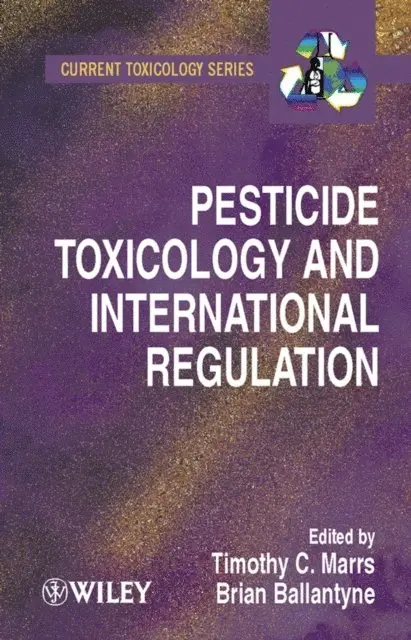
This book brings together key features of the toxicology and occupational hazards of pesticides and the way their use is regulated in the main trading regions of the world. There are chapters on each of the main groups of insecticides, namely organochlorines, anticholinesterases and pyrethrins and pyrethroids. The book also covers fungicides and herbicides, as well as more specialised agents such as microbial pesticides. The risks and hazards to humans are considered, both occupational and through the consumption of contaminated foodstuffs. Additionally, clinical aspects of pesticide poisoning are discussed. The possibility of harm from pesticide exposure has led to the development of national and international regulations governing the application of pesticides. The book describes the regulatory systems in three major economic areas: the North American Free Trade Area (USA, Canada and Mexico), the European Union and Japan. This book should be of interest to all individuals working on the development and application of pesticides anywhere in the world. All those involved in the manufacture, regulation and toxicology of pesticides should also benefit from reading this book.
Del 1 - Current Toxicology
Pesticide Toxicology and International Regulation
Inbunden, Engelska, 2003
2 841 kr
Skickas inom 5-8 vardagar
This book brings together key features of the toxicology and occupational hazards of pesticides and the way their use is regulated in the main trading regions of the world. There are chapters on each of the main groups of insecticides, namely organochlorines, anticholinesterases and pyrethrins and pyrethroids. The book also covers fungicides and herbicides, as well as more specialised agents such as microbial pesticides. The risks and hazards to humans are considered, both occupational and through the consumption of contaminated foodstuffs. Additionally, clinical aspects of pesticide poisoning are discussed. The possibility of harm from pesticide exposure has led to the development of national and international regulations governing the application of pesticides. The book describes the regulatory systems in three major economic areas: the North American Free Trade Area (USA, Canada and Mexico), the European Union and Japan. This book should be of interest to all individuals working on the development and application of pesticides anywhere in the world. All those involved in the manufacture, regulation and toxicology of pesticides should also benefit from reading this book.
E-bok
PDF, Engelska, 2013354 kr
Läs direkt efter köp
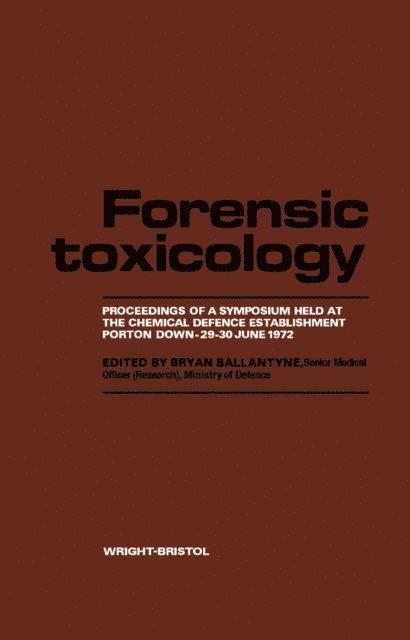
Forensic Toxicology presents the legal and medical aspects of the detrimental effects of chemicals on humans. This book discusses the immediate and long-term consequences of accident or deliberate poisoning, the detection of such poisoning, and the interpretation of the possible importance of demonstrating exogenous substances in biological fluids and tissues. Organized into 14 chapters, this compilation of papers begins with an overview of the fundamental procedure and interpretation in forensic toxicology. This text then examines the ways in which enzymes may be used in the analysis of drugs. Other chapters consider the equipment and reagents required in the rapid tests for drugs in urine. This book presents as well barbiturate poisoning from the viewpoint of the forensic pathologist performing the post mortem over the cause of death. The final chapter deals with further advances in forensic toxicology. This book is a valuable resource for general practitioners, forensic toxicologists, forensic pathologists, and police officers.
E-bok
PDF, Engelska, 2016779 kr
Läs direkt efter köp
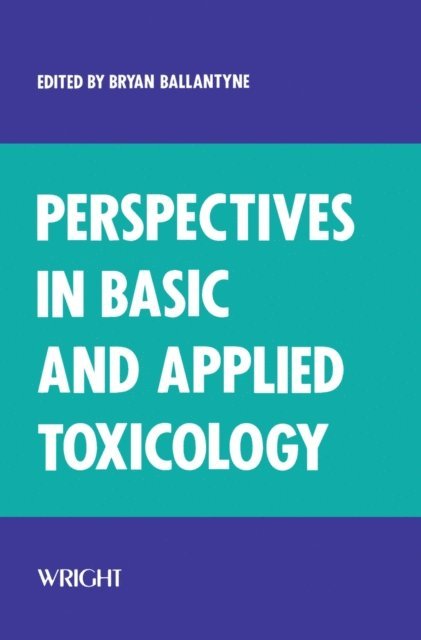
Perspectives in Basic and Applied Toxicology features a collection of essays on various aspects of toxicology. It aims to relate fundamental knowledge of toxicology to its application in assessing relevance of that information to the causation of adverse health effects, predicting hazardous situations, defining protective and precautionary measures, and the recognition and management of intoxication in humans. Another objective of this volume is to encourage those with responsibility for the training of toxicologists to instill a greater concern about ethical and moral issues as fundamental to the practice of toxicology as a profession with wide-ranging social implications. This book is organized into 14 chapters. The coverage of these chapters include assessment of chemical hazards in the workplace, the relation between animal studies and epidemiology in the context of industrial toxicology, carcinogenicity testing in animals, and biochemical evaluation of neurotoxicity. This book will be of interest to undergraduate and graduate toxicologists, pharmacologists, physicians, industrial hygienists, and other health professionals.
E-bok
PDF, Engelska, 20171 008 kr
Läs direkt efter köp
Clinical & Experimental Toxicology of Organophosphates and Carbamates considers the histochemical localization of cholinesterase in anticholinesterase poisoning. This book is organized into eight parts encompassing 59 chapters that discuss the pharmacology and toxicology of carbamates, as well as the neurobehavioral toxicology of anticholinesterases. Some of the topics covered in the book are the overview of biological and clinical aspects of organophosphates and carbamates; biochemical determination of cholinesterase activity in fluids and tissues; intermediate syndrome in anticholinesterase neurotoxicity; structure-activity relationships and anticholinesterase activity; and the molecular events in delayed neuropathy. Other parts deal with the cardiac effects of anticholinesterase agents and the ecotoxicological consequences of interactions between avian esterases and organophosphorus compounds. These topics are followed by discussions on the analysis of the cutaneous and respiratory tract absorption of anticholinesterases and the use of organophosphorus compounds as chemical warfare agents. The final parts are devoted to the toxicity of anticholinesterases to aquatic organisms. The book can provide useful information to toxicologists, doctors, students, and researchers.