3 175 kr
Skickas inom 5-8 vardagar
3 175 kr
Skickas inom 5-8 vardagar
733 kr
Läs direkt efter köp
Whenever data are categorical and their frequencies can be arrayed in multidimensional tables, log-linear analysis is appropriate. Like analysis of variance and multiple regression for quantitative data, log-linear analysis lets users ask which main effects and interactions affect an outcome of interest. Until recently, however, log-linear analysis seemed difficult -- accessible only to the statistically motivated and savvy. Designed for students and researchers who want to know more about this extension of the two-dimensional chi-square, this book introduces basic ideas in clear and straightforward prose and applies them to a core of example studies. ILOG -- a software program that runs on IBM compatible personal computers -- is included with this volume. This interactive program lets readers work through and explore examples provided throughout the book. Because ILOG is capable of serious log-linear analyses, readers gain not only understanding, but the means to put that understanding into practice as well.
733 kr
Läs direkt efter köp
Whenever data are categorical and their frequencies can be arrayed in multidimensional tables, log-linear analysis is appropriate. Like analysis of variance and multiple regression for quantitative data, log-linear analysis lets users ask which main effects and interactions affect an outcome of interest. Until recently, however, log-linear analysis seemed difficult -- accessible only to the statistically motivated and savvy. Designed for students and researchers who want to know more about this extension of the two-dimensional chi-square, this book introduces basic ideas in clear and straightforward prose and applies them to a core of example studies. ILOG -- a software program that runs on IBM compatible personal computers -- is included with this volume. This interactive program lets readers work through and explore examples provided throughout the book. Because ILOG is capable of serious log-linear analyses, readers gain not only understanding, but the means to put that understanding into practice as well.
962 kr
Läs direkt efter köp
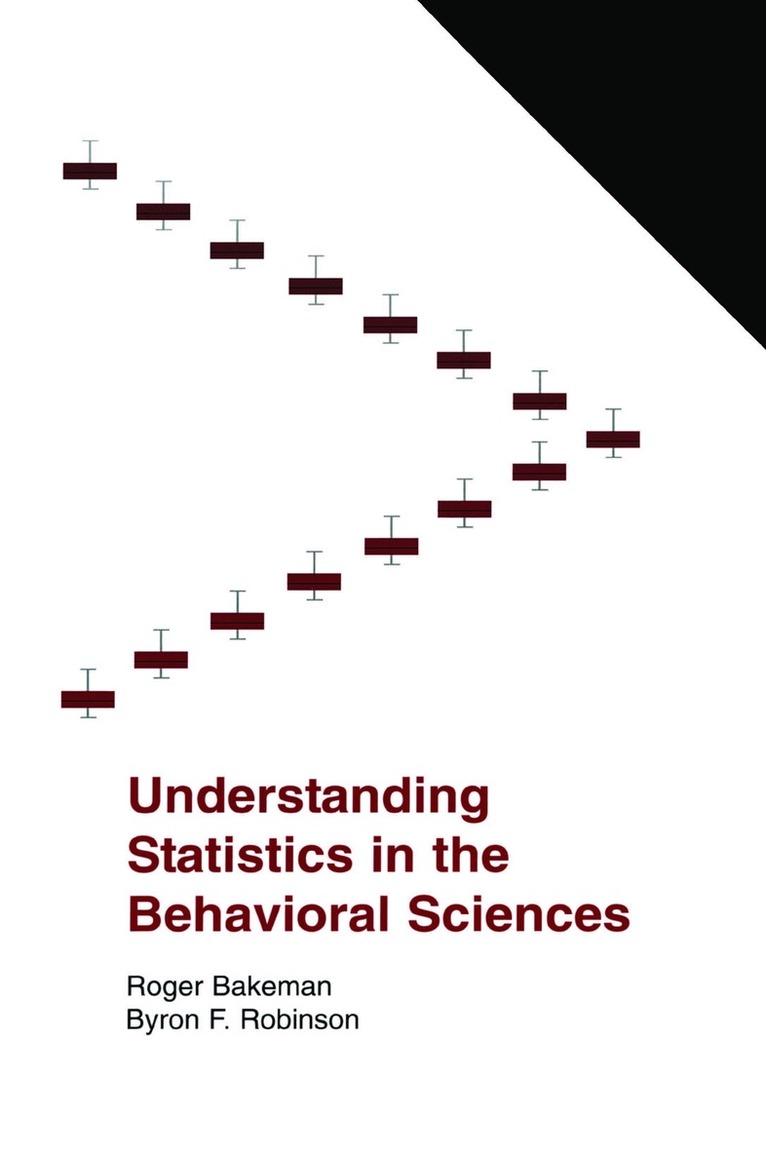
Understanding Statistics in the Behavioral Sciences is designed to help readers understand research reports, analyze data, and familiarize themselves with the conceptual underpinnings of statistical analyses used in behavioral science literature. The authors review statistics in a way that is intended to reduce anxiety for students who feel intimidated by statistics. Conceptual underpinnings and practical applications are stressed, whereas algebraic derivations and complex formulas are reduced. New ideas are presented in the context of a few recurring examples, which allows readers to focus more on the new statistical concepts than on the details of different studies.The authors'' selection and organization of topics is slightly different from the ordinary introductory textbook. It is motivated by the needs of a behavioral science student, or someone in clinical practice, rather than by formal, mathematical properties. The book begins with hypothesis testing and then considers how hypothesis testing is used in conjunction with statistical designs and tests to answer research questions. In addition, this book treats analysis of variance as another application of multiple regression. With this integrated, unified approach, students simultaneously learn about multiple regression and how to analyze data associated with basic analysis of variance and covariance designs. Students confront fewer topics but those they do encounter possess considerable more power, generality, and practical importance. This integrated approach helps to simplify topics that often cause confusion.Understanding Statistics in the Behavioral Sciences features:*Computer-based exercises, many of which rely on spreadsheets, help the reader perform statistical analyses and compare and verify the results using either SPSS or SAS. These exercises also provide an opportunity to explore definitional formulas by altering raw data or terms within a formula and immediately see the consequences thus providing a deeper understanding of the basic concepts.*Key terms and symbols are boxed when first introduced and repeated in a glossary to make them easier to find at review time.*Numerous tables and graphs, including spreadsheet printouts and figures, help students visualize the most critical concepts.This book is intended as a text for introductory behavioral science statistics. It will appeal to instructors who want a relatively brief text. The book''s active approach to learning, works well both in the classroom and for individual self-study.
962 kr
Läs direkt efter köp
Understanding Statistics in the Behavioral Sciences is designed to help readers understand research reports, analyze data, and familiarize themselves with the conceptual underpinnings of statistical analyses used in behavioral science literature. The authors review statistics in a way that is intended to reduce anxiety for students who feel intimidated by statistics. Conceptual underpinnings and practical applications are stressed, whereas algebraic derivations and complex formulas are reduced. New ideas are presented in the context of a few recurring examples, which allows readers to focus more on the new statistical concepts than on the details of different studies.The authors'' selection and organization of topics is slightly different from the ordinary introductory textbook. It is motivated by the needs of a behavioral science student, or someone in clinical practice, rather than by formal, mathematical properties. The book begins with hypothesis testing and then considers how hypothesis testing is used in conjunction with statistical designs and tests to answer research questions. In addition, this book treats analysis of variance as another application of multiple regression. With this integrated, unified approach, students simultaneously learn about multiple regression and how to analyze data associated with basic analysis of variance and covariance designs. Students confront fewer topics but those they do encounter possess considerable more power, generality, and practical importance. This integrated approach helps to simplify topics that often cause confusion.Understanding Statistics in the Behavioral Sciences features:*Computer-based exercises, many of which rely on spreadsheets, help the reader perform statistical analyses and compare and verify the results using either SPSS or SAS. These exercises also provide an opportunity to explore definitional formulas by altering raw data or terms within a formula and immediately see the consequences thus providing a deeper understanding of the basic concepts.*Key terms and symbols are boxed when first introduced and repeated in a glossary to make them easier to find at review time.*Numerous tables and graphs, including spreadsheet printouts and figures, help students visualize the most critical concepts.This book is intended as a text for introductory behavioral science statistics. It will appeal to instructors who want a relatively brief text. The book''s active approach to learning, works well both in the classroom and for individual self-study.