C. Julian Chen - Böcker
Visar alla böcker från författaren C. Julian Chen. Handla med fri frakt och snabb leverans.
4 produkter
4 produkter
Del 64 - Monographs on the Physics and Chemistry of Materials
Introduction to Scanning Tunneling Microscopy
Häftad, Engelska, 2015
888 kr
Skickas inom 7-10 vardagar
The scanning tunneling microscope and the atomic force microscope, both capable of imaging and manipulating individual atoms, were crowned with the Nobel Prize in Physics in 1986, and are the cornerstones of nanotechnology today. The first edition of this book has nurtured numerous beginners and experts since 1993. The second edition is a thoroughly updated version of this 'bible' in the field.The second edition includes a number of new developments in the field. Non-contact atomic-force microscopy has demonstrated true atomic resolution. It enables direct observation and mapping of individual chemical bonds. A new chapter about the underlying physics, atomic forces, is added. The chapter on atomic force microscopy is substantially expanded. Spin-polarized STM has enabled the observation of local magnetic phenomena down to atomic scale. A pedagogical presentation of the basic concepts is included. Inelastic scanning tunneling microscopy has shown the capability of studying vibrational modes of individual molecules. The underlying theory and new instrumentation are added. For biological research, to increase the speed of scanning to observe life phenomena in real time is a key. Advances in this direction are presented as well. The capability of STM to manipulate individual atoms is one of the cornerstones of nanotechnology. The theoretical basis and in particular the relation between tunneling and interaction energy are thoroughly presented, together with experimental facts.
Del 69 - Monographs on the Physics and Chemistry of Materials
Introduction to Scanning Tunneling Microscopy Third Edition
Inbunden, Engelska, 2021
1 379 kr
Skickas inom 5-8 vardagar
The scanning tunnelling microscope (STM) was invented by Binnig and Rohrer and received a Nobel Prize of Physics in 1986. Together with the atomic force microscope (AFM), it provides non-destructive atomic and subatomic resolution on surfaces. Especially, in recent years, internal details of atomic and molecular wavefunctions are observed and mapped with negligible disturbance. Since the publication of its first edition, this book has been the standard reference book and a graduate-level textbook educating several generations of nano-scientists. In Aug. 1992, the co-inventor of STM, Nobelist Heinrich Rohrer recommended: "The Introduction to Scanning tunnelling Microscopy by C.J. Chen provides a good introduction to the field for newcomers and it also contains valuable material and hints for the experts". For the second edition, a 2017 book review published in the Journal of Applied Crystallography said "Introduction to Scanning tunnelling Microscopy is an excellent book that can serve as a standard introduction for everyone that starts working with scanning probe microscopes, and a useful reference book for those more advanced in the field". The third edition is a thoroughly updated and improved version of the recognized "Bible" of the field. Additions to the third edition include: theory, method, results, and interpretations of the non-destructive observation and mapping of atomic and molecular wavefunctions; elementary theory and new verifications of equivalence of chemical bond interaction and tunnelling; scanning tunnelling spectroscopy of high Tc superconductors; imaging of self-assembled organic molecules on the solid-liquid interfaces. Some key derivations are rewritten using mathematics at an undergraduate level to make it pedagogically sound.
Del 64 - Monographs on the Physics and Chemistry of Materials
Introduction to Scanning Tunneling Microscopy
Inbunden, Engelska, 2007
1 886 kr
Skickas inom 3-6 vardagar
The scanning tunneling microscope and the atomic force microscope, both capable of imaging and manipulating individual atoms, were crowned with the Nobel Prize in Physics in 1986, and are the cornerstones of nanotechnology today. The first edition of this book has nurtured numerous beginners and experts since 1993. The second edition is a thoroughly updated version of this 'bible' in the field. The second edition includes a number of new developments in the field. Non-contact atomic-force microscopy has demonstrated true atomic resolution. It enables direct observation and mapping of individual chemical bonds. A new chapter about the underlying physics, atomic forces, is added. The chapter on atomic force microscopy is substantially expanded. Spin-polarized STM has enabled the observation of local magnetic phenomena down to atomic scale. A pedagogical presentation of the basic concepts is included. Inelastic scanning tunneling microscopy has shown the capability of studying vibrational modes of individual molecules. The underlying theory and new instrumentation are added. For biological research, to increase the speed of scanning to observe life phenomena in real time is a key. Advanced in this direction is presented as well. The capability of STM to manipulate individual atoms is one of the cornerstones of nanotechnology. The theoretical basis and in particular the relation between tunneling and interaction energy are thoroughly presented, together with experimental facts.
1 414 kr
Skickas inom 7-10 vardagar
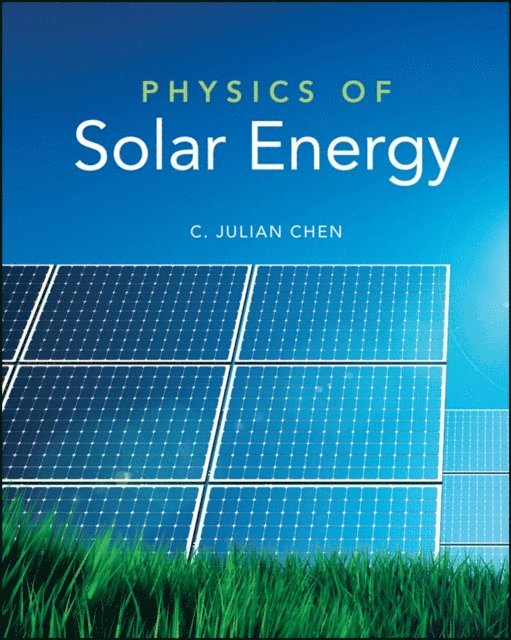
PHYSICS OF SOLAR ENERGY AND ENERGY STORAGE Join the fight for a renewable world with this indispensable introduction Solar energy is one of the most essential tools in the fight to create a sustainable future. A wholly renewable and cost-effective energy source capable of providing domestic, business, and industrial energy, solar energy is expected to become a $223 billion a year industry by 2026. The future of global energy production demands researchers and engineers who understand the physics of harnessing, storing, and distributing solar energy. Physics of Solar Energy and Energy Storage begins to meet this demand, with a thorough, accessible overview of the required fundamentals. Now fully updated to reflect the past decade of research amidst a growing understanding of the scale of our collective challenge, it promises to train the next generation of researchers and engineers who will join this vital effort. Readers of the second edition of Physics of Solar Energy and Energy Storage will find: A particular focus on lithium-ion rechargeable batteries Detailed discussions of photovoltaic solar systems, concentrating solar systems, passive solar heating, and more Homework problems and exercises throughout to reinforce learning Physics of Solar Energy and Energy Storage is ideal for mechanical, chemical, or electrical engineers working on solar or alternative energy projects, as well as researchers and policymakers in related fields.