C. Le Bris – författare
Visar alla böcker från författaren C. Le Bris. Handla med fri frakt och snabb leverans.
2 produkter
2 produkter
Del 74 - Lecture Notes in Chemistry
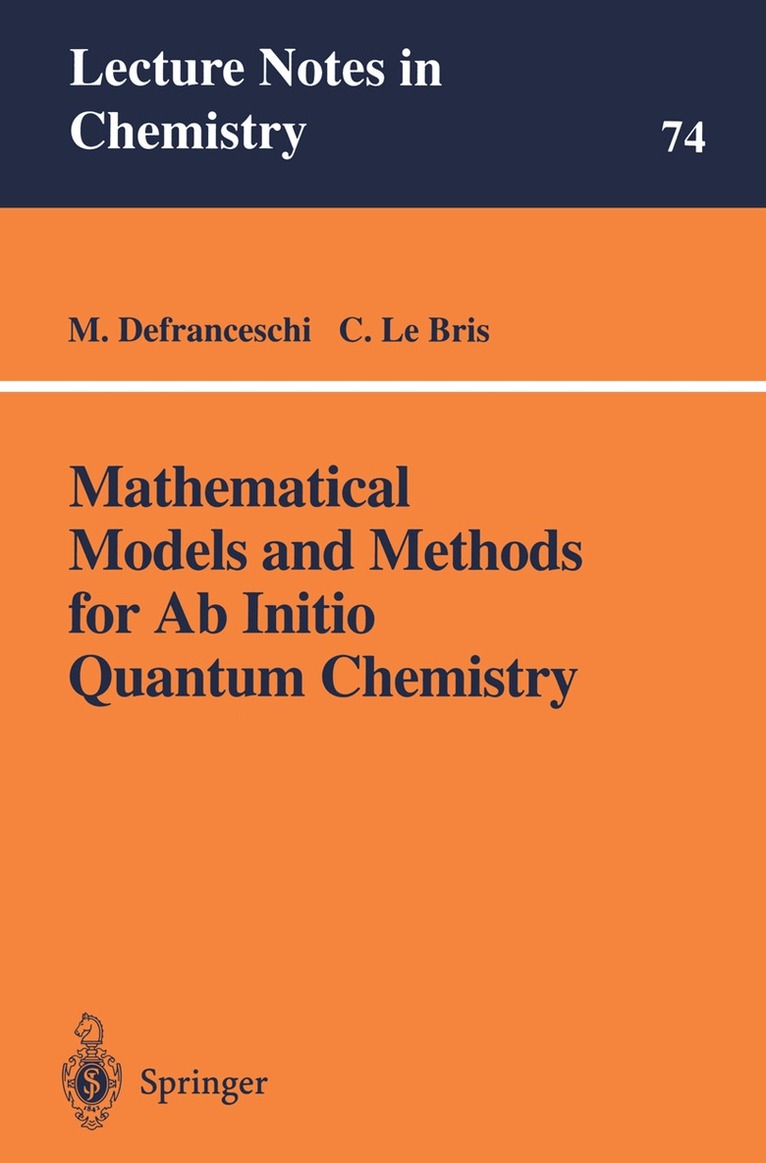
Mathematical Models and Methods for Ab Initio Quantum Chemistry
Häftad, Engelska, 2000
543 kr
Skickas inom 5-8 vardagar
On the occasion of the fourth International Conference on Industrial and Applied Mathematics!, we decided to organize a sequence of 4 minisymposia devoted to the mathematical aspects and the numerical aspects of Quantum Chemistry. Our goal was to bring together scientists from different communities, namely mathematicians, experts at numerical analysis and computer science, chemists, just to see whether this heterogeneous set of lecturers can produce a rather homogeneous presentation of the domain to an uninitiated audience. To the best of our knowledgde, nothing of this kind had never been tempted so far. It seemed to us that it was the good time for doing it, both . because the interest of applied mathematicians into the world of computational chemistry has exponentially increased in the past few years, and because the community of chemists feels more and more concerned with the numerical issues. Indeed, in the early years of Quantum Chemistry, the pioneers (Coulson, Mac Weeny, just to quote two of them) used to solve fundamental equations modelling toy systems which could be simply numerically handled in view of their very limited size. The true difficulty arose with the need to model larger systems while possibly taking into account their interaction with their environment. Hand calculations were no longer possible, and computing science came into the picture.
E-bok
PDF, Engelska, 2012712 kr
Läs direkt efter köp
On the occasion of the fourth International Conference on Industrial and Applied Mathematics!, we decided to organize a sequence of 4 minisymposia devoted to the mathematical aspects and the numerical aspects of Quantum Chemistry. Our goal was to bring together scientists from different communities, namely mathematicians, experts at numerical analysis and computer science, chemists, just to see whether this heterogeneous set of lecturers can produce a rather homogeneous presentation of the domain to an uninitiated audience. To the best of our knowledgde, nothing of this kind had never been tempted so far. It seemed to us that it was the good time for doing it, both . because the interest of applied mathematicians into the world of computational chemistry has exponentially increased in the past few years, and because the community of chemists feels more and more concerned with the numerical issues. Indeed, in the early years of Quantum Chemistry, the pioneers (Coulson, Mac Weeny, just to quote two of them) used to solve fundamental equations modelling toy systems which could be simply numerically handled in view of their very limited size. The true difficulty arose with the need to model larger systems while possibly taking into account their interaction with their environment. Hand calculations were no longer possible, and computing science came into the picture.