C. Nastasescu – författare
Visar alla böcker från författaren C. Nastasescu. Handla med fri frakt och snabb leverans.
6 produkter
6 produkter
E-bok
PDF, Engelska, 2011238 kr
Läs direkt efter köp
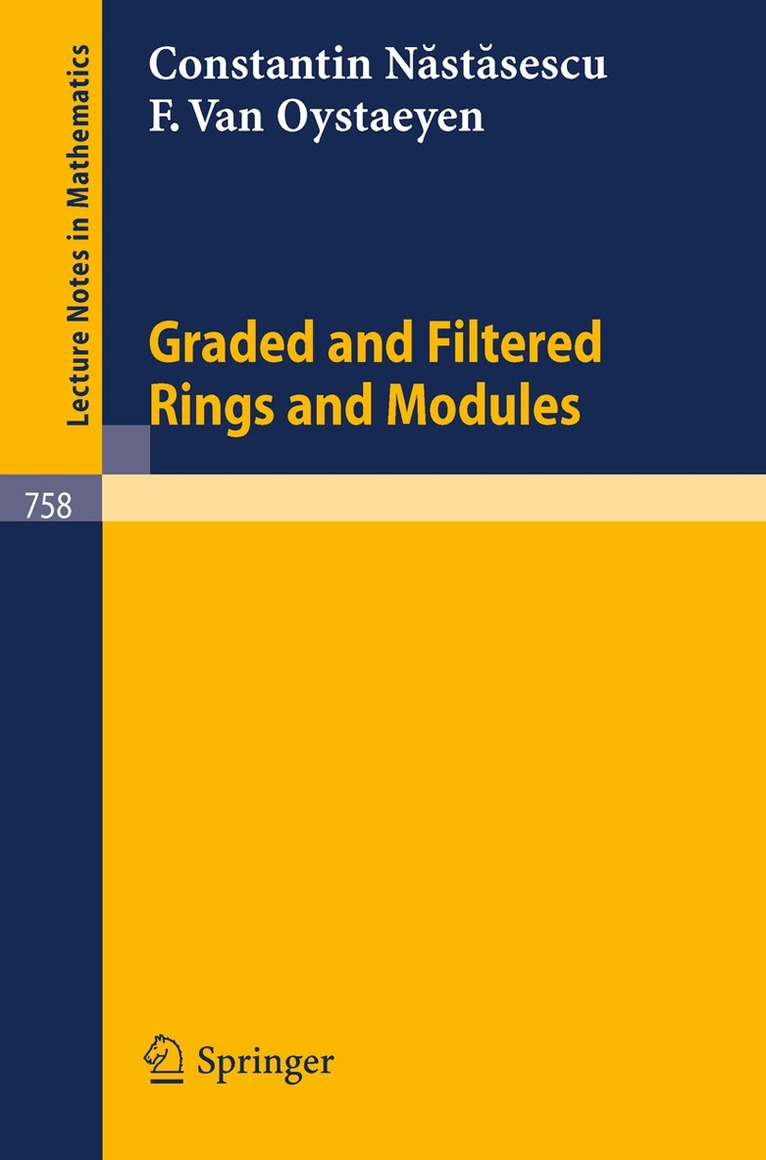
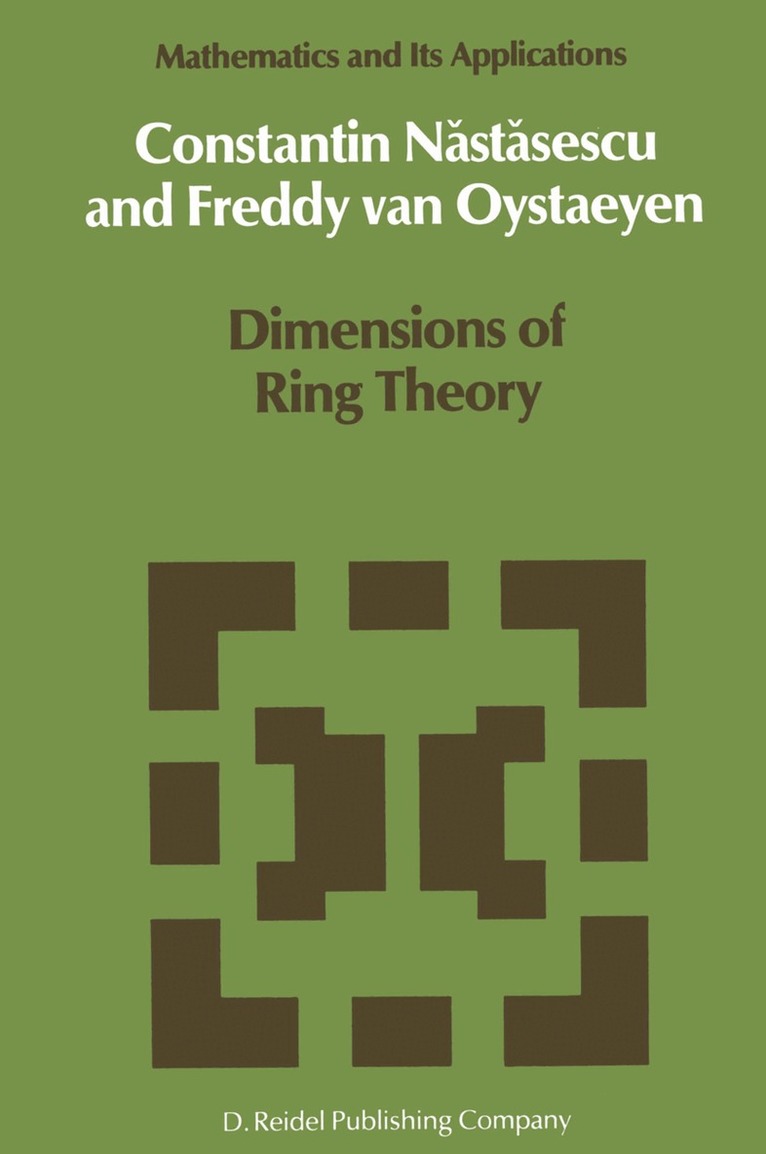
This book is aimed to be a ''technical'' book on graded rings. By ''technical'' we mean that the book should supply a kit of tools of quite general applicability, enabling the reader to build up his own further study of non-commutative rings graded by an arbitrary group. The body of the book, Chapter A, contains: categorical properties of graded modules, localization of graded rings and modules, Jacobson radicals of graded rings, the structure thedry for simple objects in the graded sense, chain conditions, Krull dimension of graded modules, homogenization, homological dimension, primary decomposition, and more.One of the advantages of the generality of Chapter A is that it allows direct applications of these results to the theory of group rings, twisted and skew group rings and crossed products. With this in mind we have taken care to point out on several occasions how certain techniques may be specified to the case of strongly graded rings. We tried to write Chapter A in such a way that it becomes suitable for an advanced course in ring theory or general algebra, we strove to make it as selfcontained as possible and we included several problems and exercises.Other chapters may be viewed as an attempt to show how the general techniques of Chapter A can be applied in some particular cases, e.g. the case where the gradation is of type Z. In compiling the material for Chapters B and C we have been guided by our own research interests. Chapter 6 deals with commutative graded rings of type 2 and we focus on two main topics: artihmeticallygraded domains, and secondly, local conditions for Noetherian rings.In Chapter C we derive some structural results relating to the graded properties of the rings considered. The following classes of graded rings receive special attention: fully bounded Noetherian rings, birational extensions of commutative rings, rings satisfying polynomial identities, and Von Neumann regular rings. Here the basic idea is to derive results of ungraded nature from graded information. Some of these sections lead naturally to the study of sheaves over the projective spectrum Proj(R) of a positively graded ring, but we did not go into these topics here. We refer to [125] for a noncommutative treatment of projective geometry, i.e. the geometry of graded P.I. algebras.
Del 758 - Lecture Notes in Mathematics
Graded and Filtered Rings and Modules
Häftad, Engelska, 1979
275 kr
Skickas inom 10-15 vardagar
E-bok
PDF, Engelska, 2006364 kr
Läs direkt efter köp
Inbunden, Engelska, 1987
543 kr
Skickas inom 10-15 vardagar
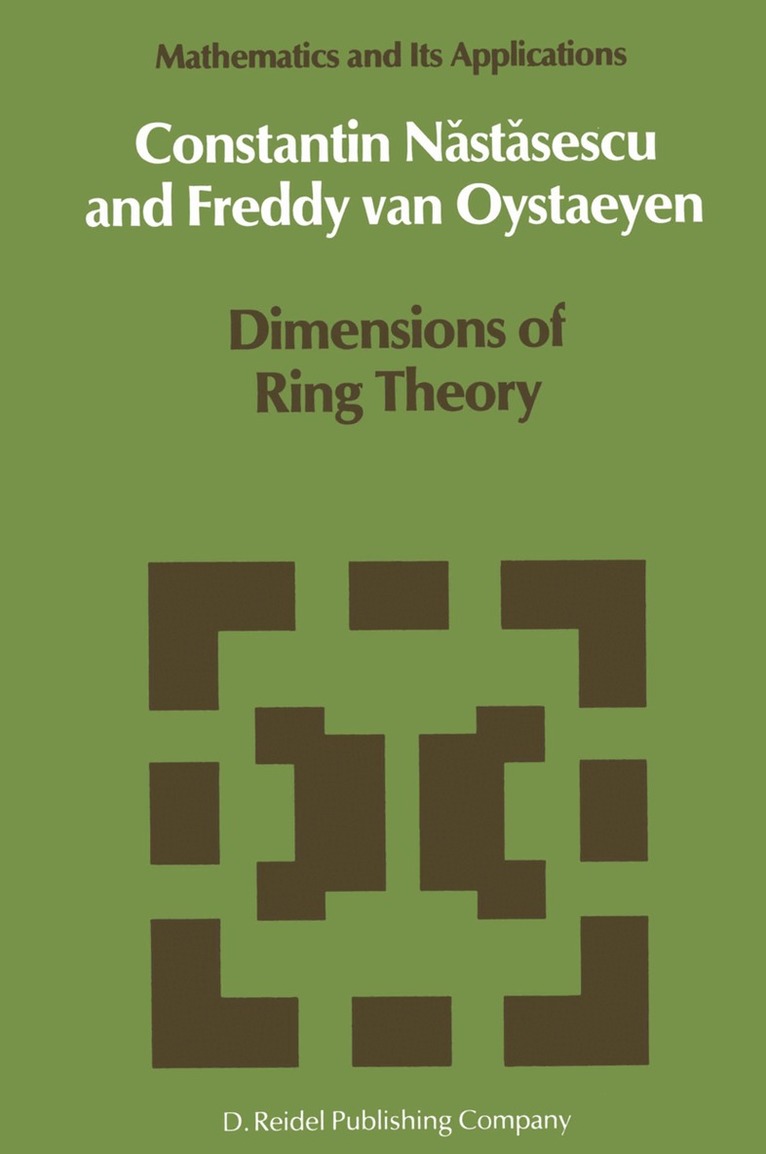
Approach your problems from the right end It isn't that they can't see the solution. It is and begin with the answers. Then one day, that they can't see the problem. perhaps you will find the final question. G. K. Chesterton. The Scandal of Father 'The Hermit Gad in Crane Feathers' in R. Brown 'The point of a Pin'. van Gulik's The Chinese Maze Murders. Growing specialization and diversification have brought a host of monographs and textbooks on increasingly specialized topics. However, the "tree" of knowledge of mathematics and related fields does not grow only by putting forth new branches. It also happens, quite often in fact, that branches which were thought to be completely disparate are suddenly seen to be related. Further, the kind and level of s9phistication of mathematics applied in various sciences has changed drastically in recent years: measure theory is used (non trivially) in regional and theoretical economics; algebraic geometry interacts with physics; the Minkowsky lemma, coding theory and the structure of water meet one another in packing and covering theory; quantum fields, crystal defects and mathematical programming profit from homotopy theory; Lie algebras are relevant to filtering; and prediction and electrical engineering can use Stein spaces. And in addition to this there are such new emerging subdisciplines as "experimental mathematics", "CFD", "completely integrable systems", "chaos, synergetics and large-scale order", which are almost impossible to fit into the existing classification schemes. They draw upon widely different sections of mathematics.
E-bok
PDF, Engelska, 2012712 kr
Läs direkt efter köp
Approach your problems from the right end It isn''t that they can''t see the solution. It is and begin with the answers. Then one day, that they can''t see the problem. perhaps you will find the final question. G. K. Chesterton. The Scandal of Father ''The Hermit Gad in Crane Feathers'' in R. Brown ''The point of a Pin''. van Gulik''s The Chinese Maze Murders. Growing specialization and diversification have brought a host of monographs and textbooks on increasingly specialized topics. However, the "tree" of knowledge of mathematics and related fields does not grow only by putting forth new branches. It also happens, quite often in fact, that branches which were thought to be completely disparate are suddenly seen to be related. Further, the kind and level of s9phistication of mathematics applied in various sciences has changed drastically in recent years: measure theory is used (non trivially) in regional and theoretical economics; algebraic geometry interacts with physics; the Minkowsky lemma, coding theory and the structure of water meet one another in packing and covering theory; quantum fields, crystal defects and mathematical programming profit from homotopy theory; Lie algebras are relevant to filtering; and prediction and electrical engineering can use Stein spaces. And in addition to this there are such new emerging subdisciplines as "experimental mathematics", "CFD", "completely integrable systems", "chaos, synergetics and large-scale order", which are almost impossible to fit into the existing classification schemes. They draw upon widely different sections of mathematics.
Häftad, Engelska, 2011
543 kr
Skickas inom 10-15 vardagar
Approach your problems from the right end It isn't that they can't see the solution. It is and begin with the answers. Then one day, that they can't see the problem. perhaps you will find the final question. G. K. Chesterton. The Scandal of Father 'The Hermit Gad in Crane Feathers' in R. Brown 'The point of a Pin'. van Gulik's The Chinese Maze Murders. Growing specialization and diversification have brought a host of monographs and textbooks on increasingly specialized topics. However, the "tree" of knowledge of mathematics and related fields does not grow only by putting forth new branches. It also happens, quite often in fact, that branches which were thought to be completely disparate are suddenly seen to be related. Further, the kind and level of s9phistication of mathematics applied in various sciences has changed drastically in recent years: measure theory is used (non trivially) in regional and theoretical economics; algebraic geometry interacts with physics; the Minkowsky lemma, coding theory and the structure of water meet one another in packing and covering theory; quantum fields, crystal defects and mathematical programming profit from homotopy theory; Lie algebras are relevant to filtering; and prediction and electrical engineering can use Stein spaces. And in addition to this there are such new emerging subdisciplines as "experimental mathematics", "CFD", "completely integrable systems", "chaos, synergetics and large-scale order", which are almost impossible to fit into the existing classification schemes. They draw upon widely different sections of mathematics.