C. Randall Henning – författare
Visar alla böcker från författaren C. Randall Henning. Handla med fri frakt och snabb leverans.
14 produkter
14 produkter
E-bok
PDF, Engelska, 2017396 kr
Läs direkt efter köp
Tangled Governance addresses the institutions that were deployed to fight the euro crisis, reestablish financial stability in Europe, and prevent contagion to the rest of the world. Henning explains why European leaders chose to include the International Monetary Fund (IMF) in the crisis response and provides a detailed account of the decisions of the institutions that make up the troika (the European Commission, European Central Bank, and IMF). He examinesthe institutions negotiating strategies, the outcomes of their interaction, and the effectiveness of their cooperation. The institutional strategies of key member states, including Germany and the United States, are also explored in this study.The book locates its analysis within the framework of regime complexity, involving clusters of overlapping and intersecting regional and multilateral institutions. It tests conjectures in the regime-complexity literature against the seven cases of financial rescues of euro area countries that were stricken by crises between 2010 and 2015. Tangled Governance concludes that states use some institutions to control others, that complexity is the consequence of a strategy to control agency drift.States mediate conflicts among institutions and thereby limit fragmentation of the regime complex and underpin substantive efficacy. In reaching these conclusions, the book also answers several key puzzles, including why Germany and other northern European countries supported IMF inclusion despiteits adopting positions opposed to their preferences; why crisis fighting arrangements endured intense conflicts among the institutions; and, finally, why the United States and the IMF promoted further steps to complete the monetary union.
E-bok
Engelska, 2017396 kr
Läs direkt efter köp
Tangled Governance addresses the institutions that were deployed to fight the euro crisis, reestablish financial stability in Europe, and prevent contagion to the rest of the world. Henning explains why European leaders chose to include the International Monetary Fund (IMF) in the crisis response and provides a detailed account of the decisions of the institutions that make up the troika (the European Commission, European Central Bank, and IMF). He examinesthe institutions negotiating strategies, the outcomes of their interaction, and the effectiveness of their cooperation. The institutional strategies of key member states, including Germany and the United States, are also explored in this study.The book locates its analysis within the framework of regime complexity, involving clusters of overlapping and intersecting regional and multilateral institutions. It tests conjectures in the regime-complexity literature against the seven cases of financial rescues of euro area countries that were stricken by crises between 2010 and 2015. Tangled Governance concludes that states use some institutions to control others, that complexity is the consequence of a strategy to control agency drift.States mediate conflicts among institutions and thereby limit fragmentation of the regime complex and underpin substantive efficacy. In reaching these conclusions, the book also answers several key puzzles, including why Germany and other northern European countries supported IMF inclusion despiteits adopting positions opposed to their preferences; why crisis fighting arrangements endured intense conflicts among the institutions; and, finally, why the United States and the IMF promoted further steps to complete the monetary union.
Inbunden, Engelska, 2017
553 kr
Skickas inom 5-8 vardagar
Tangled Governance addresses the institutions that were deployed to fight the euro crisis, reestablish financial stability in Europe, and prevent contagion to the rest of the world. Henning explains why European leaders chose to include the International Monetary Fund (IMF) in the crisis response and provides a detailed account of the decisions of the institutions that make up the troika (the European Commission, European Central Bank, and IMF). He examines the institutions negotiating strategies, the outcomes of their interaction, and the effectiveness of their cooperation. The institutional strategies of key member states, including Germany and the United States, are also explored in this study.The book locates its analysis within the framework of regime complexity, involving clusters of overlapping and intersecting regional and multilateral institutions. It tests conjectures in the regime-complexity literature against the seven cases of financial rescues of euro area countries that were stricken by crises between 2010 and 2015. Tangled Governance concludes that states use some institutions to control others, that complexity is the consequence of a strategy to control agency drift. States mediate conflicts among institutions and thereby limit fragmentation of the regime complex and underpin substantive efficacy. In reaching these conclusions, the book also answers several key puzzles, including why Germany and other northern European countries supported IMF inclusion despite its adopting positions opposed to their preferences; why crisis fighting arrangements endured intense conflicts among the institutions; and, finally, why the United States and the IMF promoted further steps to complete the monetary union.
Inbunden, Engelska, 2002
923 kr
Skickas inom 10-15 vardagar
The effective governance of global money and finance is under enormous stress. Deep changes over the last decade in capital markets, exchange rate systems, and government finances suggest dramatic shifts in the contours of monetary power, with tensions rising between the functional logic of international economics and the geographic logic of state-centered politics. Governing the World's Money assesses those tensions and the prospects for their peaceful resolution. Governing the World's Money surveys the frontiers of the global monetary system in ten original essays. Leading scholars of international relations and economics explore the evolution of the instruments available to policy officials for monetary governance. As they analyze the contemporary reordering of political authority in a market-oriented global economy, they open new pathways for the study of regional monetary integration and international institutional reform.
E-bok
Engelska, 2010296 kr
Läs direkt efter köp
The European economic and monetary union has changed the structure of international monetary relations fundamentally. In this book two experts--one European, the other American--offer transatlantic perspectives on the ramifications of the monetary union and the launch of the euro. C. Randall Henning examines selected American views on Europe's monetary union, and looks at the political, economic, and institutional interests of the United States as they are affected by the creation of the euro. He examines the external monetary policymaking machinery of the union and discusses the relationship of the monetary union to international institutions, particularly the meetings of the G-7 finance ministers and central bank governors and the International Monetary Fund. Henning is generally sympathetic to European integration, supportive of the monetary union, and persuaded of the importance of international cooperation. Pier Carlo Padoan presents a European view of the role of the euro in the international system. He looks at the euro as a potential global currency and examines the transition phase between a regional currency and a global currency. Central to this is an analysis of the appropriate exchange rate policy for the euro. He also considers euro-dollar relations and the prospects for transatlantic cooperation. C. Randall Henning is a professor at The American University and a senior fellow at the Institute for International Economics. Pier Carlo Padoan is a professor at the University of Rome and the College of Europe.
Häftad, Engelska, 2000
278 kr
Skickas inom 10-15 vardagar
The European economic and monetary union has changed the structure of international monetary relations fundamentally. In this book two experts--one European, the other American--offer transatlantic perspectives on the ramifications of the monetary union and the launch of the euro. C. Randall Henning examines selected American views on Europe's monetary union, and looks at the political, economic, and institutional interests of the United States as they are affected by the creation of the euro. He examines the external monetary policymaking machinery of the union and discusses the relationship of the monetary union to international institutions, particularly the meetings of the G-7 finance ministers and central bank governors and the International Monetary Fund. Henning is generally sympathetic to European integration, supportive of the monetary union, and persuaded of the importance of international cooperation. Pier Carlo Padoan presents a European view of the role of the euro in the international system. He looks at the euro as a potential global currency and examines the transition phase between a regional currency and a global currency. Central to this is an analysis of the appropriate exchange rate policy for the euro. He also considers euro-dollar relations and the prospects for transatlantic cooperation. C. Randall Henning is a professor at The American University and a senior fellow at the Institute for International Economics. Pier Carlo Padoan is a professor at the University of Rome and the College of Europe.
Häftad, Engelska, 1994
222 kr
Skickas inom 5-8 vardagar
Häftad, Engelska, 1996
222 kr
Skickas inom 5-8 vardagar
Häftad, Engelska, 1997
250 kr
Skickas inom 3-6 vardagar
Häftad, Engelska, 1999
365 kr
Skickas inom 3-6 vardagar
Häftad, Engelska, 2002
178 kr
Skickas inom 5-8 vardagar
Häftad, Engelska, 2008
204 kr
Skickas inom 5-8 vardagar
E-bok
PDF, Engelska, 2008133 kr
Läs direkt efter köp
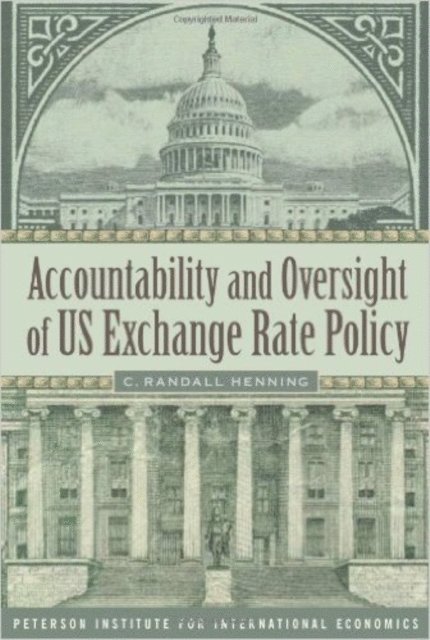
The dispute over Chinese exchange rate policy within the United States has generated a series of legislative proposals to restrict the discretion of the US Treasury Department in determining currency manipulation and to reform the department''s accountability to the Congress. This study reviews the Treasury''s reports to the Congress on exchange rate policy—introduced by the 1988 trade act—and Congress''s treatment of them. It finds that the accountability process has often not worked well in practice: The coverage of the reports has sometimes been incomplete and not provided a sufficient basis for congressional oversight. Nor has Congress always performed its own role well, holding hearings on less than half of the reports and overlooking important substantive issues. Several recommendations can improve guidance to the Treasury, standards for assessment, and congressional oversight. These include (1) refining the criteria used to determine currency manipulation and writing them into law; (2) explicitly harnessing US decisions on manipulation to the IMF''s rules on exchange rates; (3) clarifying the general objectives of US exchange rate policy; (4) reaffirming the mandate to seek international macroeconomic and currency cooperation; and (5) institutionalizing multicommittee oversight of exchange rate policy by Congress. As they develop legislation targeting manipulation, furthermore, legislators should not lose sight of the broader purposes of the 1988 act relating to the effective valuation of the dollar, the current account, and their ramifications for the US economy overall.
Häftad, Engelska, 2012
247 kr
Skickas inom 5-8 vardagar