Camila Vergara - Böcker
Visar alla böcker från författaren Camila Vergara. Handla med fri frakt och snabb leverans.
3 produkter
3 produkter
227 kr
Skickas inom 7-10 vardagar
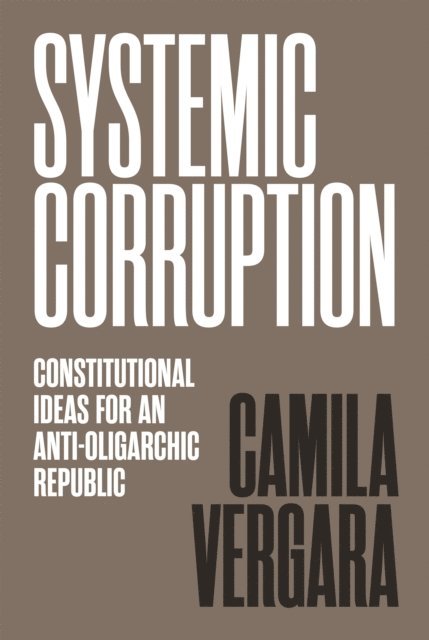
A bold new approach to combatting the inherent corruption of representative democracyThis provocative book reveals how the majority of modern liberal democracies have become increasingly oligarchic, suffering from a form of structural political decay first conceptualized by ancient philosophers. Systemic Corruption argues that the problem cannot be blamed on the actions of corrupt politicians but is built into the very fabric of our representative systems.Camila Vergara provides a compelling and original genealogy of political corruption from ancient to modern thought, and shows how representative democracy was designed to protect the interests of the already rich and powerful to the detriment of the majority. Unable to contain the unrelenting force of oligarchy, especially after experimenting with neoliberal policies, most democracies have been corrupted into oligarchic democracies. Vergara explains how to reverse this corrupting trajectory by establishing a new counterpower strong enough to control the ruling elites. Building on the anti-oligarchic institutional innovations proposed by plebeian philosophers, she rethinks the republic as a mixed order in which popular power is institutionalized to check the power of oligarchy. Vergara demonstrates how a plebeian republic would establish a network of local assemblies with the power to push for reform from the grassroots, independent of political parties and representative government.Drawing on neglected insights from Niccolò Machiavelli, Nicolas de Condorcet, Rosa Luxemburg, and Hannah Arendt, Systemic Corruption proposes to reverse the decay of democracy with the establishment of anti-oligarchic institutions through which common people can collectively resist the domination of the few.
439 kr
Skickas inom 7-10 vardagar
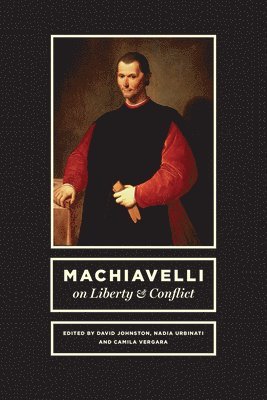
More than five hundred years after Machiavelli wrote The Prince, his landmark treatise on the pragmatic application of power remains a pivot point for debates on political thought. While scholars continue to investigate interpretations of The Prince in different contexts throughout history, from the Renaissance to the Risorgimento and Italian unification, other fruitful lines of research explore how Machiavelli's ideas about power and leadership can further our understanding of contemporary political circumstances. With Machiavelli on Liberty and Conflict, David Johnston, Nadia Urbinati, and Camila Vergara have brought together the most recent research on The Prince, with contributions from many of the leading scholars of Machiavelli, including Quentin Skinner, Harvey Mansfield, Erica Benner, John McCormick, and Giovanni Giorgini. Organized into four sections, the book focuses first on Machiavelli's place in the history of political thought: Is he the last of the ancients or the creator of a new, distinctly modern conception of politics? And what might the answer to this question reveal about the impact of these disparate traditions on the founding of modern political philosophy?The second section contrasts current understandings of Machiavelli's view of virtues in The Prince. The relationship between political leaders, popular power, and liberty is another perennial problem in studies of Machiavelli, and the third section develops several claims about that relationship. Finally, the fourth section explores the legacy of Machiavelli within the republican tradition of political thought and his relevance to enduring political issues.
361 kr
Skickas inom 7-10 vardagar
A bold new approach to combatting the inherent corruption of representative democracyThis provocative book reveals how the majority of modern liberal democracies have become increasingly oligarchic, suffering from a form of structural political decay first conceptualized by ancient philosophers. Systemic Corruption argues that the problem cannot be blamed on the actions of corrupt politicians but is built into the very fabric of our representative systems.Camila Vergara provides a compelling and original genealogy of political corruption from ancient to modern thought, and shows how representative democracy was designed to protect the interests of the already rich and powerful to the detriment of the majority. Unable to contain the unrelenting force of oligarchy, especially after experimenting with neoliberal policies, most democracies have been corrupted into oligarchic democracies. Vergara explains how to reverse this corrupting trajectory by establishing a new counterpower strong enough to control the ruling elites. Building on the anti-oligarchic institutional innovations proposed by plebeian philosophers, she rethinks the republic as a mixed order in which popular power is institutionalized to check the power of oligarchy. Vergara demonstrates how a plebeian republic would establish a network of local assemblies with the power to push for reform from the grassroots, independent of political parties and representative government.Drawing on neglected insights from Niccolò Machiavelli, Nicolas de Condorcet, Rosa Luxemburg, and Hannah Arendt, Systemic Corruption proposes to reverse the decay of democracy with the establishment of anti-oligarchic institutions through which common people can collectively resist the domination of the few.