Can E Korman - Böcker
Visar alla böcker från författaren Can E Korman. Handla med fri frakt och snabb leverans.
2 produkter
2 produkter
1 817 kr
Skickas inom 3-6 vardagar
This book presents a concise and rigorous exposition of Preisach hysteresis models and their applications to the modeling of neural memory. It demonstrates that memory of Preisach hysteresis models mimics such properties as: selective nature of neural memories extracted from sensory inputs, distributed nature of neural memories and their engrams, neural memory formation as an emerging property of sparse connectivity, neural memory stability with respect to protein turnover, neural memory storage plasticity and neural memory recalls and their effect on storage.The text is designed to be accessible and appealing to a broad audience of neuroscientists, biologists, bioengineers, electrical engineers, applied mathematicians and physicists interested in neural memory and its molecular basis.
1 275 kr
Skickas inom 3-6 vardagar
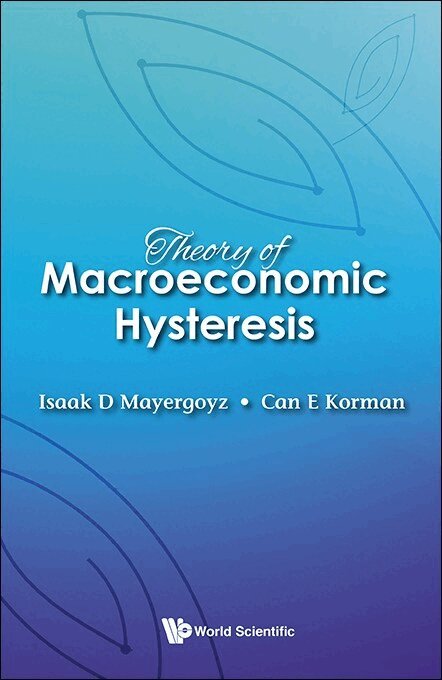
This book deals with the mathematical theory of macroeconomic hysteresis, which is the theory of aggregation of microeconomic hysteresis. Microeconomic sunk cost hysteresis is usually represented by relatively simple hysteresis loops with no discrete memory of past economic shocks. It turns out that macroeconomic aggregation leads to the formation of complex multibranch hysteresis with discrete memory of past economic shocks. Consequently, the macroeconomic aggregation of microeconomic hysteresis results in the emergence of new economic phenomena.In the book, the basic properties of macroeconomic hysteresis are mathematically studied. It is demonstrated that certain important properties of macroeconomic hysteresis (such as history-dependent branching, erasure effects of some past economic shocks, geometric features of macroeconomic hysteresis loops, etc.) are insensitive to specific structures of microeconomic hysteresis subject to aggregation. This suggests that the above properties may be viewed as universal. Furthermore, it is pointed out that these aggregation models have the prediction power of future macroeconomic branching, which may be employed for the prediction of future economic evolution.