Carl Saxer – författare
Visar alla böcker från författaren Carl Saxer. Handla med fri frakt och snabb leverans.
4 produkter
4 produkter
Häftad, Engelska, 2013
722 kr
Skickas inom 10-15 vardagar
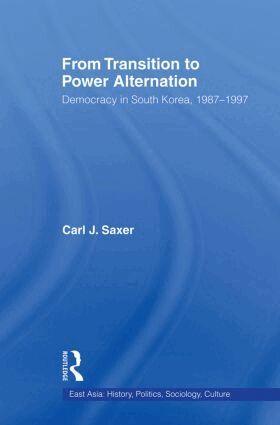
In 1987 South Korea began a democratic transition after almost three decades of significant economic development under authoritarian rule. Increased civil unrest caused by dissatisfaction resulted in the regime agreeing to constitutional changes in the summer of 1987. By 1992 the first president without a military background was elected and during his tenure a further deepening of democracy took place. These reforms were instrumental in making it possible that in 1997 for the first time in South Korean history an opposition candidate was elected president. This book examines the initial transition and later attempts at consolidating democracy in South Korea, and argues that although significant progress had been made and a power alternation achieved by late 1997, South Korea could not, by the end of that decade (1987-97), be considered a consolidated democracy.
Inbunden, Engelska, 2002
2 252 kr
Skickas inom 10-15 vardagar
In 1987 South Korea began a democratic transition after almost three decades of significant economic development under authoritarian rule. Increased civil unrest caused by dissatisfaction resulted in the regime agreeing to constitutional changes in the summer of 1987. By 1992 the first president without a military background was elected and during his tenure a further deepening of democracy took place. These reforms were instrumental in making it possible that in 1997 for the first time in South Korean history an opposition candidate was elected president. This book examines the initial transition and later attempts at consolidating democracy in South Korea, and argues that although significant progress had been made and a power alternation achieved by late 1997, South Korea could not, by the end of that decade (1987-97), be considered a consolidated democracy.
E-bok
Engelska, 2013845 kr
Läs direkt efter köp
In 1987 South Korea began a democratic transition after almost three decades of significant economic development under authoritarian rule. Increased civil unrest caused by dissatisfaction resulted in the regime agreeing to constitutional changes in the summer of 1987. By 1992 the first president without a military background was elected and during his tenure a further deepening of democracy took place. These reforms were instrumental in making it possible that in 1997 for the first time in South Korean history an opposition candidate was elected president. This book examines the initial transition and later attempts at consolidating democracy in South Korea, and argues that although significant progress had been made and a power alternation achieved by late 1997, South Korea could not, by the end of that decade (1987-97), be considered a consolidated democracy.
E-bok
PDF, Engelska, 2013845 kr
Läs direkt efter köp
In 1987 South Korea began a democratic transition after almost three decades of significant economic development under authoritarian rule. Increased civil unrest caused by dissatisfaction resulted in the regime agreeing to constitutional changes in the summer of 1987. By 1992 the first president without a military background was elected and during his tenure a further deepening of democracy took place. These reforms were instrumental in making it possible that in 1997 for the first time in South Korean history an opposition candidate was elected president. This book examines the initial transition and later attempts at consolidating democracy in South Korea, and argues that although significant progress had been made and a power alternation achieved by late 1997, South Korea could not, by the end of that decade (1987-97), be considered a consolidated democracy.